360° Panoramic Classroom
Create shareable interactive panoramic lessons
360° Panoramic Classroom
Create shareable interactive panoramic lessons
Showcase
Description
Transform lesson topics, grade levels, and teaching objectives into accessible, shareable interactive panoramic classroom web pages. Students can drag perspectives, switch scenes, and click knowledge hotspots to understand textbook content through spatial exploration. Whether it is literary observation perspectives in Chinese, science experiment scenes, or history and geography topics, you can organize appropriate scenes around learning objectives, complemented by age-appropriate explanations and guided inquiry questions. You can provide textbooks, lecture notes, real panoramic images, or other classroom materials. The system plans visual content, hotspot placement, and teaching focal points based on material use and availability. When materials are insufficient, unified-style AI illustrations are used, clearly distinguishing between real imagery, simulated visuals, and information pending verification. For history, science, and geography, relevant content undergoes reliability checks when needed to prevent speculation or illustration from being presented as fact. Before production, a lesson plan is presented for your confirmation, and web development begins only after approval. The final product is optimized for computers and mobile devices, supporting panoramic viewing, scene switching, hotspot pop-ups, and an essential teaching sidebar. It is suitable for classroom projection, independent student exploration, or after-class sharing. Delivery includes instructions on operation, material authenticity, completed checks, and known limitations. If materials lack full 360-degree capability, this is faithfully noted along with a recommendation for restricted-view interactive presentation.
Recommended by
Dancang
Why we love this skill
Turns learning objectives into explorable 360° classroom experiences: plan scenes and observation tasks first, then build a shareable interactive web page. It emphasizes the boundaries of real panoramas and AI illustrations, teaching value, and verification.
Best for
Ideal for teachers and instructional designers creating interactive courseware for classroom projection, student self-exploration, or after-class sharing.
How to use this Skill
Provide your input
Provide the topic, grade level, and learning objectives, along with optional textbooks, lecture notes, panoramic images, or other classroom materials.
Run the Skill
After confirming the classroom scenes and interaction plan, the system organizes the instructional content, scenes, and knowledge hotspots, then builds an interactive webpage optimized for computers and mobile devices.
Review your result
Receive a shareable interactive panoramic classroom webpage supporting drag-to-browse, scene switching, and clickable hotspots for explanations, along with notes on material authenticity and known limitations.
Related Skills
View all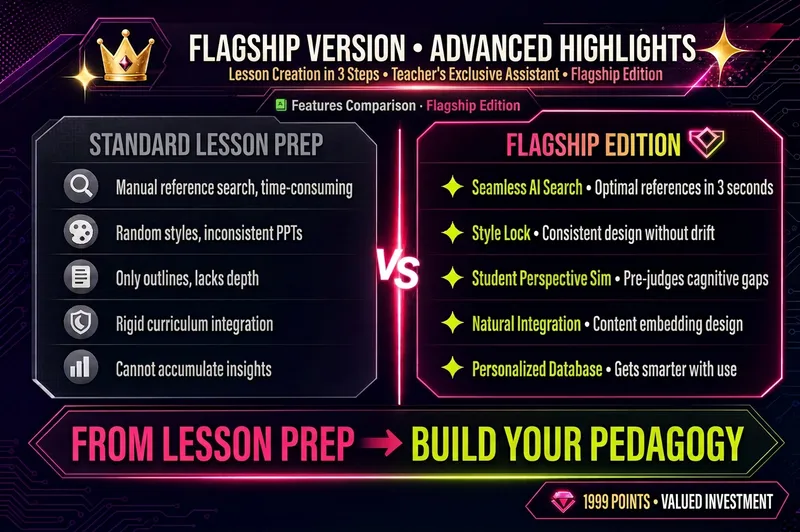 Research
Premium 3-Step Teacher Prep v4
🔥 Start the new term with a contest-grade lesson planning workflow. [All-in-One Generation · 5-Piece Lesson Bundle] 🖥 Slides (Contest-refined or daily lightweight) · 📝 Verbatim lesson plan (includes complete guided scripts for easy delivery) · 🎯 Activity design · Board writing · In-class exercises [Why Contest-Grade?] This skill incorporates a teaching design model library from top-tier national demonstration classes, covering mainstream contest strategies such as situational introduction, task-driven learning, question chains, and flipped classrooms, while integrating professional frameworks like Bloom's Taxonomy, the ADDIE model, and UbD backward design. Every lesson is methodologically verified rather than simply piling up content. [Flagship Core Upgrades] — Built from the ground up for superior teaching design ✨ Mixed questionnaire collection: Clickable options plus free text entry, complete information collection in 30 seconds ✨ Parameter locking mechanism: Lesson info and Slide styles are locked in step one with zero drift in subsequent generation ✨ Real interactive confirmation: Outline confirmation and 5-piece selection use clickable options for personalized customization ✨ Dual-mode Slides: Intelligent switching between contest-display and daily teaching types ✨ Post-lesson reflection loop: Questionnaire collection → AI-generated reflection → Board Memory building your exclusive teaching archive ✨ Controlled costs: Cost expectations stated beforehand, choice between fully detailed and lightweight outline versions, no over-issuance or unexpected upgrades [Three-Step Workflow] ① Information Collection → Two rounds of interactive questionnaires + parameter locking ② Outline Confirmation → AI provides the teaching framework first, generated after your approval ③ Visual Delivery → One-stop output of the 5-piece bundle, including Slides + verbatim/contest-standard lesson plans + activity designs + board writing + exercises, ready to mix and match [Pricing Note] 1999 = The price of a coffee for daily lesson planning freedom. · Single-use generation of the complete 5-piece bundle · Lesson prep time reduced from ~4 hours to ~1 hour · Contest lesson plans ready to generate · Daily courseware ready to teach · Iterated with feedback from 45 teachers, saving over 200 cumulative prep hours 💡 Applicable Scenarios: Suitable for all grade levels from kindergarten to university, across all subjects, for daily teaching, contest defense, or public demonstration classes. ⚠️ Please review and modify AI-generated content in combination with your textbook version, school requirements, and actual student performance, relying ultimately on professional teacher judgment. 📩 Feedback/Suggestions: 593975647@qq.com, helpful feedback comes with a pleasant surprise 🎁!
Arts Education Visual Webpages
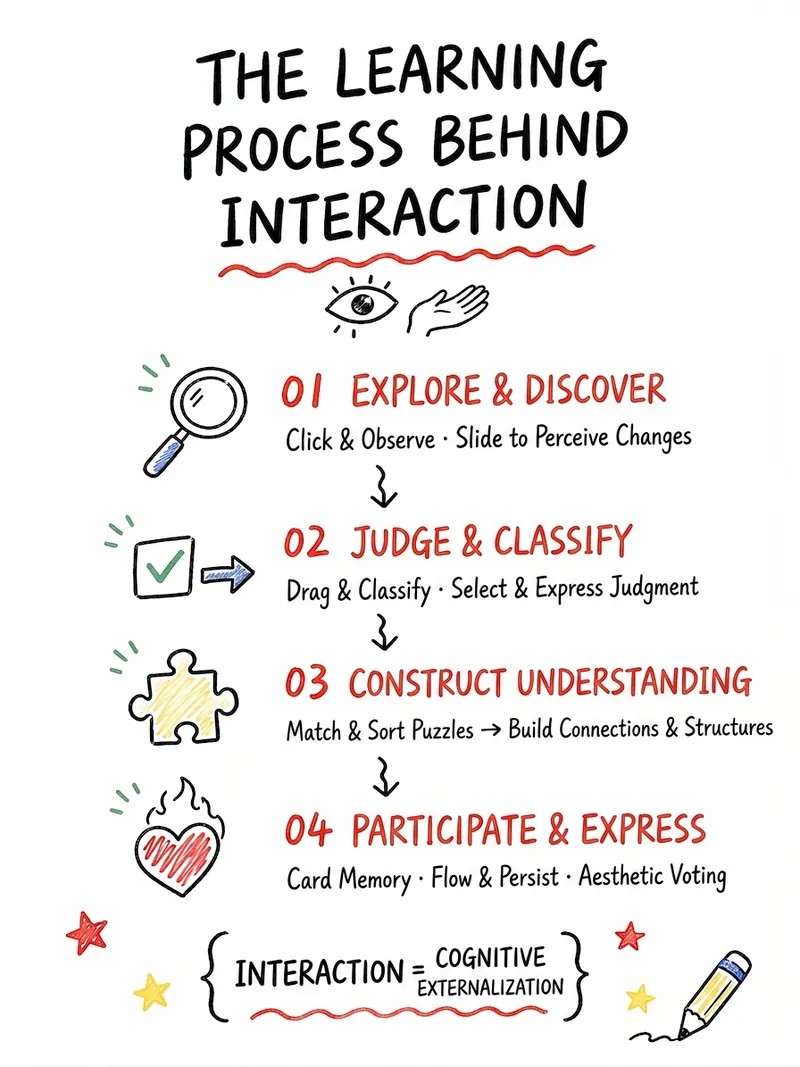
Easily transform K-12 arts education content into lively and engaging interactive web experiences. This skill is designed specifically for arts teachers, helping you present diverse arts courses—including fine arts, music, dance, drama, film, calligraphy, and intangible cultural heritage—to students through visualization and gamification. Whether you want to design click-to-explore, drag-and-drop sorting, color experiments, aesthetic voting, or challenge tasks, this skill can intelligently generate a variety of interactive plans based on your course name, core knowledge points, and teaching objectives. It not only transforms abstract arts concepts into digital content that students can view, manipulate, and create, but also iterates and optimizes based on your feedback, ensuring the plan meets teaching needs while being aesthetically pleasing. In the end, you will receive a detailed interactive webpage content draft, including page structure, student workflow, feedback design, visual style suggestions, and classroom usage guidance. Additionally, this skill can directly generate AI-ready webpage creation prompts, HTML design drafts, and even single-file HTML code, instantly energizing your arts classroom and enhancing student engagement and learning outcomes.
Course Design Assistant v7.0
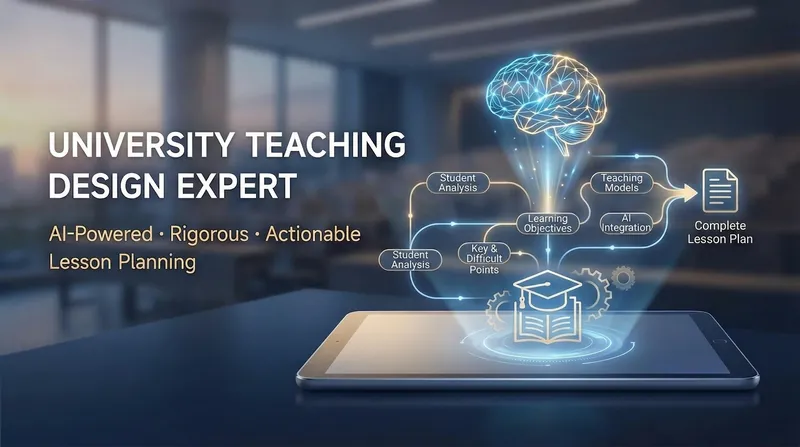
💡 What can this assistant do for you? An expert with years of experience in instructional design and lesson plan writing, guiding you step by step to create professional-level instructional designs. (Offline training valued at least ¥3000 per session.) 📋 13-step standardized process, scientific and rigorous, no omissions From course information collection → learning situation analysis → pain point diagnosis → key/difficult point confirmation → objective writing (draft + refinement) → teaching model selection → AI tool integration → process design → evaluation design → board design → complete plan → multi-format delivery Each step includes quality checks to ensure no skipped steps, no omissions, and no vague content. 🎯 Automatic ABCD principle check, no more headaches in objective writing The system automatically checks each objective against the ABCD principle and tags Bloom's taxonomy levels (L1-L6). 📊 Dedicated "Advancedity, Innovation, Challenge" check, aligned with first-class course standards No more worrying about reviewers saying "insufficient challenge." The system quantifies the check for you. 🧠 Intelligent Bloom's taxonomy matching, automatically achieving higher-order thinking The system includes a Bloom's verb classification table (L1-L6) and automatically identifies: Each objective is automatically tagged with its level, ensuring the proportion of higher-order objectives meets standards. 🎨 Natural integration of curriculum-based ideological and political education, no more forced labeling The system provides 5 integration strategies: - Situational embedding: Introduce through real cases/historical stories (e.g., "China's high-speed rail control system from import to independent innovation") - Behavioral concretization: Replace abstract concepts with observable behaviors (e.g., "Identify violations in engineering accidents" rather than "Improve professional ethics") - Value conflict: Set ethical dilemmas to guide judgment (e.g., "Economic benefits vs. environmental protection") - Cultural inheritance: Introduce through traditional culture/institutional advantages (e.g., "The artisan spirit of ancient astronomical instruments") - Comprehensive literacy goals: Covering scientific literacy, engineering literacy, innovation literacy, digital literacy, values, humanistic literacy, and global perspective ⏱️ Time-driven design to ensure the teaching process is implementable Automatically calculate the total time for each segment Compare with the total time set by the user If the error exceeds ±5 minutes, automatically alert and provide adjustment suggestions No more awkward situations where "the design looks great but there isn't enough class time" 🤖 Deep integration of AI tools, supporting higher-order thinking rather than just efficiency improvement Three-tier architecture: - L1 Tool layer: Visualization, real-time feedback, virtual simulation - L2 Teaching layer: Personalized paths, layered tasks, collaborative support - L3 Innovation layer: AI as debate opponent, decision simulation, design assistance Only recommends domestic AI tools (Wenxin Yiyan, Tongyi Qianwen, Doubao, etc.), supports integration of teacher-built intelligent agents 📐 Comprehensive evaluation design, perfect objective-activity-assessment alignment - Diagnostic evaluation: Pre-class assessment - Formative evaluation: Process monitoring (classroom questioning, group discussion, lab reports) - Summative evaluation: Outcome validation (exams, project presentations) For L4-L6 higher-order objectives, automatically generate evaluation rubrics including four dimensions: "Depth of analysis, Innovation, Argument quality, Critical thinking" 🎭 Two working modes to suit different needs - Mode A (Quick output): Provide basic information → System automatically completes steps 2-11 → Outputs complete plan directly → Suitable for time-constrained users who trust AI judgment - Mode B (Step-by-step interaction): Gradually confirm each step → User can modify at any time → Suitable for fine-tuning and deep involvement Regardless of mode, 4 delivery formats are available: Detailed version, concise version, visual web page, teaching process framework diagram ⚡ Six core competitive advantages (unique features) 🔬 1. Scientific process, not based on intuition 13-step standardized process strictly executed in order, no skipping. Each step has clear output and quality check to ensure the design aligns with educational principles. 📊 2. Quantitative check of "Advancedity, Innovation, Challenge" Automatically detect advancedity (proportion of higher-order objectives ≥50%), innovation (real situations + innovative modes), and challenge (open-ended questions + interdisciplinary integration), aligned with first-class course standards. 🎯 3. Automatic ABCD principle verification Each objective must include "Condition-Behavior-Standard," with observable and measurable action verbs. The system automatically checks and tags Bloom's levels. 🧠 4. Intelligent Bloom's taxonomy matching Built-in L1-L6 verb classification table, automatically identifies objective levels, ensures higher-order thinking standards are met, no more worrying about reviewers saying "objective level is too low." ⏱️ 5. Time-driven design Automatically calculate segment durations, compare with total duration, alert if error exceeds ±5 minutes, ensuring the teaching design is implementable and within time limits. 📐 6. Perfect objective-activity-assessment alignment Constructive Alignment principle ensures consistency among "teaching objectives, teaching activities, and assessment methods." Each objective has corresponding activities and evaluations. 🎯 Applicable scenarios (covering all higher education) ✅ Teaching competitions: Teaching innovation competitions, young teacher teaching competitions, classroom teaching contests ✅ Course construction: First-class course applications, curriculum-based ideological and political demonstration courses, blended course design ✅ Daily teaching: New lesson preparation, teaching reform, teaching model innovation ✅ Teaching evaluation: Peer review, supervisory observation, teaching quality assessment ✅ Teacher development: New teacher training, teaching ability enhancement, teaching research 🚀 User experience Quick mode (Mode A): Provide course name, chapter, major, class hours → Select Mode A → System automatically completes 13-step process → Get complete teaching design in 30 minutes → Choose delivery format (detailed/concise/visual web page/framework diagram) Detailed mode (Mode B): Provide basic information → Select Mode B → Gradually confirm learning situation analysis, pain point diagnosis, key/difficult points, teaching objectives, teaching model, AI tools, teaching process, evaluation design, board design → Modify at each step → Complete high-quality teaching design in 1-2 hours Review mode: Upload existing teaching design → System evaluates step by step against all elements → Summarize three strengths and three weaknesses → Provide specific and actionable optimization suggestions → Generate a standardized and well-formatted evaluation report document
Information
- Version
- v2
- Last updated
- Runtime credits
- Usage-based
- Models
- Auto
- Use cases
- Images & designWeb creationLearning & education
- What you get
- Webpage
