Consultation Notes@泛函
Consultation Notes@泛函
Showcase
Description
Automatically convert job consultation audio transcripts into structured QA documents. Extract key questions and answers, categorize by topic, preserve important details, and output natural, flowing paragraph notes.
Related Skills
View all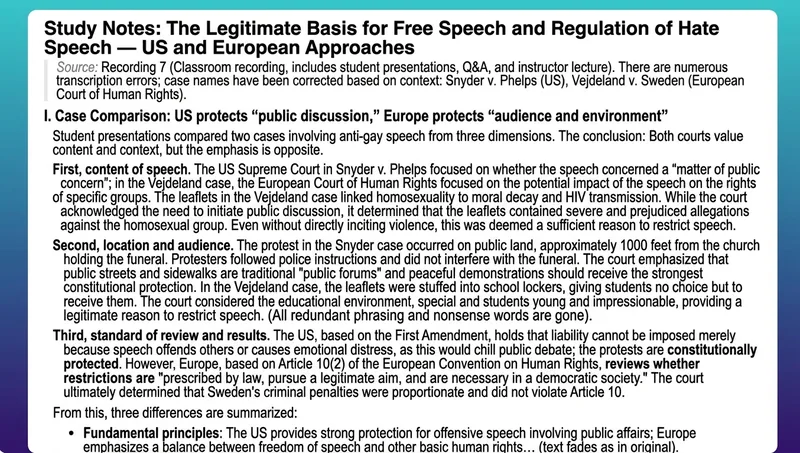
Voice Script to Study Notes
This skill efficiently transforms learning materials you provide—such as videos, articles, conversation transcripts, or personal notes—into clear, concise study notes. It is especially suited to students, researchers, and professionals who need to extract core knowledge from large amounts of information and organize it systematically.

Meeting Minutes Expert
Organize meeting recordings, speech transcripts, or rough notes into structured meeting minutes with one click: automatically extract key decisions, action items (responsible person + deadline), pending issues, and risks. Supports converting spoken language to written language, relative date conversion, and sensitive phrase warnings. First produces a detailed master version, then generates on demand: a concise version for WeChat/email, a task tracking table version, follow-up message templates grouped by responsible person, or a PPT presentation version.
 Write
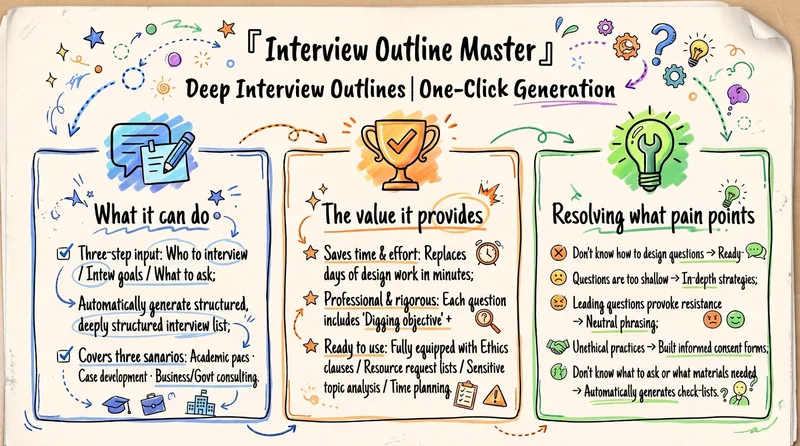
Interview Outline Master V2
Three primary scenario pathways: 🎓 Scenario A | Academic research (theses and journal articles, including research-question mapping and safeguards against leading questions) 📚 Scenario B | Case development (professional master's and teaching cases, including key-event timelines and triangulation) 💼 Scenario C | Commissioned research and consulting (business and government consulting, following a current state–problems–causes–needs–recommendations framework) Four interviewee-type pathways: automatically adapt wording, ethical requirements, and sensitive-topic anticipation for government officials, business executives, frontline employees or customers, and academic experts. Pre-interview materials checklist: send it with the invitation to request materials for refining the guide; when no materials are available, automatically supplement with public-source research. Ready-to-use structure: each probing point explains “what you are uncovering,” with five follow-up strategies (clarification, deeper probing, comparison, hypothesis, and paradox), informed-consent ethics provisions, and time planning.
Information
- Version
- v3
- Last updated
- Runtime credits
- Usage-based
- Models
- Auto
