
Journey to the West: Demons
Map the pilgrimage and open a demon dossier
Journey to the West: Demons
Map the pilgrimage and open a demon dossier
Showcase
Description
SKILL FEATURES Pilgrimage route mapped by distance: Starting in Chang'an and ending at Vulture Peak, arrange the trials in the order they appear in the original, with chapter ranges, ancient place names, and modern equivalents (such as Flowing-Sand River, Flaming Mountain, and the Tongtian River) to answer “Which trial are they on?” Demon dossiers (core feature): Create one file per demon, including names and aliases, origins (fallen star deity/Bodhisattva’s mount/wild mountain spirit/formed from human nature), lair, magical items, powers, weaknesses, nemeses, subduer, outcome, and chapters of appearance. Eighty-one Trials index: List the trials according to commonly used editions, noting trials that may be combined or whose numbering is uncertain. Explain inconsistencies in the original to prevent confusion between different lists. Ability panels for the four travelers: Rate Sun Wukong/Zhu Bajie/Sha Wujing/Tang Sanzang across four dimensions—“combat ability—magical power—mental strength—weaknesses”—with personality arcs and growth milestones, such as Wukong’s shift from “showing off” to “asking for help.” Magical item compendium: Organize the Diamond Cudgel, Purple-Gold Red Gourd, Plantain Fan, Human Seed Bag, and other items by category, noting their owners, uses, methods of countering them, and where they are returned. Buddhist and Daoist deity hierarchies: Map the four systems of Heaven, Vulture Peak, the underworld, and the Dragon Palaces, along with their procedures for handling cases (report a problem → investigate → request aid → subdue the demon), explaining “Why do they have to go to Heaven for reinforcements every time?” Thematic threads: Draw out separate threads such as “cultivating the mind (the restless monkey and horse)” “team roles” “satire of officialdom” “female demons and tests of desire” and “cause and effect,” supporting close reading of the whole novel and argumentative essay material. Multiple levels of depth: Children’s story edition (emphasizing plot and courage)/original-text reading edition/in-depth study edition (including alchemical metaphors, chapter poems, and key points from Ming and Qing commentaries). Recommended prompts Turn “The Three Attacks on the White Bone Demon” into a demon dossier, clearly identifying its origins and symbolism Create a “full pilgrimage route map for Tang Sanzang and his disciples,” with ancient and modern place-name comparisons Trace the causes and consequences of the “Flaming Mountain trial,” including a magical item entry for the Plantain Fan Create a dossier on the Great Kings Golden Horn and Silver Horn, clearly listing their five magical items and who subdues them Draw a deity hierarchy diagram for “Heaven—Vulture Peak—the underworld—the Dragon Palaces,” explaining why reinforcements must always be summoned Analyze the thematic thread of “the restless monkey and horse” from the in-depth study edition, with explanations of the chapter poems
Related Skills
View all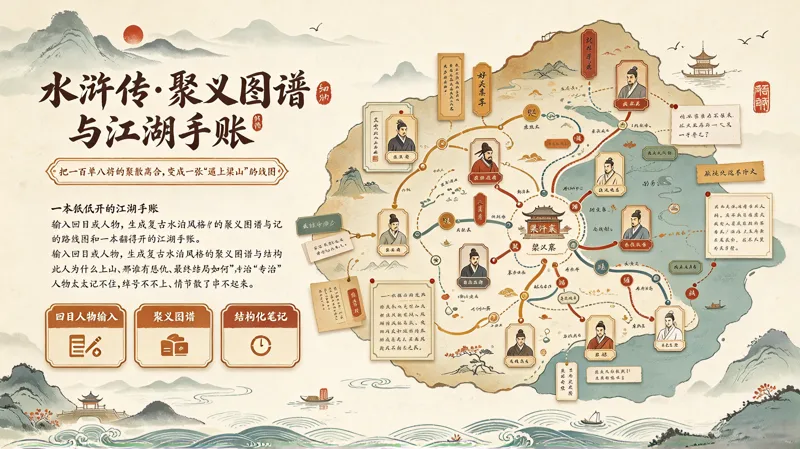
Water Margin: Brotherhood Map
SKILL features Mountain Ascent Route Map: Break down how each hero was “forced to Liangshan” into four stages: “original identity—unfair treatment—key turning point—guide to Liangshan,” with chapter ranges, answering “who came how.” Juyi Hall Rank and Lineage Chart: Output the 108 heroes in Heavenly Spirits and Earthly Fiends order, with nicknames, star designations, weapons, origins, and identities before joining Liangshan. Browse by faction: Chao Gai’s former followers, Song Jiang’s close allies, surrendered generals, or wandering outlaws. Favor and Feud Relationship Network: Mark five relationship types: “benefactor—enemy—sworn brother—spouse or relative—superior or subordinate.” Highlight relationships that later turned hostile, such as Lin Chong and Lu Qian, or Wu Song and Zhang Dujian. Story Unit Cards: Turn each classic episode—“Fists the Town’s Tyrant,” “The Mountain Shrine in the Snowstorm,” “Wu Song Fights the Tiger at Jingyang Ridge,” “The Cunning Seizure of the Birthday Gifts,” and more—into an independent card with causes, consequences, key characters, and chapter appearances. Thematic Through Lines: Pull out separate lines for “officials driving people to rebellion,” “loyalty, righteousness, and amnesty,” “the fate of female characters,” “the psychology of surrendered generals,” and “power shifts on Liangshan,” for whole-book reading and argumentative essay material. Geographic Jianghu Map: Mark Liangshan Marsh and key locations, including Tokyo’s Kaifeng Prefecture, Yanggu County, Cangzhou, Jiangzhou, Daming Prefecture, Zengtou City, and Fang La’s sphere of influence, with comparisons between historical and modern place names. Final Outcome Overview: Summarize the 108 heroes’ casualties after the campaign against Fang La and the survivors’ destinations, solving the ultimate problem of “I can’t remember who died and who lived.” Multiple Reading Levels: Children’s story version, emphasizing heroic legends; original-text reading version; and in-depth study version, including key points from Jin Shengtan’s commentary and discussion of the controversy over amnesty. Recommended prompts Generate a character card for Lin Chong with the four-stage ascent route and favor-and-feud relationship network Turn “Three Attacks on Zhujiazhuang” into a story unit card, clearly marking the factions and key characters Generate a Juyi Hall rank and lineage chart for the 36 Heavenly Spirits Help me trace the “Liangshan power shift” line (Wang Lun → Chao Gai → Song Jiang) in the in-depth study version Create a final outcome overview of the 108 heroes after the campaign against Fang La, showing who died and who survived Turn “Lu Zhishen’s character arc” into a thematic through-line journal, with Jin Shengtan’s commentary
Three Kingdoms Campaign Guide
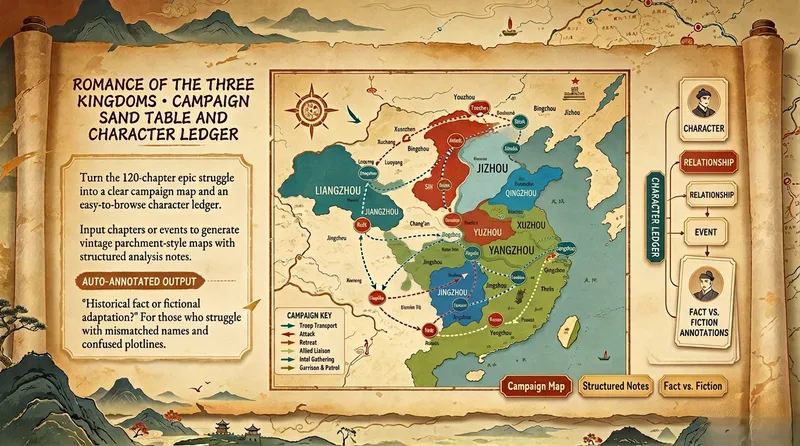
SKILL Features Chapter-by-chapter routes: Connect the chapter titles into a “campaign route,” with each chapter represented as a city or skirmish. Mark the starting and ending chapters, causes, and consequences to prevent losing track of earlier events. Character lineage trees: Organize the main characters by faction (Wei / Shu / Wu / other warlords / Han imperial house), showing lord–strategist–general relationships and identifying those who switched allegiance, such as Zhang Liao, Jia Xu, and Fa Zheng—the easiest relationships to confuse. Four elements for every campaign sandbox: Every major battle includes “time—location (ancient name + modern location)—troop strength and commanders on both sides—key to victory or defeat,” plus terrain and tactical notes such as fire attacks, water attacks, cutting off supplies, and feigned surrender. Strategy breakdown cards: Break down Thirty-Six Stratagems-style episodes into “plotter—bait—opponent’s psychology—flaw—result—what if the opponent had seen through it?” Build strategic thinking and create material that can also be adapted for writing. History and novel side by side: Mark each point as “recorded in Records of the Three Kingdoms / added in Pei’s annotations / fictionalized or adapted in the novel,” including examples such as borrowing arrows with straw boats, the Empty Fort Strategy, the oath of the Peach Garden, and borrowing the east wind. Avoid treating the novel as historical fact. Ancient and modern place-name and route correction: Jingzhou, Hanzhong, Jieting, Chibi, and other ancient place names always include their modern locations and strategic significance, with both names shown on the map. Classical and plain-language reading: For classic passages such as the Longzhong Plan, Memorial on Dispatching the Army, and proclamation against the rebels, provide excerpts of the original text, plain-language translations, and key-term notes while preserving the feel of the original. Thematic throughlines: Pull out themes such as loyalty and righteousness, power and strategy, talent movement, female characters, and fate versus human action to support reading the entire book and building material for argumentative essays. Multiple reading depths: Children’s story version (plot-focused, lighter on strategy) / Full original-text version / Deep study version (including narrative perspective, foreshadowing and callbacks, and key points from Mao Zonggang’s commentary). Recommended prompts Turn the Battle of Guandu into a campaign sandbox with the four battle elements and a historical comparison Map the chapter route around the Battle of Red Cliffs (Chapters 43–50), including ancient and modern place names Create a Shu-Han character lineage chart showing those who switched allegiance and their family relationships Turn Zhuge Liang’s “Longzhong Plan” into a thematic journal with original excerpts and plain-language translations Break down the “Chain Stratagem / Self-Injury Stratagem” into strategy cards and mark which parts are fictionalized in the novel Create a thematic chart of female characters in the Three Kingdoms, using the deep study version
Zizhi Tongjian: Power & Rule
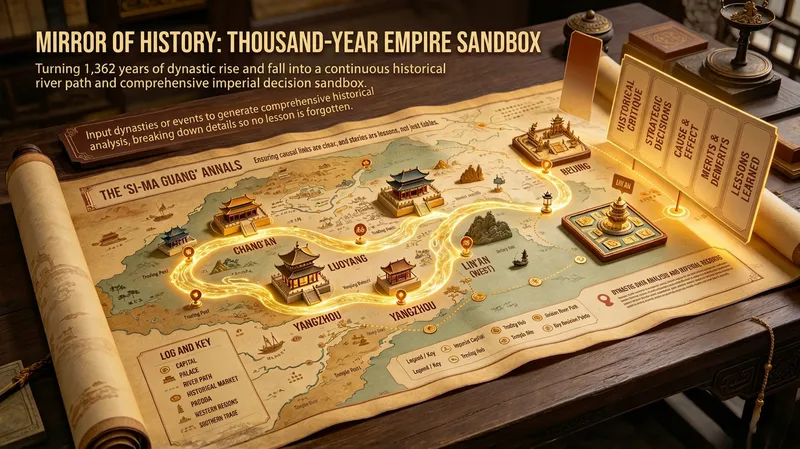
SKILL FEATURES Millennium River Timeline: Divides the period from the 23rd year of King Weilie of Zhou (403 BCE) to the sixth year of Xiande of Later Zhou (959 CE) into several “river sections,” each labeled with its central conflict and main line of power transfer. Imperial Decision Sandbox: Breaks each major decision into eight steps: “background—options—decision-maker psychology—execution—immediate result—long-term impact—Sima Guang’s commentary—modern insights.” Causal Chain Tracing: Looks back at root causes (at least one level) and forward through consequences (at least two levels), addressing the common problem of viewing events in isolation. Rise-and-Fall Profiles: Tracks the trajectories of key figures, such as Shang Yang, Zhang Yi, Han Xin, Zhuge Liang, Wang Meng, and Wei Zheng, noting “why they gained power / why they lost power / their final outcome.” Institutional Change Line: Separately traces the evolution from feudalism to commanderies and counties, provinces and commanderies, military governorships, and provincial administration, enabling cross-dynasty comparison. War and Coup Quick-Reference Cards: Covers each major battle or coup with six elements: “time—place—sides—troop strength—key to victory or defeat—later impact.” History and Commentary in Two Columns: The left column presents excerpts from Zizhi Tongjian, including “Sima Guang says,” while the right provides plain-language translation and interpretations from modern management and political science perspectives. Multiple Detail Levels: General edition (focused on stories and insights) / close-reading edition (with selected original passages and key points from Hu Sansheng’s annotations) / management insights edition (for entrepreneurs and managers, focused on decision-making methodology). SUGGESTED QUESTIONS Break down the decision sandbox for the “Xuanwu Gate Incident,” including Sima Guang’s commentary and modern insights Turn “foreign policy during the reign of Emperor Wu of Han” into a causal chain, general edition Create a decision map for the “Reforms of Shang Yang,” with an institutional change line Summarize the “Battle of Fei River” in a war quick-reference card, clearly marking the key to victory or defeat Create a rise-and-fall profile of “Zhuge Liang’s Northern Expeditions,” close-reading edition, including key points from Hu Sansheng’s annotations Analyze “the relationship between Emperor Taizong of Tang and Wei Zheng” from the management insights perspective, with transferable principles
Information
- Version
- v2
- Last updated
- Runtime credits
- Usage-based
- Models
- Auto
