
Read Legal Papers/Cases
Break down legal arguments and case analysis
Read Legal Papers/Cases
Break down legal arguments and case analysis
Showcase
Description
Turn difficult legal research papers or cases into clear, accessible Chinese explanations that are easy to review and useful for research. After you provide a paper or case, the analysis focuses on the original text’s research framework, reasoning, and key points. It helps you quickly understand what question the author raised, how it was analyzed, and the logical relationships between different views, rather than stopping at simple excerpts or a linear summary. The result is written to a new document named after the paper title or case name for easy reference, archiving, and further research. For academic papers, the explanation first presents the overall structure, then breaks down the connections between the research question, central claims, supporting evidence, and conclusions. When legal concepts or technical terms appear, they are explained in context with the corresponding English terms to make the material easier to read. For legal cases, the analysis covers the disputed issue, applicable rules, application of the facts, and conclusion. It may also reconstruct the legal reasoning as “major premise—minor premise—conclusion,” while explaining the relevant statutes, causes of action, and analytical assumptions. This Skill is designed for students, researchers, and legal professionals who need to read legal scholarship, prepare literature reviews, study case analysis, organize legal reasoning, or explain legal materials clearly to others.
Recommended by
淡苍
Why we love this skill
Move from understanding to analysis: map frameworks, unpack argument links, and trace rules, claim bases, and assumptions through IRAC or premise–conclusion reasoning.
Best for
Law students, researchers, and legal professionals reading papers, analyzing cases, and organizing legal reasoning.
How to use this Skill
Provide your input
Provide a legal research paper or case.
Run the Skill
Systematically organize the source’s research framework, key points, evidence, and legal reasoning. Cases are analyzed by issue, rule, application of facts, and conclusion, with key terms explained.
Review your result
Generate a Chinese explanation document named after the paper title or case name for review, research, archiving, and teaching.
Related Skills
View all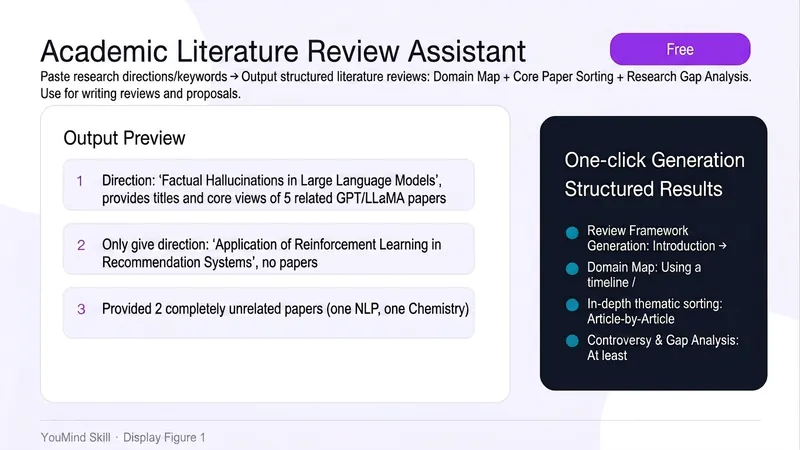
Literature Review Assistant
Writing a literature review is an inevitable challenge for graduate students—but turning information from 50 papers into a logically structured review, rather than a mere summary list, relies on methodology, not brute force. Tell it your research direction and the core papers you've already read. It first builds a framework—field map, thematic sorting, debates and gaps—then, after your confirmation, helps organize the language chapter by chapter. It doesn't write the paper for you, but helps you present the papers you've read with academic logic. ✨ Core Capabilities 1. Review framework generation: Introduction → Field map → Thematic sections → Debates and gaps → Outlook, standard academic structure 2. Field map: Sort domain development by timeline/school of thought, highlight milestone papers 3. In-depth thematic analysis: Individual paper introduction + intra-group comparison + overall contributions and limitations 4. Debate and gap analysis: At least 3 points of debate + 3 research gaps, with specific literature sources 5. Academic writing norms: Citation format, bilingual terminology, critical language rather than mere description 📱 Use Cases - Literature review chapter for graduate thesis/proposal writing - Related Work section of journal papers - Quick literature overview + structured notes when entering a new field - Used in combination with "论文速读笔记" and "论文双模研读" to form a "Read → Analyze → Synthesize" literature workflow ⚠️ Note: This skill does not perform real-time academic search. You need to provide information on papers you have already read (title/author/key points), and it helps you organize and write.
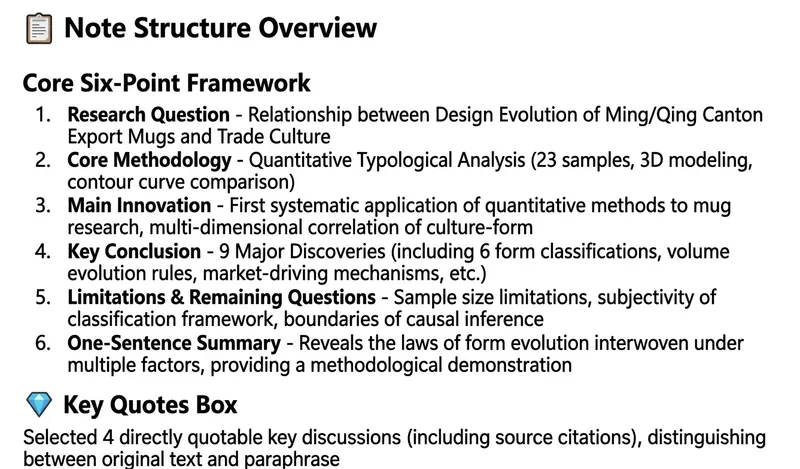
Paper Quick Note Generator
A 30-page paper due for tomorrow's group meeting; 40 papers to review for literature survey, each read from scratch, only to forget key points and lose that quotable line. Half of research time is spent on 'reading.' Paste an arXiv link or paper text and instantly receive a structured speed-reading note ready for use. ✨ Core Capabilities 1. Six-part speed-reading framework: Research Question / Core Method / Main Innovation / Key Conclusion / Limitations & Doubts / One-Sentence Summary 2. Automatically extracts 'quotable quotes' with location markers; copy directly for literature reviews. 3. Contribution breakdown: What's new compared to existing work, explained in plain language. 4. Critical perspective: Methodological flaws, overclaims, reproducibility risks pointed out point by point. 5. Optional outputs: Group meeting presentation outline / literature card / draft review paragraph / multi-paper comparison table. 6. Chinese-English terminology glossary, not machine-translated. 📱 Use Cases Graduate student thesis proposals and literature reviews, group meeting paper sharing, researchers tracking frontiers, tech professionals diving into technical papers; output can be posted on Zhihu or WeChat public accounts as academic content to attract readers. Make papers thinner—so you spend more time thinking than slogging through text.
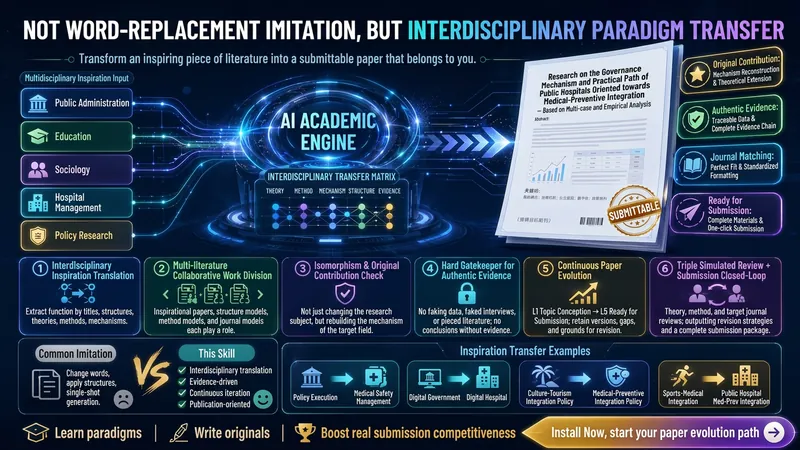
Paper Imitation & Pub. Expert
📚 Paper Imitation & Pub. Expert Develop an inspiring paper into your own high-quality original work step by step. Ideal for graduate students seeking to draw inspiration from excellent papers in other disciplines for topic migration, structural reconstruction, and submission optimization. 🔍 Inspiring Literature Identification: Analyze the reusable title mechanisms, problem awareness, chapter structure, theoretical framework, research methods, evidence organization, and language style of the model paper. 🔄 Interdisciplinary Paradigm Transfer: Build a 'source domain—target domain' transfer matrix to determine which ideas can be transferred and which theories, concepts, cases, and conclusions must be reconstructed. 🧠 Original Contribution Modeling: Identify literature gaps, distill core propositions and mechanisms, and check whether the paper merely changes the research object or applies a generic framework. 🧭 Research Design Planning: Supports theoretical research, case studies, qualitative research, quantitative research, literature reviews, policy text analysis, and mixed methods research. 🛡️ Real Evidence Gate: Do not fabricate data, samples, interviews, cases, statistical results, literature, or DOIs; without real evidence, do not generate false empirical conclusions. ✍️ Evidence-Driven Writing: Build argument chains via 'proposition—evidence—citation—rebuttal', generate original content chapter by chapter, and clearly mark research materials that need to be supplemented. 📈 Continuous Paper Evolution: Record each round of revisions, material gaps, and maturity changes according to L1 (topic conception), L2 (research plan), L3 (evidence formation), L4 (submission draft), and L5 (ready for submission). 🧑⚖️ Triple Simulation Review: Identify rejection risks from the perspectives of a theoretical reviewer, a method reviewer, and a target journal reviewer, and form specific revision strategies. 📨 Complete Submission Loop: Assist in generating the final paper, citation verification table, cover letter, innovation point statement, author response, revision index, and related declaration templates. ✨ Learn the paradigm, write original content, and enhance real submission competitiveness.
Information
- Version
- v16
- Last updated
- Runtime credits
- Usage-based
- Models
- Auto
- Use cases
- Research & analysisLearning & education
- What you get
- DocumentDiagram