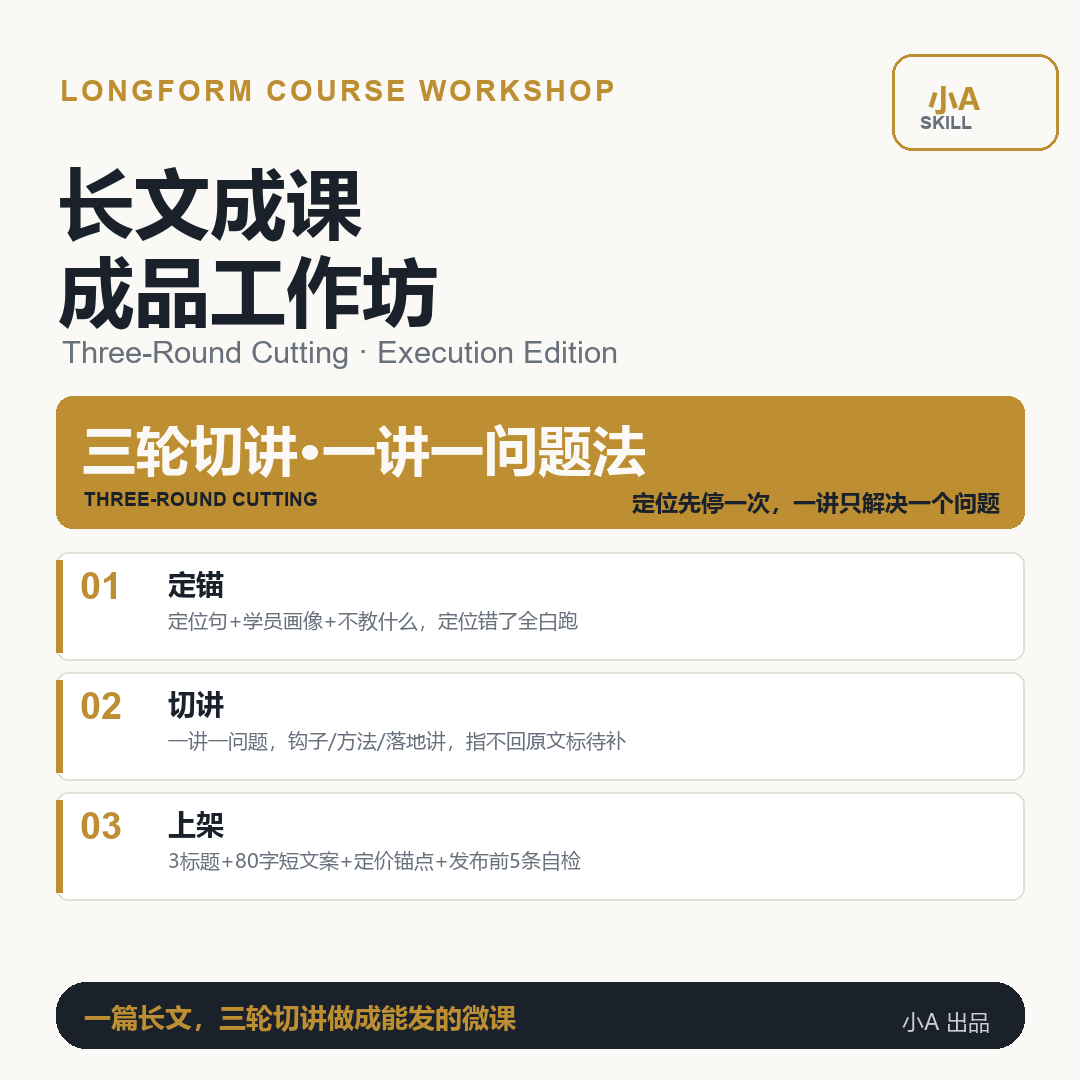
Micro-Course Rescuer
Turn one long text into a 3-part mini-course
Micro-Course Rescuer
Turn one long text into a 3-part mini-course
Showcase
Description
Turn a long text into a breakdown table, lecture handouts, and publishing copy for a 3-part mini-course through three rounds of segmentation. Uses only the source text without inventing anything. **Core Selling Point**: Beyond planning tips—directly generates your course profile, 3-part breakdown table, lecture handouts, and publishing kit. Each lecture solves one real problem, and every point links back to the source text. **Best For**: Content creators and knowledge bloggers looking to quickly test the waters; anyone with a long text, notes, or book excerpt who doesn't know how to structure it into a course. **Input**: A source text (1,800+ words of long text, notes, book excerpt, or draft) + goal (free lead-magnet course or low-priced entry-level course). **Output**: 8 content pieces + 4 finished pieces (12 total). Course profile, breakdown table, lecture handouts, and publishing kit are generated one by one. If tools are unavailable, a copy-pasteable package is provided with unproduced items marked. ## [Exclusive Methodology] Three-Round Segmentation · One Problem Per Lecture If your positioning is wrong, the next two rounds are wasted—so the first round must pause to confirm the course profile, which is the most efficient step in the entire workflow. 1. **Anchor**: Positioning formula "Help [who] achieve [result] in [scenario] using [method]" + 3 student persona questions + clarify what "not to teach" (cut anything the source text cannot support or exceeds capacity). 2. **Segment**: Each lecture solves one real problem (lecture titles written as questions); default hook lecture -> method lecture -> practical lecture; each point maps to a source paragraph, unmapped items marked as [To Be Added], no fluff. 3. **Publish**: 3 titles from result/pain-point/scenario angles + 80-word short copy (pain point -> what you get -> who it's for -> call to action) + pricing anchor + 5 pre-release self-checks. Remember it in one sentence: **Pause to anchor first, solve one problem per lecture.** ## [Grounded in Rules] Standards Based on Current Official Guidelines Anchored only in real public standards: target platform skill package guidelines, copyright duplication and fair use, AI-generated content labeling requirements, and restrictions on absolute terms and earnings promises in publishing copy. **Any fields, clauses, or rules that are unclear will be marked as "To Be Verified"—never filled from memory**; rules unrelated to this scenario are explicitly marked as not applicable. ## [v1 New · From Intermediates to Finished Files] Older versions provided editable intermediates; this version turns content **into ready-to-use files**: first detects your current session's tool capabilities, tells you what is about to be generated and the consumption cost, and only acts after your confirmation— - **Breakdown Table + Course Profile File**: Positioning sentence, what not to teach, 3 lecture problem titles, and corresponding source paragraphs in one table; - **Lecture Handout Drafts**: Five-section format per lecture (hook/explanation/demonstration/practice/summary) + take-away checklist, written as an editable draft; - **Publishing Kit + Checklist**: 3 titles, 80-word short copy, pricing anchor, and 5 pre-release self-checks. **No generation tools in the session?** Delivers a "ready-to-paste finished content package"—formatted entirely in Markdown, ready to use when copied into Word or tables. **Never pretends to generate, never invents file paths.** ## [Details Page Body] ### What Boundaries Are Maintained The service scope is clear: **only arranges your provided real material into a breakdown table / lecture handout drafts / publishing kit**. If you lack workflows, course content, cases, qualifications, data, or student reviews, they remain [To Be Added]; the skill will not invent them just to make the table look nice. It does not copy others' works, cites sources, and does not promise platform review or publishing results. ### Core Architecture 1. Anchor: Positioning sentence + student personas + what not to teach, pause to confirm; 2. Segment: One problem per lecture + five-section handout + take-away checklist; 3. Publish: 3 titles + 80-word short copy + pricing anchor + 5 self-checks. + Authoritative anchoring layer + execution delivery layer (detect -> authorize -> output finished product -> accept/fallback).
Recommended by
Dancang
Why we love this skill
Rigorously condenses a long text into a 3-part micro-course where each lesson solves a single problem, while simultaneously generating handouts, a segmentation table, and publishing copy. It strictly uses real source material, clearly marks missing content, and balances structure, publishing compliance, and direct deliverability.
Best for
Content creators and knowledge bloggers looking to quickly turn long articles, notes, or book excerpts into mini-courses.
How to use this Skill
Provide your input
Provide an article, notes, book excerpt, or draft of 1,800+ words, and specify whether you want a free lead-magnet course or a low-priced entry-level course.
Run the Skill
First define the course positioning based on the source text, then split the content into 3 lectures focusing on one problem each, and organize handouts and publishing copy.
Review your result
Receive the course profile, 3-lecture breakdown table, lecture draft handouts, publishing kit, and pre-release checklist; missing info will be marked as pending.
Related Skills
View all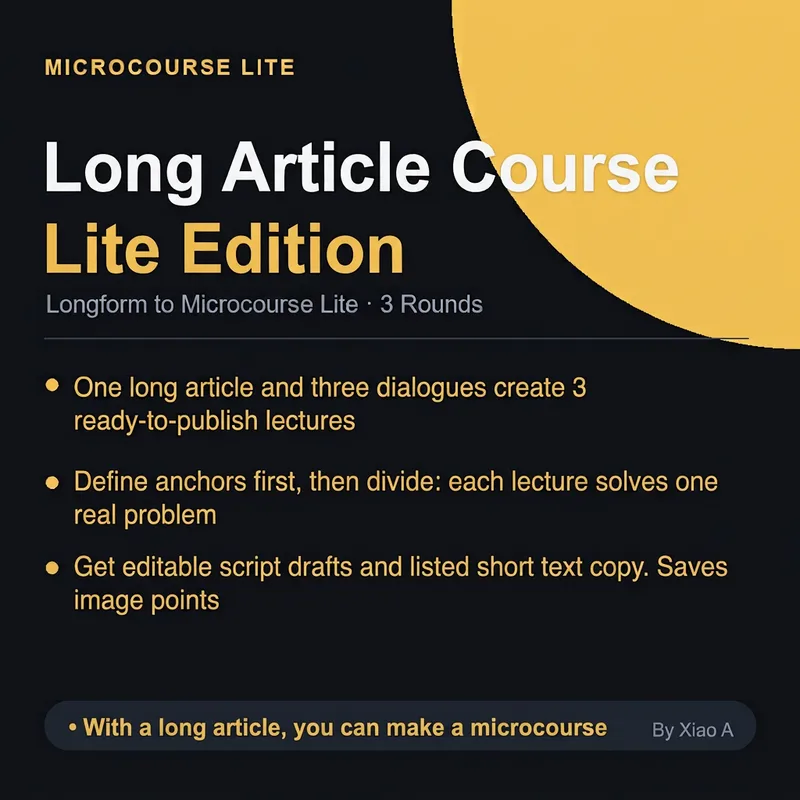 Research
Long-form to Mini-Course Lite
This skill is the focused, lightweight version of the course creation knowledge distiller. It accepts a single input—such as a long article, notes, book excerpts, or a speech draft—and uses a 3-turn conversation to cut it into a ready-to-publish mini-course. It does not handle multi-source experience, build full training camps, or generate images, Slides, or videos. ## Overview **Turn an existing long article into a 3-lecture mini-course through three turns of conversation.** It skips full course packages and image-generation credits, giving you editable structures, lecture draft notes, and publishing descriptions instead. It is ideal for quick testing, content repurposing, and creating lead-generation courses. ## What You Will Get 1. **Course Identity**: A one-sentence positioning statement, learner persona, and clear boundaries on what is not taught, ensuring alignment before proceeding. 2. **3-Lecture Outline**: Each lecture solves a real problem and maps back to original text paragraphs, with unmapped parts marked as pending. 3. **Five-Part Lecture Drafts**: Hook, explanation, demonstration, practice, and summary, with every section serving as an editable draft. 4. **Takeaway Checklist**: Choose from a template, checklist, or mnemonic device so students leave with practical tools.
 Research
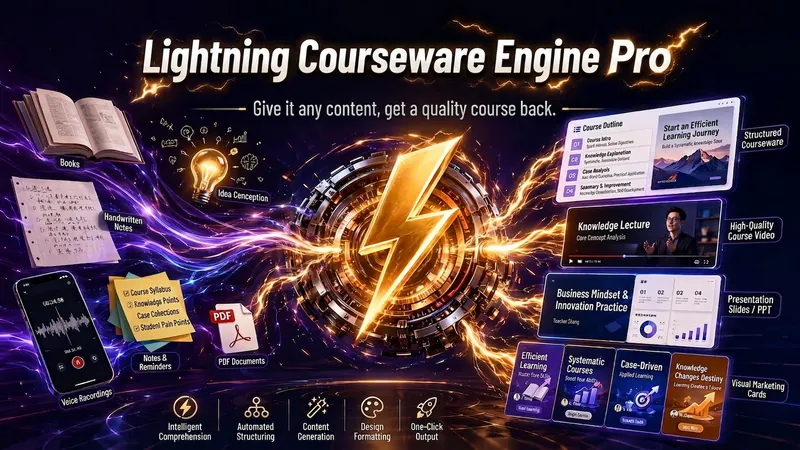
Lightning Course Engine Pro
Helps you get your course roughly 80% done — everything you need is included. This is an AI course producer, not a content ghostwriter. It won't generate content from scratch for you, but it will guide you using 5 original methodologies (HOOK-FLOW-LAND three-part structure, one-cut positioning, onion peeling extraction, heartbeat curve, funnel course creation) to turn a book, an idea, or even five years of work experience into a sellable course product in 4 rounds of dialogue. --- ## 🎯 Who It's For ✅ **Knowledge Monetizers** — professionals with expertise who want to package their experience into paid courses ✅ **Trainers/Instructors** — need to quickly develop new courses without starting from scratch ✅ **Content Creators** — have an audience and want to launch paid courses but don't know where to start ✅ **Corporate Training Leads** — customize training for teams and seek efficient output ✅ **Side Hustlers** — have a skill but zero course design experience --- ## 🔥 Core Logic: The 20/80 Rule **You provide 20%** — real experience, unique insights, practical cases (the soul of the course) **It handles 80%** — structure building, content organization, script polishing, courseware creation All knowledge points are anchored in your materials and real experiences, **zero fabricated cases, zero filler**. --- ## 🛡️ Three-Round AI Flavor Removal Review Tired of course scripts that sound like a robot reading? This one won't. **First pass** — Eliminate all templated AI clichés ("As we all know," "It is worth noting," "Let's explore together") **Second pass** — Inject your natural speaking rhythm and tone (write the script the way you talk) **Third pass** — Read through to ensure every line sounds like you're chatting with students The delivered script is **ready to record, with almost no edits needed**. --- ## 📦 Final Deliverables (6-Piece Set) ✅ Precision Positioning Report — who the course is for, what problem it solves, why they should buy from you ✅ Three-Level Course Outline — chapters, sections, knowledge points, clear structure ✅ Teaching Script — every sentence is ready to read, not an outline ✅ Editable Course Slides — visual presentation, not text-heavy PPT ✅ Visual Asset Pack — images, icons, covers, ready to use ✅ Monetization Plan — pricing strategy, sales copy, promotion tips **Ready to use, not a semi-finished product you need to rework.** --- ## 🎯 Typical Use Cases **Scenario 1: Turn a book into a workshop** You finished a professional book and want to host a reading club/workshop → Upload the book material, get a complete course package after 4 rounds of dialogue **Scenario 2: Turn work experience into a paid course** You have 5 years of unique insights in a field → Input real cases and methodologies, generate a sellable course **Scenario 3: Rapid corporate training course development** Your company needs new employee training, tight deadline → Provide training goals and materials, get the script and courseware the same day **Scenario 4: Turn your content IP into a course** You have viral content and want to make a systematic course → Import articles/videos, automatically extract into structured course **Scenario 5: Side-hustle instructor from 0 to 1** Want to create online courses but have zero experience → Full-process guidance from idea to finished product
 Write
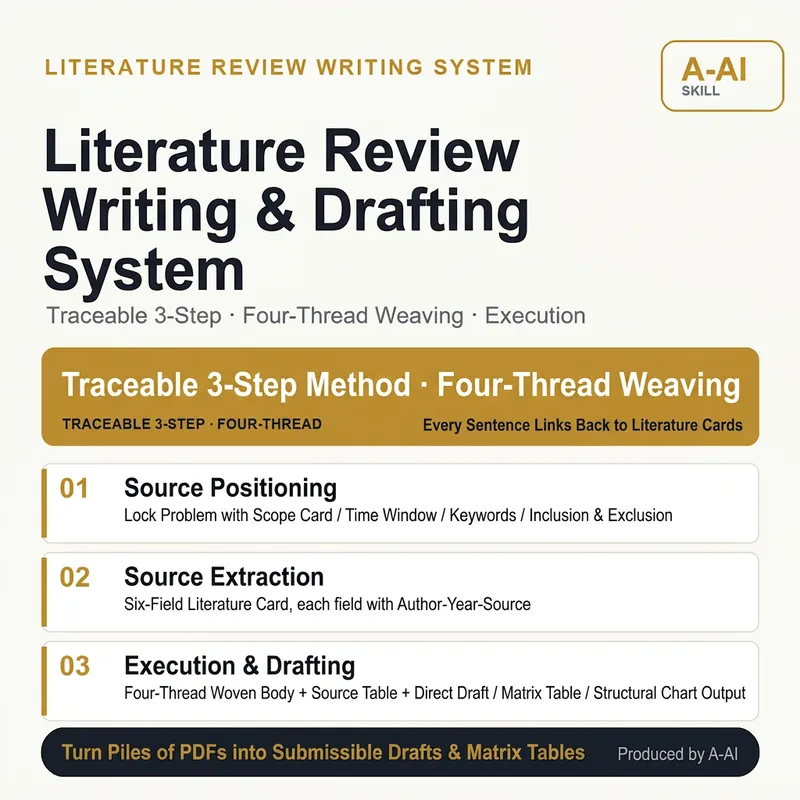
Literature Review Builder
Struggling with a monotonous literature review or missing citations? The three-step provenance method and four-line weaving help you locate, extract, and weave content so every sentence links back to a literature card. Execution upgrade: upon authorization, directly receive a review draft, literature matrix table, and four-line structure diagram, organizing only what you have read without inventing citations. **Core Value**: Beyond templates—after authorization, receive the review draft, literature matrix table, and four-line weaving diagram directly; every step anchors to verifiable public standards without making up a single citation. **Best For**: Graduate students and early-career researchers writing research proposals, thesis chapters, or grant foundations; anyone with piles of unorganized literature, monotonous reviews, or unreferenced claims. **What to Input**: Service goal + concise research question + read literature list (PDF, notes, or citations) + discipline + target format. **What You Get**: 8 content items (verification card, scope card, 6-field card library, citation authenticity check, four-line outline, body draft, traceback table + gap, self-check + authoritative anchor check) + 5 finished items (authorization record, review draft, literature matrix table, four-line structure diagram, acceptance table). Replaced with a ready-to-paste content package when tools are unavailable. ## Exclusive Methodology: Three-Step Provenance & Four-Line Weaving Reviews read like laundry lists because claims lack sources and literature is not broken down. This method addresses precisely that: 1. **Provenance Location**: Scope cards lock in your research question, time window, keywords, database, and inclusions/exclusions to set boundaries. 2. **Provenance Extraction**: Create 6-field cards for each source—claim, method, finding, limitation, key quote, association—with (author, year, source). Never write about what you haven't read or invent page numbers. 3. **Provenance Weaving**: Weave timeline, theme, method, and debate into the body, linking each paragraph to card numbers for balanced critique. Output a citation traceback table and 3 gaps. Remember: Every claim links back to a literature card. ## Evidence-Based Public Standards Anchored in public standards rather than guesswork: GB/T 7714-2015, APA 7, COPE, PRISMA 2020 (applicable only to systematic or scoping reviews). Clear boundaries are marked, deferring to target school or journal requirements. ## Version 1 Update: From Templates to Finished Files This version turns content into usable files. It detects tool capabilities, informs you of generation plans, and proceeds upon confirmation: - **Review Draft**: Four-line format with provenance and references, ready for Word; - **Literature Matrix Table**: Row-by-row 6-field cards ready for Excel; - **Four-Line Structure Diagram**: Maps your cards and relationships. **No generation tools?** Receive a ready-to-paste content package with full text, Markdown matrix, and prompts. ## Details ### Why Reviews Become Laundry Lists It happens when you write without breaking down cards. The three-step method breaks down sources first, then weaves them logically. ### Three Steps 1. **Location**: Scope card + inclusion/exclusion. 2. **Extraction**: 6-field cards with source info and citation checks. 3. **Weaving**: Four-line body text + critique + traceback table + 3 gaps. + **Authoritative Anchoring**: Verifiable public standards. + **Execution Delivery**: Tool detection → authorization → output → acceptance. ### What It Does Not Do - **Only processes read content**: No invented citations, authors, years, sources, page numbers, or data. - **No fake generation**: Clearly marks missing tools and provides paste-ready packages. - **No publication guarantees**: Focuses on clarity and rigor. - **No forced authority**: Applies standards only when appropriate. - **Honest resource usage**.
Information
- Version
- v3
- Last updated
- Runtime credits
- Usage-based
- Models
- Auto
- Use cases
- Writing & contentLearning & educationMarketing & growth
- What you get
- DocumentBriefPlan
