Marxist Scalpel Writing
Marxist Scalpel Writing
Description
A long-form writing skill for WeChat public accounts that examines social hot topics through a Marxist theoretical framework. Its style: hot events, cool analysis, deep theory, and a warm ending. Provide a trending event or topic, and it will produce a written argumentative essay that unfolds layer by layer like peeling an onion, grounds theory in reality, and ends with a probing question or aphorism.
Showcase
Instructions
[Topic Confirmation and Material Preparation] We receive trending events or topics from users. If a user does not provide a specific event, we ask about the social phenomenon they wish to analyze. We then collect precise factual material about the event: granular data such as specific dates, amounts, number of people, area, and document numbers (numbers must be accurate to the last digit; vague quantifiers like "approximately" or "about" are unacceptable; online searches can be used to complete the data). Simultaneously, we determine the core theoretical framework of this paper, prioritizing: first, Marx's original works (down to specific chapters, such as Volume I of *Capital*, *Economic and Philosophical Manuscripts of 1844*, *Theses on Feuerbach*, and *Critique of the Gotha Programme*); second, Western social science theories (psychology, sociology, communication studies, such as cognitive dissonance, social currency, cultural capital, and information gap theory), which can be cross-referenced within the same paper.
[Choose the Article Framework] Based on the nature of the topic, choose one of the following three structural templates and create a corresponding paragraph-level outline before you begin writing:
Path A (Philosophizing Hot Topics, Suitable for In-Depth Analysis of a Single Event): [Specific Event + Precise Data Opening] → [Raising the Core Question of "Why"] → [Introducing the Framework of a Single Philosopher/Theorist] → [Structural Isomorphic Comparison of Event and Theory] → ["Going a Deeper Step" to Critique of Social Structure] → [Concession Section Defense] → [Returning to Personal Daily Life + Aphoristic Closing].
Path B (multiple theoretical lenses superimposed, suitable for group behavior/propagation phenomena): [Phenomenon statement] → [Core issue] → [Theoretical lens one + event verification] → [Theoretical lens two + event verification] → [Theoretical lenses three and four superimposed layer by layer] → [Prism-like conclusion: intertwined resonance of various mechanisms] → [Value judgment reversal + cautionary follow-up questions to conclude].
Path C (Historical in-depth analysis, suitable for policy/concept origin tracing): [Start with current policies/events] → [A historical retrospective declaration that "did not appear out of thin air"] → [A three-stage leapfrog narrative, with a landmark event and theoretical positioning for each stage] → [Extract the consistent internal logic] → [Point out the incompleteness and tension of the current stage] → [Return to the theoretical origin to provide directional conclusion].
【Title Design】Use one of the following two sentence structures: (1) Two-part structure: "Main Title: Subtitle" - The main title creates tension (paradox, counterintuitive judgment, or quotation), and the subtitle clarifies the analytical framework or topic scope; (2) Bridging structure: "From X to Y" "How X would view Y" - Weld specific events and abstract theories directly into the title. Popular words can be enclosed in quotation marks and elevated to the object of analysis. Produce 3 candidate titles for users to choose from, or directly select the best one.
[Opening Paragraph Writing] The first paragraph must anchor a real public event at a specific point in time, and must contain at least two precise figures (amount, number of people, date, document number, etc.) to establish credibility through data granularity. The pace of addressing the issue should be controlled within the first two paragraphs: the first paragraph states the phenomenon, and the second paragraph must conclude with a core "why" question, with the entire text addressing this question in a progressively deeper manner. Avoid making slogans or value judgments in the opening paragraph—judgments should only appear at the end of the argumentative chain.
[Main Argument Writing] Follow these rules to advance step by step:
1. Peeling an onion-like approach: surface phenomenon → direct attribution → "deeper" structural attribution → theoretical positioning → returning to the generalized deduction of daily life, with each layer connected by progressive transition words (in other words / looking deeper / what is worth pondering / what is even more alarming / looking back / returning to the essence of...).
2. The "Three-Piece Set" Method for Theoretical Processing: When introducing any complex concept, provide the proposer's name + the year of proposal or the title of the work + a plain-language translation, and then immediately verify it with a current event. Never let the theory remain suspended for more than one paragraph.
3. Questioning Engine: Before entering a new level of argumentation, ask yourself a question and then answer it in the whole paragraph. Ask no fewer than three questions in the whole text.
4. Paradoxical Structure: Make good use of "dual roles/two contradictory things being true at the same time" to reveal the essence of the problem, transform the conflict from "between people" to "structure and people", and always conclude that "this is not a moral problem, but a structural problem" - all social phenomena must be advanced to a structural explanation, and attribution at the level of personal effort/personal morality is considered incomplete.
5. Concession Paragraph Defense Loop: After the critical argument reaches its climax, arrange a "of course" concession paragraph to actively state the rationality of the opposing view, and then retract with "but the problem is".
6. Core metaphors: taken from everyday life scenes (orchard, crossing a river, central kitchen, scaffolding, mirror, prism, etc.), and each core metaphor must be reused at least twice in the text to form a closed loop of imagery.
[Language Structure and Formatting Guidelines]
Sentence structure: Frequent use of the negative reconstruction sentence structure "not A, but B" (often used in two or more sets to form a parallel structure); use the structure "this is exactly / this is precisely / this is" to emphasize the judgment sentence and deliver the final blow to each argument; a three-part parallel question can be used before the end to build up momentum; the fixed grammar for quoting theories is "person's name + year/work + proposed/pointed out/written + plain language translation".
Narrative perspective: The entire text is mainly written in the third person with objective narration. Only in the last third of the article is the first person used in the form of "I think" or "I believe" allowed. The ending paragraph switches to "we/you" to allow the reader to immerse themselves in the story.
Layout: No subheadings are used for sectioning. The entire text is structured by paragraph transition words, presenting a long, flowing text. The main body paragraphs (lines 5-8) alternate with a single sentence ("highlighting paragraph") to create a sense of breathing. There is a blank line before and after the highlighting paragraph. It does not rely on bolding, underlining, or color markings, but emphasizes sentence structure rather than visual style. The intensity of emotion is adjusted by sudden changes in sentence length and the density of rhetorical questions, without using exclamation marks.
[Concluding Writing] Strictly follow the three-step approach: (1) Bring the grand topic back to the everyday situation of "each of us"; (2) Pose a fundamental question without a standard answer; (3) Conclude with a short, aphoristic statement (often a parallel or progressive two-sentence structure). Avoid ending with calls to action (follow/like/share) or fixed interactive prompts, leaving the final step of reflection to the reader.
[Style Red Line Self-Check] After the draft is completed, check the following red lines one by one. If any line is violated, make corrections:
1. Does it contain internet slang such as "family members" or "absolutely not"? Emojis or exclamation marks? The language must always maintain the style of a formal written argumentative essay.
2. Does the main body of the argument use an itemized list (1234/firstly and secondly)? – The logic must proceed in a paragraph-like flow.
3. Does the opening paragraph use slogans or make value judgments beforehand?
4. Are there social phenomena that remain at the level of individual morality and have not progressed to a structural explanation?
5. Does the ending include a call to action or interactive prompts?
After passing the self-check, use a document writing tool to save the final draft as a document and deliver it to the user.
Related Skills
View all Write
Write公众号活人感观点写作
把一个热点事件、社会现象、职场或情感议题、个人经历、行业观察、产品素材或已有草稿,写成有明确立场、真实情绪和传播张力的微信公众号文章。它不会停留在四平八稳的“各有道理”,而是帮助你找到更适合目标读者的观察角度,抓住真正的冲突与痛点,用具体场景、生活细节和可复述的判断,让文章像一个有经历、有偏好、也承认认知边界的真人作者在说话。 除了可直接发布的正文,还会额外产出一条 120 字以内的发布简介——它不是全文摘要,而是一枚“鱼饵”,用最少的字制造好奇与悬念,让刷到的读者愿意点开。创作全程还会执行原创度与引用卡控:正文不使用第三方的成段原文,能转述就转述,确需引用则保持简短,并在文末统一注明信源,避免被平台判定为低创作度内容而影响推流。 此外还会同步整理创作决策、标题方向和文章核心观点,并围绕事实质疑、反对意见、个人经历分享、断章取义等真实评论场景,准备有作者人格的回应方式,方便你应对发布后的讨论。对于热点、争议事件以及法律、医疗、财务等高风险内容,会区分已知事实、合理推断与作者判断,避免虚构信息,也会标出仍需补充来源或核验的部分。 适合需要写社会观察、职场表达、情感观点、成长议题和行业评论的公众号作者、自媒体编辑与内容团队,尤其适合那些想摆脱理中客和 AI 腔,同时又不希望靠攻击个人、夸大事实或制造无谓对立来获得传播的文章创作场景。
 Write
WriteAI Hotspot Deep Writing
Enter an AI hot topic, automatically search for real-time news from home and abroad, apply first-principles deep analysis, and produce a warm, insightful, and shareable long-form article for WeChat official accounts.
Deep Insight Commentary
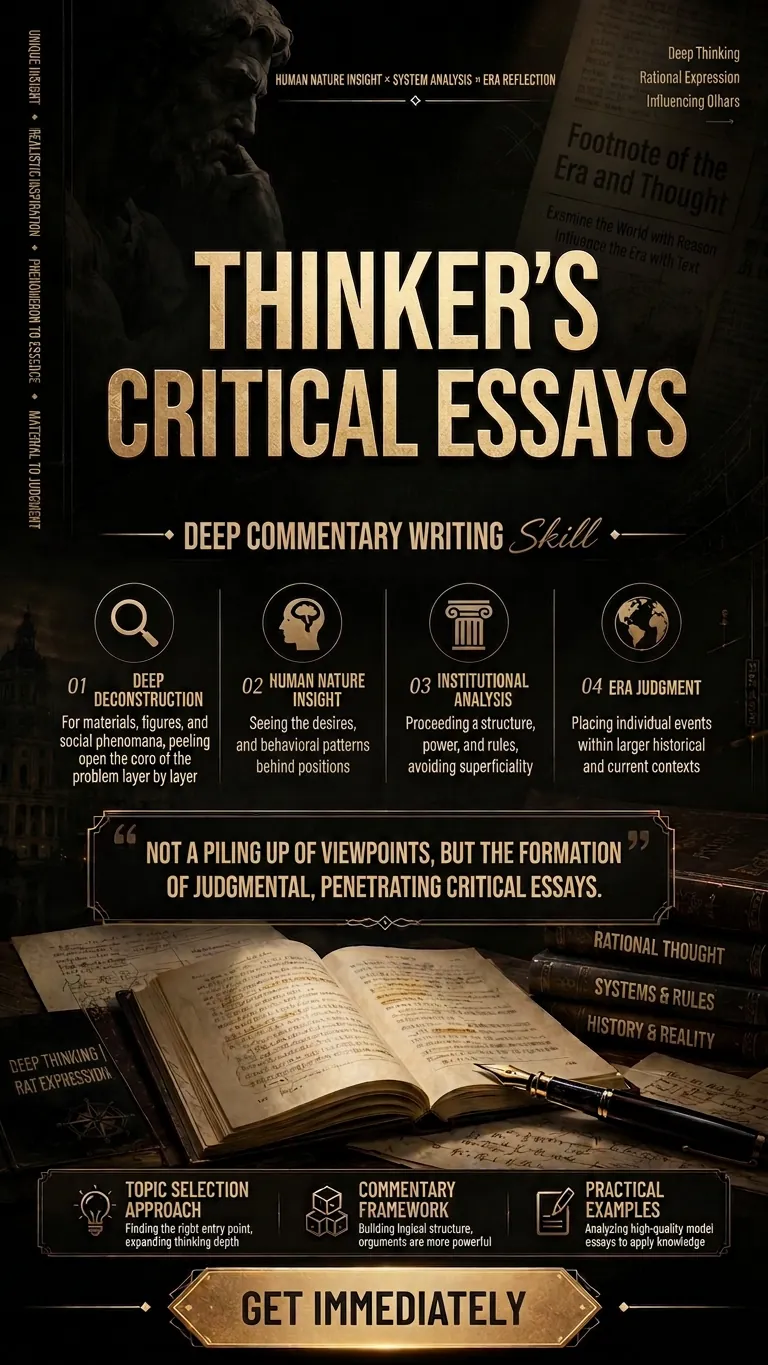
The Sage's Commentary helps you deeply analyze materials, people, or social phenomena, going beyond the surface to reach the core. Based on reading, it integrates insights from history, institutions, human nature, and inner depth to provide unique perspectives and practical inspiration. Whether you're taking book notes, analyzing historical figures, commenting on social phenomena, or deconstructing political power structures, this tool helps you start from the text, deconstruct common sense, and deeply analyze structure, human nature, institutions, and the trends of the era, ultimately forming personal judgments that guide action. It advocates learning from history and breaking attachments with the heart, not blindly following authority or being trapped by emotions—seek the truth first, then judge. You can use it to organize scattered ideas into layered long-form writing or elevate ordinary material into thought-dense articles. It's especially suited for analyzing literary character psychology, reinterpreting classical ideas in modern contexts, and reflecting on personal situations and creative challenges, as well as deep discussions on topics like AI and knowledge production in the information age. In the end, it provides judgments that are both sharp and restrained, rather than empty slogans or feel-good platitudes.