
Pre-submission Quality Check v2.0
Pre-submission Quality Check v2.0
Showcase
Description
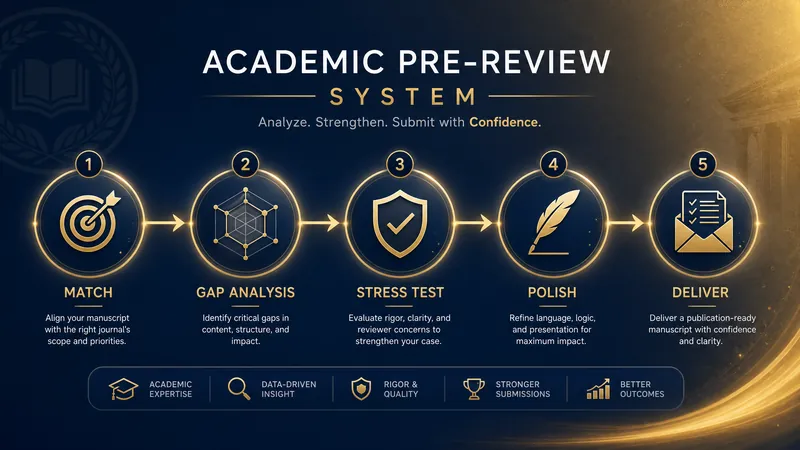
Comprehensive pre-submission quality check system for journal papers. Features a six-dimensional parallel review (structure, logic, methods, language, citations, journal alignment) plus four enhanced modules: journal profile analysis, AIGC risk recheck, abstract smart rewrite, and desk-reject risk radar. Simulates a senior reviewer's perspective, outputting a structured issue list, severity grading, submission readiness score, and desk-reject probability estimate.
Related Skills
View all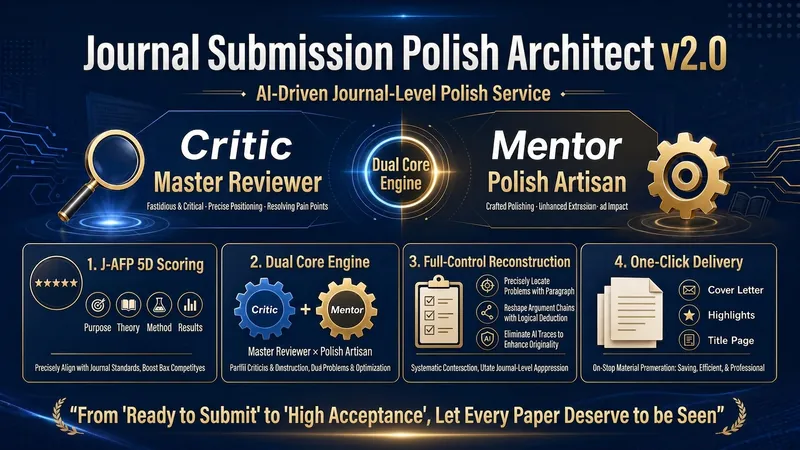
Journal Submission Refinement Architect v2.0 (Advanced Version)
A dynamic, adaptable review, restructuring, and step-by-step revision system for any target academic journal. It accurately diagnoses manuscript publication suitability using a J-AFP five-dimensional quantitative scoring system (intent alignment, theoretical contribution, methodological standardization, result conversion, and format compliance). Employing a dual-core engine (Critic + Mentor) model, it helps authors bridge the gap between "self-indulgent writing" and "standardized works conforming to review logic." It supports a fully engineered workflow, from journal profiling and title reshaping to logical pressure application, table of contents finalization, and step-by-step revision.
Journal Pre-review Expert V7.0
Top Journal Submission Pre-review Expert V7.0 is a full-process pre-review Skill for social sciences and humanities scholars. It simulates the perspective of senior reviewers at Nature/Science/ASR/AJS-level journals, driven by a dual-core engine (Reviewer Butcher + Polishing Craftsman) across six phases. V7.0 core upgrades: · Governance layer: unified dashboard + step mode (default/fast-forward/slow-motion) + ratchet version management + mid-join logic · All 15 quick commands implemented (/express /jump /benchmark /ethics-scan /cover-letter /polish /abstract /checklist /audit /resume /skip /rerun /export /persona /lang) · Cross-phase vulnerability tracking table: tracks from Phase 2 to Phase 5 with status closure · 6 virtual reviewer personas (methodology hawk, theoretical purist, contextualist, ethics reviewer, etc.), each with 4-5 typical criticisms, automatically activating 3-4 based on research type · Full language pair support: Chinese→English, English→English, Chinese→Chinese, with Chinglish terminator engine covering 7 categories of high-frequency errors · Benchmark paper five-dimensional comparison + no-benchmark degradation path · New AI usage transparency check and citation quality deep audit Applicable scenarios: PhD students/early-career faculty pre-submission self-check, advisors guiding students to revise manuscripts, research group submission strategy discussions. Supports full-process guidance for Chinese native speakers submitting in English.

Apex-Scholar Reviewer v5.1
The success rate of academic paper submissions is directly related to the logical rigor, linguistic authenticity, and format compliance of the manuscript. However, researchers often focus on scientific content itself and find it difficult to simultaneously balance critical review from a reviewer's perspective and Native Speaker-level language polishing. Additionally, different journals (e.g., IEEE's engineering style vs. Nature's narrative style) have vastly different requirements for writing style, further increasing the complexity of submissions. This system acts as a senior reviewer & academic writing mentor for Nature/Science-level journals, using a dual-core adversarial engine (Critic core responsible for logical attack, Mentor core responsible for language reconstruction) to perform comprehensive stress testing and refinement of the paper, ensuring the output can withstand the scrutiny of the most rigorous reviewers.
Information
- Version
- v3
- Last updated
- Runtime credits
- Usage-based
- Models
- Auto