
AI Patent Innovation Miner
AI-assisted innovation mining and patent drafting
AI Patent Innovation Miner
AI-assisted innovation mining and patent drafting
Showcase
Description
AI Patent Innovation Miner | Turn your R&D achievements into valuable patent assets. Designed for R&D personnel, product innovation teams, and corporate intellectual property teams, this tool transforms technical pain points, solutions, experimental records, and competitor information into structured patent innovation analysis results. Five core capabilities: Innovation Mining: Generate candidate innovation points from dimensions such as technical principles, materials, structures, processes, and application scenarios. Patent Search and Comparison: Plan search keywords and classification codes, compare real published patents and key claims, and identify potential differences. Innovation Value Assessment: Screen directions worthy of further verification from angles such as novelty, inventiveness, technical effects, and feasibility. Opposing Opinion Simulation: Adopt a patent examiner perspective to identify potential issues with novelty, inventiveness, sufficient disclosure, and claim support, and propose improvements. Technical Disclosure Drafting: Output a structured draft including technical background, summary of the invention, embodiments, technical effects, and intended protection points. Applicable Scenarios: Food and beverage, packaging materials, biotechnology, chemical engineering, intelligent manufacturing, and other technical R&D fields. Core Value: Reduce repetitive work for R&D personnel transitioning from technical results to patent disclosures, improve innovation mining and internal review efficiency, and support the continuous accumulation of corporate intellectual property assets. Note: Patent search conclusions are based on actually verifiable published literature; unverified searches are explicitly noted without fabricating patent numbers, claims, or grant prospects. Final patentability, infringement risks, and filing strategies must be further confirmed by professionals.
Related Skills
View all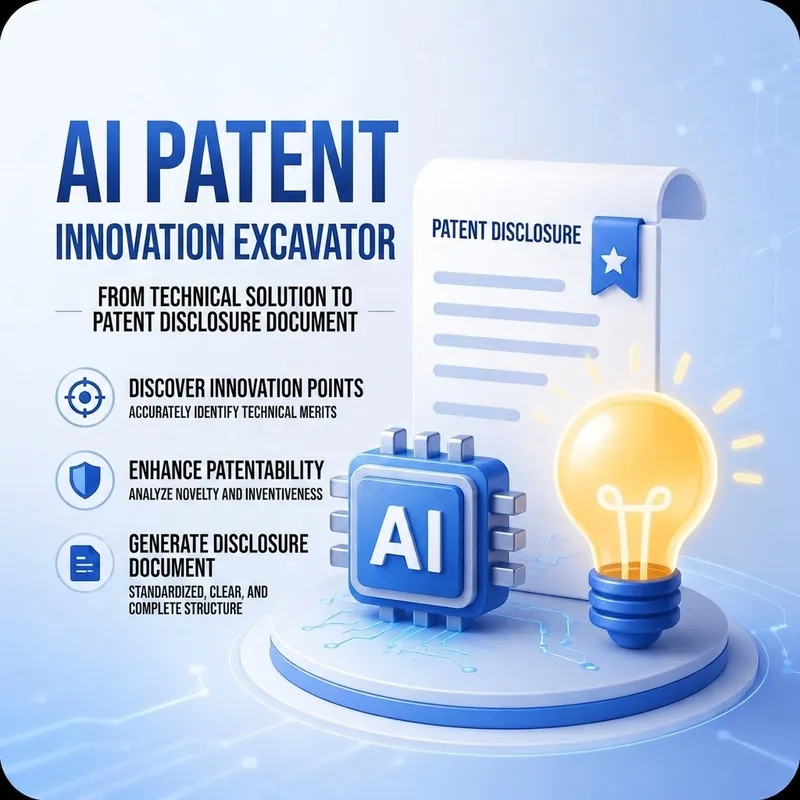
AI Patent Innovation Miner V5
Many R&D personnel are not lacking in innovation, but rather do not know where their innovation lies. This AI patent innovation miner can help you: 🔍 Find innovation points 💡 Uncover technical highlights 📄 Write technical disclosure documents 🚀 Improve patent output efficiency Whether it's product development, process improvement, experimental research, or paper results, you can quickly turn them into patent ideas. Especially suitable for: R&D personnel in food, biology, materials, medicine, AI, electronics, mechanics, and other technical fields. From technical solutions to patent disclosure documents, done in one step.
PatentForge - Patent Analysis
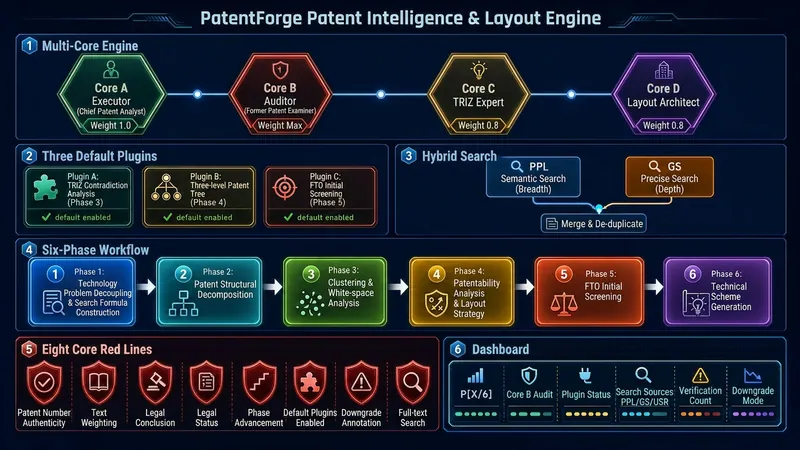
PatentForge is a 6-stage full-process patent intelligence analysis engine (technical problem decoupling → structured patent deconstruction → clustering and white-space analysis → patentability analysis and layout strategy → FTO initial screening → technical solution generation). It integrates a hybrid model of Perplexity patent semantic search + googleSearch exact search, with 3 plugins enabled by default (TRIZ contradiction analysis + three-level patent tree + FTO initial screening), a multi-core adversarial engine (Executor A + Auditor B + TRIZ Expert C + Layout Architect D), 8 core red lines, and dynamic dashboard tracking. Designed for R&D engineers, patent analysts, and IP managers. Trigger words: patent analysis, patent layout, patent search, FTO, patentability, technical solution, PatentForge. Operation Manual: Method 1: Quick Start (One-Sentence Version) Help me analyze the patent layout for this technical problem: [describe your technical problem in one sentence], and the technical field is [your field]. Example: Help me analyze the patent layout for this technical problem: automatic removal of slag from the inner wall of metal pipes after laser cutting, technical field: laser processing + automated cleaning. Method 2: Standard Start (Recommended) Please conduct patent intelligence analysis and layout for the following technical problem: 1. Technical problem: [the core technical problem you want to solve, be as specific as possible] 2. Technical field: [the field involved, e.g., mechanical/electronics/materials/testing/control/AI, etc.] 3. Constraints: [limitations such as volume/cost/material/working conditions, e.g., "cost ≤ 500 RMB, must adapt to existing production line"] 4. Exclusions: [approaches explicitly not to be used, e.g., "do not use chemical cleaning"] 5. Known competitors or patents (optional): [names of known competitors or patent numbers] 6. Existing search results: No (AI will perform Perplexity + googleSearch hybrid search) Example: Please conduct patent intelligence analysis and layout for the following technical problem: 1. Technical problem: automatic detection and defect localization of deep-sea pipeline welds under high-pressure environments; the existing ROV-mounted ultrasonic testing probe has unstable coupling under turbulent flow conditions, causing signal loss 2. Technical field: underwater robotics + ultrasonic testing + signal processing 3. Constraints: working water depth ≤ 3000m, pressure-resistant sealing, must fit existing ROV mechanical interface, single inspection speed ≥ 2m/min 4. Exclusions: do not use radiographic testing (radiation safety restrictions), do not use magnetic particle testing (non-ferromagnetic material pipes) 5. Known competitors or patents: CNXXXXXXXXXX (an underwater ultrasonic testing device) 6. Existing search results: No Method 3: Start with Search Results (When Patent Data Already Exists) Please conduct patent intelligence analysis and layout for the following technical problem. I have provided search results: 1. Technical problem: [core technical problem] 2. Technical field: [field] 3. Constraints: [constraints] 4. Exclusions: [approaches not to be used] 5. Known competitors or patents: [patent number or competitor name] 6. Existing search results: Yes Below is the list of patents I found: [Paste patent numbers, titles, applicants, etc., one per line] Example: Please conduct patent intelligence analysis and layout for the following technical problem. I have provided search results: 1. Technical problem: stiffness degradation and abnormal noise of foldable screen hinges under frequent folding 2. Technical field: precision machinery + material mechanics 3. Constraints: folding life ≥ 300,000 cycles, hinge thickness ≤ 2.5mm, torque decay ≤ 10% 4. Exclusions: do not use liquid metal damping 5. Known competitors or patents: None 6. Existing search results: Yes Below is the list of patents I found: CNXXXXXXXXXX A flexible screen hinge mechanism Company X US2021XXXXXXXXX Hinge mechanism for foldable display Samsung CNXXXXXXXXXX Hinge stiffness adjustment device Company X WO2022/XXXXXXXX Foldable hinge with variable stiffness LG
Grant Proposal Review PRO V2.0
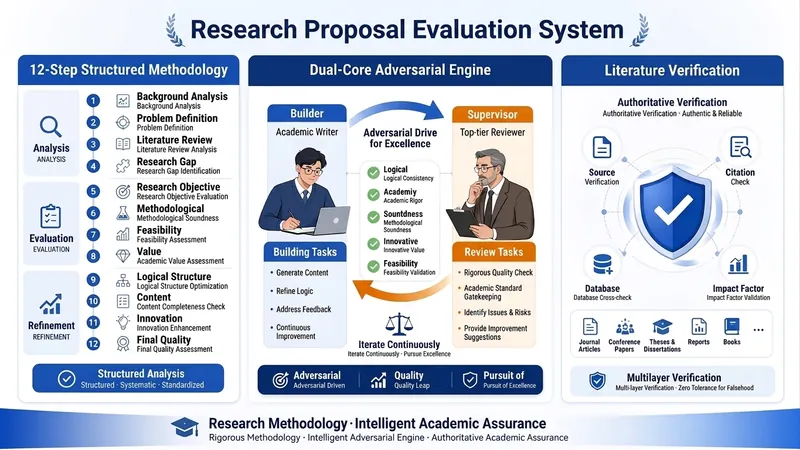
🎯 Core Functionality Overview This is an intelligent review and optimization system specially designed for national social science, education ministry, and provincial grant applications. It simulates the thinking mode of a senior review expert with 15 years of experience, ensuring academic rigor and competitiveness through three core mechanisms. 🔧 Three Core Mechanisms 1️⃣ 12-Step Structured Methodology Covers the full lifecycle of grant proposal review: Phase 1-3: Basic Diagnosis - In-depth analysis of announcement (funding priorities, review criteria, application requirements) - Cross-disciplinary type judgment (precise identification of 8 types) - Research GAP five-dimension identification (theory/methodology/empirical/policy/technology) Phase 4-7: Core Element Review - Research question TMAQ model analysis (theory/methodology/approach/question four dimensions) - Research objective SMART principle test - Research content framework completeness assessment - Research approach type matching (6 types) Phase 8-10: Deep Quality Enhancement - Precise extraction of key difficulties (distinguish criteria + breakthrough paths) - Innovation point seven-dimension mining - Feasibility seven-dimension argumentation Phase 11-12: Overall Optimization - Nine-dimension quality check (academic rigor, innovativeness, feasibility, etc.) - Comprehensive optimization suggestions and final report 2️⃣ Dual-Core Adversarial Mechanism (Builder vs Supervisor) Working Principle: - Builder (academic writer): Generates optimization plans based on user materials - Supervisor (top journal reviewer): Challenges Builder's plans with the strictest standards - Adversarial iteration: 3 rounds of confrontation to ensure plans are robust Application Scenarios: - Innovation point mining: Builder proposes innovation points → Supervisor questions novelty → iterative optimization - Feasibility argumentation: Builder designs plan → Supervisor challenges feasibility → supplementary argumentation - Literature citation: Builder cites literature → Supervisor verifies authenticity → ensure academic standards 3️⃣ Literature Authenticity Verification Mechanism Two working modes: Mode A: Placeholder Mode (Default) - Use markers like [Literature Placeholder-001] in place of specific references - Output a Literature Requirement List specifying search requirements for each placeholder - User searches and fills in real references Mode B: Real-Time Verification Mode - Call Google Scholar to verify literature authenticity in real time - Generate Literature Verification Report (authenticity/relevance/authority scores) - Ensure every citation is traceable Preventing AI Hallucination: - Prohibits fabricating authors, journals, DOIs - All references must be verified or marked as placeholders - Guarantees academic integrity bottom line 💡 Core Value and Applicable Scenarios ✅ Key Pain Points Addressed 1. Academic sloppiness: AI-generated content often includes fake references, logical gaps 2. Insufficient innovation: Difficulty uncovering true academic innovation points 3. Weak feasibility: Research plans lack systematic argumentation 4. Cross-disciplinary difficulty: Interdisciplinary topics often fall between two stools 🎓 Target Users - University faculty (social sciences, education, humanities) - Researchers (applying for national and provincial grants) - Academic teams (needing systematic review processes) 📋 Typical Workflow 1. Input: Upload announcement + proposal draft 2. Review: System executes 12-step structured analysis 3. Adversarial: Dual-core mechanism iteratively optimizes key sections 4. Verification: Literature authenticity check 5. Output: Complete review report + optimization suggestions + literature list 🔍 Differences from Traditional Review | Dimension | Traditional Human Review | Expert Review System | |-----------|------------------------|----------------------| | Review depth | Depends on personal experience | 12-step structured + 9D QC | | Academic rigor | Hard to fully audit | Literature verification + dual-core adversarial | | Innovation mining | Subjective judgment | 7-dimension systematic analysis | | Feasibility argumentation | Experience-driven | 7-dimension item-by-item argumentation | | Consistency | Varies by individual | Standardized process | | Efficiency | Days to weeks | 1-2 hours for initial review | The core advantage of this system is: it makes the tacit knowledge of a 15-year senior review expert explicit, structured, and replicable, enabling every user to receive top-level expert review services.
Information
- Version
- v3
- Last updated
- Runtime credits
- Usage-based
- Models
- Auto
- Use cases
- Writing & contentResearch & analysisBusiness & strategy
- What you get
- ReportDocumentPlan
