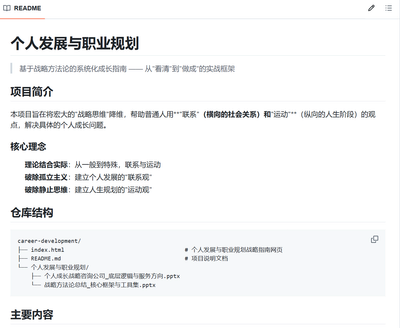
Career & Personal Development
Future career direction, survival, efficiency
Career & Personal Development
Future career direction, survival, efficiency
Showcase
Description
1. Skill Overview - Skill positioning and core value - Technology stack description - Design standards introduction 2. Core Working Principles - Single-page application architecture - localStorage data persistence mechanism - Page switching and state management 3. Main Functional Modules (5 core modules) - Dashboard - New lead form - Quality assessment report - Improvement plan - Settings page 4. Operation Flow (3 core processes) - Complete steps to add a new lead - Filter and search operations - Lead deletion confirmation process 5. Applicable Scenarios (4 typical scenarios) - Lead management for small sales teams - Customer management for individual entrepreneurs - Lead collection at exhibitions/events - Teams with high accessibility requirements 6. Key Features (5 major features) - Comprehensive accessibility design (WCAG 2.1 AA) - Responsive design - Excellent user experience - Comprehensive utility function library - Design system (CSS variables) 7. Technical Details - Performance optimization strategies - Security features - Browser compatibility - Extensibility
Recommended by
Nico@YouMind
Why we love this skill
This resource helps you plan personal development and offers practical workplace survival and efficiency tips, with code examples and professional language for deeper insight.
Instructions
🎯 Key Highlights
- Code references: All functional modules include clickable links pointing to specific files and line numbers.
- Code examples: Key implementation details are accompanied by actual code snippets.
- Professional Language: The document uses a professional language and has clear logic.
- Practical Value: Detailed explanation of the practical application scenarios and value of the skills.
Related Skills
View all Write
WritePersonal Memory System
💡 Core Value Explanation (30-second version) What is this? Personal Memory System is a smart tool that lets AI remember you persistently. No need to reintroduce yourself every conversation, no need to repeatedly explain work style and project background. Just 5 minutes to initialize, and AI will permanently remember who you are, your preferences, and your project status. What problems does it solve? Pain point 1: Repeated introductions wasting time ❌ Every new conversation: "I'm a product manager, working on an AI project, prefer concise style..." ✅ Set once, works forever—AI automatically remembers your full context Pain point 2: Fragmented context scattered everywhere ❌ Preferences in one conversation, projects in another Board, skill stack in yet another place ✅ 10-dimension structured storage, manage all personal context in one place Pain point 3: Recalibrating when switching scenarios ❌ Switch Boards and have to explain everything again, switch AI platforms and start from scratch ✅ Tiered export (L0-L3), migrate to any scenario in 2 minutes Pain point 4: Privacy concerns, afraid to share ❌ Not sure what info to give AI, worry about leaking privacy ✅ 4-level disclosure mechanism—you fully control the information boundary What value does it provide? Value 1: Save time ⏱️ Initial setup: 5-10 minutes Subsequent updates: 1-2 minutes Cross-scenario migration: 2 minutes Cumulative savings: 30+ minutes per week of repeated introductions Value 2: Improve quality 📈 AI fully understands your work style Output automatically matches your preferences Suggestions align with your skill level Result quality improves by 50%+ Value 3: Protect privacy 🔒 4-level disclosure: L0 public → L3 private Automatic anonymization: names, amounts, health info Local storage: full data control Privacy risk reduced by 80%+ Value 4: Continuous accumulation 📚 10-dimensional complete profile Version history traceable Cross-platform migratable Personal AI asset continuously appreciates Who is it for? ✅ Product managers: record work methodology, team structure, project status ✅ Independent developers: maintain skill stack archive, tech preferences ✅ Creators: save aesthetic principles, style rules ✅ Researchers: manage research background, knowledge system If you frequently collaborate with AI, you need this tool. 📸 4 Effect Demonstration Images Image 1: Intelligent extraction from chat history Function: Automatically analyze your chat history, extract key information Value: No manual entry needed, quickly build profile in 5 minutes Display: Chat history on left with highlighted keywords, automatically generated structured info cards on right Image 2: 10-dimension structured profile Function: Complete personal context model covering identity, rules, projects, skills, etc. Value: Manage all info in one place, no more scattered fragments Display: 10-dimension collapsible list, D2 Cognitive OS starred, progress indicator showing 3/10 complete Image 3: 4-level privacy protection Function: Tiered export, from public to private—you decide what to share Value: Different levels for different scenarios, full privacy control Display: L0-L3 card comparison, information density increasing left to right, with lock icons and token counts Image 4: Auto-sync MEMORY Function: PCA full profile ↔ MEMORY.md core summary auto-sync Value: Board Memory always up to date, no manual maintenance needed Display: Blue sync arrow between two documents, labeled "Auto Sync" and "Real-time Update"
 Research
Offer Toolkit
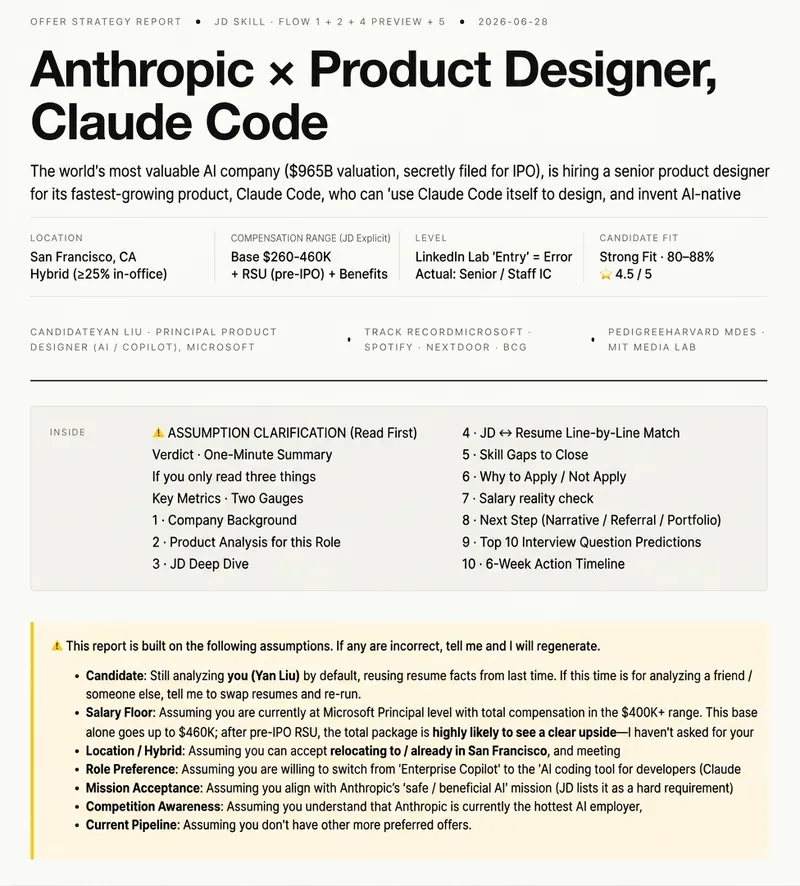
A job search system backed by 10 years of experience at a major Silicon Valley company, packaging genuine hiring insights and job search methodologies into AI. Offer Toolkit | AI Job Search Assistant From "discovering your dream job" to "landing the offer," it breaks down the entire job search process into three smart modules: ① JD Decoder Deeply analyze the job description and generate a personalized Offer Strategy Report: - Whether it's worth applying - Role fit assessment - Core strengths and skill gaps - Interview focus and high-probability question predictions ② Resume Builder Transform your experience from a "job description" into a compelling impact story that recruiters recognize: - Automatically structure your personal experience - Optimize project descriptions and quantify achievements - Generate ATS-friendly, high-quality resumes - Supports 11+ print-ready professional templates ③ Behavioral Story Library Mine your real experiences to build reusable interview story assets: - Extract key projects and growth experiences - Automatically convert to STAR Framework - Build a personal Behavioral Interview Story Bank - Efficiently handle "Tell me about a time..." questions Whether you're debating "should I apply for this job," want to "optimize your resume," need to "analyze a JD," or are preparing for your next behavioral interview, Offer Toolkit will automatically identify your needs and route you to the most suitable AI module. Keywords: Job Search, Offer, Career, Job Hunt, JD, Job Description, Resume, CV, Behavioral Interview, STAR, Tell me about a time, Interview Preparation ------------------------------------- job-description-skill: Paste a JD and your resume, and you'll get an HTML report telling you: whether you should apply for this job, how well you match, what gaps exist, what the interview will likely ask, whether the salary is reasonable, and what to do in the next 6 weeks. resume-skill: Helps you polish your existing resume, import from LinkedIn, or write one from scratch through conversation. Provides 11 print-ready templates (Classic-ATS, Ledger, Tech Compact, Modern Sidebar, Pillar, Elegant Serif, Atelier, Timeline, Swiss, Executive, Color-block). Each time, it provides two files: one directly printable as PDF, and one you can edit by clicking words in the browser. bq-skill: It doesn't give you ready-made answers; instead, it helps you dig out things you've actually done and organize them into a reusable story library. It will ask about your experiences step by step, help you clarify your thinking using STAR/CAR, and tag them with labels like "decision-making" and "overcoming adversity." It saves one copy in Chinese and one in English, so you can use the same story for different behavioral questions next time. It can also look at a JD and predict 20 questions the company might ask, helping you prepare one by one. Three shared rules: 1. No fabrication. All experiences, responsibilities, and numbers come from what the user has actually said. It can help rephrase weak expressions, but it will never invent companies, positions, achievements, or quantified numbers. Numbers must be verified with the user. 2. Ask only one question at a time. Digging stories, building resumes, and preparing BQs are conversations, not questionnaires. 3. Structure first, then output. First convert to a standard data model, confirm it's correct, then render HTML or generate answers.

New Format Textbook Designer
This skill aims to provide vocational educators with a one-stop solution for developing new-format textbooks. Whether you need to plan a new course textbook from scratch or want to innovatively revamp an existing textbook, it follows advanced methodologies for vocational new-format textbook development and guides you step by step through the entire process from concept to implementation. You only need to provide course and program basic information. The skill will automatically perform input analysis and gap diagnosis, comparing against national professional teaching standards, '1+X' certificate standards, and other 'four alignments' requirements. It evaluates existing materials and offers professional strategic recommendations. Then, it gradually assists you in completing topic selection argumentation, clarifying the ten major features of the textbook, designing an integrated path for 'post-course-competition-certification,' and establishing a school-enterprise dual-element, department-faculty dual-level management mechanism and team building plan. In core content design, the skill guides you in selecting an appropriate textbook format (e.g., project-based, workbook-style), designing a detailed outline, and transforming teaching objectives into actionable learning tasks. At the same time, it deeply explores and plans the integration of ideological and political education into the curriculum, and designs a comprehensive digital resource package and a scientific teaching evaluation system. Finally, all planning results are consolidated into a complete Markdown development plan document, and a professional, concise Slides presentation is automatically generated to help you easily present and promote new-format textbook construction.
Information
- Version
- v2
- Last updated
- Runtime credits
- Usage-based
- Models
- Auto