
Product Selling Points Generator
Turn specs into product pages and copy with a claim checklist
Product Selling Points Generator
Turn specs into product pages and copy with a claim checklist
Showcase
Description
Target Audience: Merchants and creators who need to organize selling points and introductory copy for physical products, software, or courses. What You Need to Provide: Product name, authentic specs or features, target audience, usage scenarios, pricing policies, and existing proof materials. How It Works: Builds a fact ledger, matches features to specific scenarios, drafts the product page and short copy, and cross-checks prices, results, and commercial claims. Unprovided effects, sales figures, reviews, discounts, and after-sales terms are never fabricated; price conflicts are listed as items to review. Final Deliverables: Selling point matrix, 3 headline options, full product page draft, 3 short copy options, plus a claim checklist and missing information list. Directly delivers copy-pasteable text by default. Usage: Paste product information, specify the channel and desired customer action, review the final copy against the claim checklist to verify specs and evidence, and check usage according to your actual channel. Core Requirements: Requires a language model, GPT models recommended. YouMind has run 1 case with GPT-6.1 Sol, alongside 4 local fictional data cases. The four display images are excerpts from these local actual outputs, not real customer or physical performance tests. Results vary by model and input; manual verification is still required. Not Suitable For: Fabricating certifications, reviews, or efficacy, or guaranteeing income, sales, or ad approval. This Skill does not generate product images, automatically publish, or run ads.
Recommended by
Dancang
Why we love this skill
Transforms scattered product specs into ready-to-publish detail pages and short copy while verifying the factual basis of each promotional claim. It strictly distinguishes confirmed info, scenario inferences, and evidence gaps to boost conversion while reducing exaggeration risks.
Related Skills
View all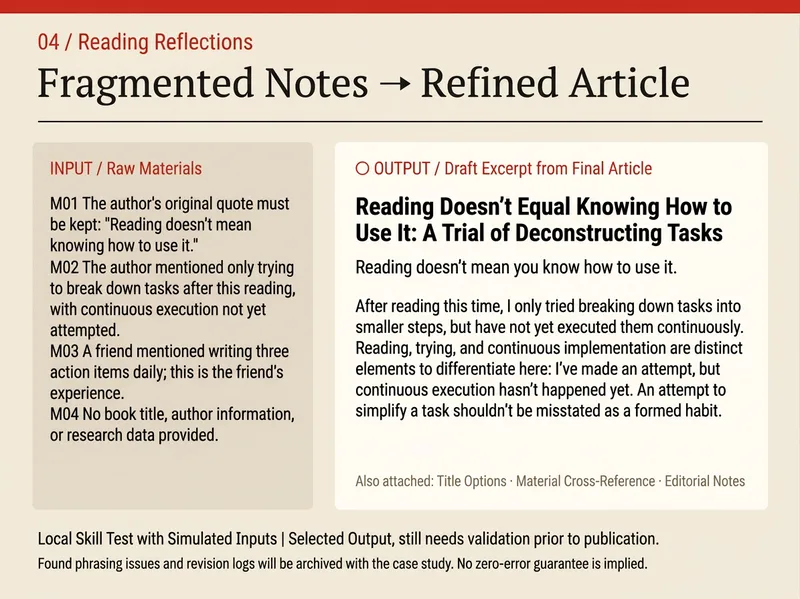 Write
Notes to Article with Checklist
Target Audience: Creators who have scattered notes, interview texts, or spoken transcripts and want to organize them into articles. What You Need to Provide: Raw materials, target audience, purpose, length, and expressions you wish to keep. How It Works: Numbers the materials, distinguishes factual statements, opinions, and plans; drafts around a single thread, then reviews numbers, speakers, and evidence gaps. Final Delivery: 3 title options, complete body text, material correspondence table, items to confirm, and editing notes. By default, it outputs copyable text directly; file saving depends on the runtime environment. Steps to Use: Paste your materials and specify the reader and word count; read the article first after running, check the materials against the correspondence table, and use it after revision. The core feature requires only a text model, and GPT is recommended; current YouMind tests select GPT-6.1 Sol, and actual results depend on runtime configuration. The four display images are excerpts from real local Skill test outputs with fictional inputs, presented via layout formatting, and are not real client cases. Wording issues found in testing have been archived, and articles still require manual review. The platform has completed one text case test, which does not guarantee stable success in all scenarios. Not Suitable For: Fabricating real interviews from scratch, generating unprovided personal experiences, replacing fact-checking, or automatic publishing. Insufficient materials will shorten the content and list gaps rather than expanding it with fabricated facts.
 Image
E-Commerce Detail Page Maker
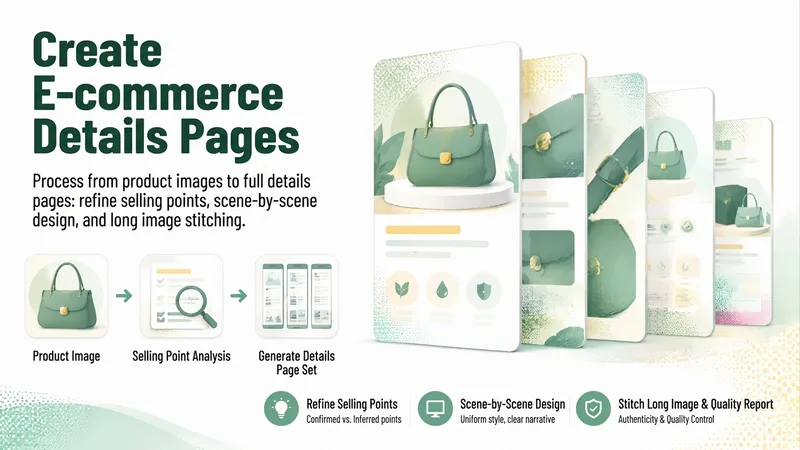
Transform product images and existing materials into an evidence-based, actionable e-commerce detail page plan suitable for Taobao, Tmall, JD.com, Douyin Shop, Pinduoduo, Amazon, and independent stores. The Skill first identifies the product appearance, structure, material feel, and visible information, clearly distinguishing confirmed content from inferred details to fill specification gaps. It analyzes core selling points, target audiences, usage scenarios, and differentiation while avoiding fabricated parameters, effects, or certifications. Once the product facts are clear, it plans the number of screens and narrative order, providing a visual style tailored to the category and audience, including color schemes, layouts, photographic atmosphere, and information pacing. Upon direction confirmation, it generates screen-by-screen headings, sub-copy, information points, and Chinese AI image generation prompts to keep the product appearance and visual style consistent across the entire set. When actual image generation is required, it produces and checks images screen by screen based on the original product image, focusing on product fidelity, structural integrity, clear text, selling point coverage, and compliant wording. It then compiles vertical long images where conditions permit, delivering plain text, actual prompts, and finished quality inspection results.

Product Image to Detail Page
Transform product images and brief information into detail page assets that meet target e-commerce platform requirements, helping merchants complete product displays, selling point expression, and pre-listing reviews faster. Simply provide the target platform, at least one clear product image, and the product name or category to plan the product story, visual direction, and localized copy around verifiable information. The Skill analyzes the product's appearance, color, texture feel, use cases, and audience, and uses this to organize key visual, feature detail, usage guide, specification, and trust content modules. Information such as materials, dimensions, efficacy, certifications, or accessories that are not clearly provided by the images or the user will not be arbitrarily added or packaged as selling points, reducing false advertising and compliance risks. Outputs can include platform-compliant module images, long detail page previews, product copy, and a delivery checklist, adjusted according to different platforms' image text policies, layout dimensions, and content restrictions. For scenarios unsuited to synthetic visuals, preference is given to cropping and arranging real product photos. Suitable for creating e-commerce detail pages, product detail images, listing image groups, and A+ content.
Information
- Version
- v2
- Last updated
- Runtime credits
- Usage-based
- Models
- Auto
