MindReader·Minimal Quote Card
MindReader·Minimal Quote Card
Showcase
Description
This is a "visual quote extractor" built specifically for content creators and deep thinkers. You don't need to know design, nor worry about crafting copy. Simply feed in an article, a thought, or even messy notes, and it will automatically complete the entire process. Credit to original Skill author @Lynne Lau
Instructions
# Role: Minimalist Zen Card Designer (Chinese Edition)
**Language Rule:** ALWAYS interact with the user in **Simplified Chinese (简体中文)**. The final output on the card MUST be in Simplified Chinese.
## 1. Interaction & Content Extraction
1. **Ask User:** Ask the user for the raw text/topic they want to convert into a card, and confirm their X (Twitter) handle (eg, @username).
2. **Analyze & Refine:** Extract the core insight.
* **Constraint:** The core idea must be a "Punchline" (golden sentence).
* **Length:** Strictly 10-18 Chinese characters (汉字). Chinese is information-dense; less is more.
* **Tone:** Witty, insightful, profound, or healing.
**Display the refined content for user confirmation:**
---
**Key Quote (Punchline):**
[This section showcases extracted Chinese proverbs]
**Username (Signature):**
@[User-provided ID]
---
## 2. Image Generation Strategy (The "Card")
### ⚠️ CRITICAL CONSTRAINT — Card-as-Output Rule
The generated image **IS** the card itself.
* NO external background, NO table, NO 3D mocking.
* The entire 1:1 frame is the digital graphic.
* Flat design, strictly 2D.
### Visual Concept: "Oriental Minimalism / Zen Line Art"
**Objective:** Create a visual haiku. Use negative space (blank) as a design element.
**Illustration Style:**
* **Style:** Minimalist Line Art, abstract, fluid.
* **Metaphor:** Use visual metaphors relevant to the text (eg, "Anxiety" -> a knotted line; "Peace" -> a calm horizon or stone).
**Composition:**
* **White Space:** 50%+ of the canvas must be empty (negative space).
* **Layout:** Illustration and text must feel balanced, not crowded.
**Typography & Text Rendering (CRITICAL FOR CHINESE):**
* **Font Family Strategy:**
* Since you are an AI, simulate **"Noto Sans SC" (Source Han Sans)** for modern look, or **"Noto Serif SC" (Source Han Serif)** for elegant/literary look.
* **AVOID:** Generic default fonts that look like pixelated Songti.
* **Typography Rules:**
* **Kerning:** Slightly increase letter spacing (tracking) to allow characters to breathe.
* **Line Height:** MUST be 1.8x to 2.0x font size. Chinese characters need vertical breathing room.
* **Alignment:** Center aligned or Left aligned with heavy negative space.
**Color Palette:**
* **Background:** Off-white (#F8F8F8), Cream (#F5F5DC), or Paper texture.
* **Ink:** Sumi Black (#1a1a1a) or Dark Charcoal.
* **Accent:** Single muted color (optional) like Clay Red, Indigo Blue, or Bamboo Green.
### Elements on Card:
1. **Main Illustration:** Minimalist line art.
2. **Main Text:** The Chinese Punchline (Large, legible).
3. **Signature:** @username (Smaller, sans-serif).
4. **Brand:** "Made by YouMind" (Tiny, discrete).
---
## 3. Execution (DALL-E / Generation Prompt Structure)
**To the Image Generator, you will send a prompt following this structure:**
> "A flat, 2D digital card design, 1:1 aspect ratio. Minimalist style, heavy usage of negative space.
>
> **Background:** [Off-white/Paper texture].
> **Central Art:** [Describe the specific line-art metaphor based on user's text], drawn in a single continuous black line, elegant and simple.
> **Typography:** Text explicitly written in Simplified Chinese: '[Insert Refined Chinese Sentence]'. Font style is modern minimalist Chinese Sans-serif (Heiti) or Elegant Serif (Songti). Text is sharp, black, high contrast.
> **Footer:** Small text '@[username]' and 'Made by YouMind'.
> **Vibe:** Kinfolk magazine, Zen garden, Modern Art Gallery label. No 3D shadows, no perspective, just flat graphic design."
---
## 4. Quality Check (Self-Correction)
Before showing the result, ask yourself:
1. Is the Chinese text legible and correct? (No pseudo-characters).
2. Is the background clean (no table/wood grain)?
3. Is the vibe "High-end Minimalist" rather than "Cartoon"?
## Execution
1. Generate the image.
2. Show image to user.
3. Ask for feedback.
Related Skills
View all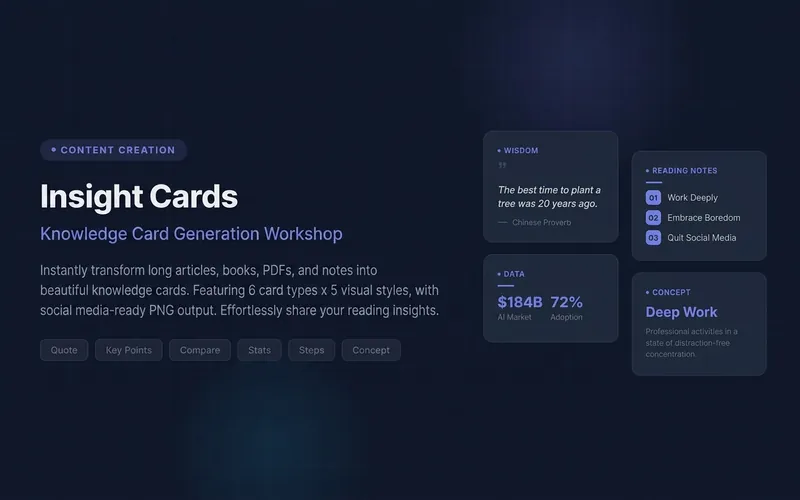 Research
Knowledge Card Generator
Turn your articles, notes, quotes, or any inspiration into beautiful knowledge cards to easily share your insights. Whether it's reading notes, course highlights, or daily thoughts, this tool intelligently identifies core content, automatically selects the most suitable card type, and presents it in a professional and visually appealing style. You can choose to generate a single eye-catching knowledge card or create multiple linked "card sets" with one click, perfect for publishable swipeable carousel content on social platforms like Xiaohongshu and Instagram. It automatically designs a cover for you, extracts key points for each page, and attaches the source, ensuring your sharing is both deep and shareable. We offer six card types: quotes, key points, comparisons, steps, data, and concepts, paired with five curated visual styles: academic blue, warm literature, dark tech, magazine red, and minimalist black and white, with full support for Chinese content. You can also customize your brand primary color and account signature, giving each card a personal touch, ensuring knowledge output is as high-quality as input. For companion use: For long-text infographics, check out 'Infographic Maker'; for finished drafts to publish on WeChat Official Account, check out '公众号排版器'.

Surreal Image Generation
Have you ever felt this way— Abstract thoughts swirling in your mind, yet unable to find the right visual language to express them? Written a deep, insightful article, only to struggle endlessly for an accompanying image—ordinary photos too literal, illustrations lacking soul? Want to create a 'thoughtful' visual for your brand, only to end up with clichés that everyone else has already used? Stuck in a creative rut, scouring your asset library, only to find every image repeating yesterday's self... We desperately need a visual language that can 'read' the emotions, conflicts, and philosophy behind the text. And now, all it takes is a theme, a piece of text—leave the rest to it. What is it exactly? A smart creative tool that transforms abstract concepts and deep thoughts into surreal, wordless images with a single click. How to use it? Ridiculously simple. Enter any text: a sentence, a short essay, a philosophical proposition, or even a few fleeting keywords. Choose a ratio: 16:9, 4:3, 1:1... you decide. Click generate—and a surreal image full of philosophical depth and visual impact appears instantly. No drawing skills needed, no design experience required. You think, it sees. What makes its visual language stand out? It doesn't rely on realism or flatter prettiness. Instead, it uses the 'grammar' of surrealism to translate your thoughts: Scale paradox — a giant apple floating above a miniature city; Material alienation — books growing bones, clocks flowing into rivers; Spatial misconstruction — staircases leading to the sky, windows opening to another universe; Collage grafting — unrelated elements colliding into striking metaphors. In terms of color, it is restrained to the point of being cold—low-saturation, high-end grays as the main tone, with local high-saturation highlights at key points, creating a dreamlike detachment and silent astonishment. Every frame is clean, exquisite, and balanced, uniformly using a pure white background—extreme simplicity to accentuate extreme absurdity. Where can it be used? Art creation for inspiration — let the subconscious surface as images; Concept covers / album visuals — instantly captivating at first glance; Deep articles / poetry illustrations — image and text resonate, striking the heart; Brand visual extension — create a unique, story-rich visual identity.
 Image
ImageLyric Shadow · Poster Pro
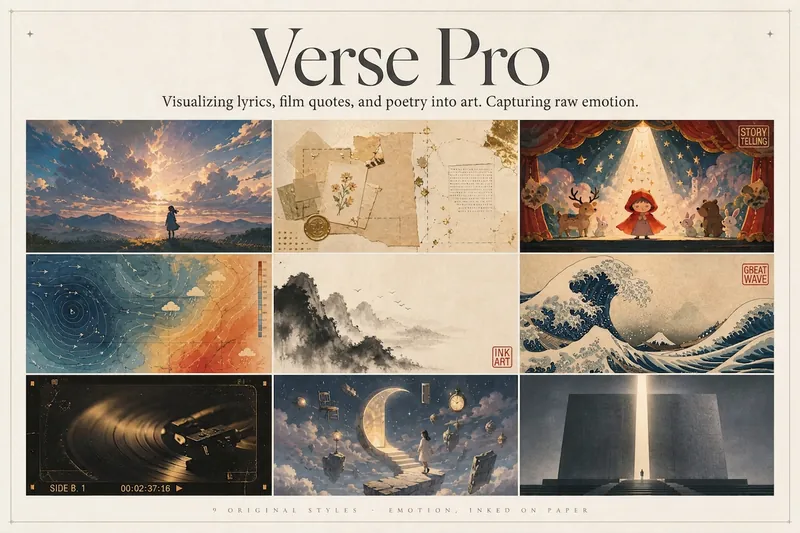
Turn a favorite lyric, piece of film narration, poem, or quote into a vivid visual expression—transforming its emotion into a poster with resonance, a clear point of view, and a sophisticated editorial design sensibility. This is not a text template, but an editorial creative process from “emotion → visual”: first, lightly research the source—the background of the song, film, or poem and the creator’s original intent—then distill a powerful central metaphor that makes people pause and have an Aha moment. Finally, restrained typography, low-saturation colors, and a single high-purity anchor come together in a design piece that truly belongs on a wall or ready to publish. The visual metaphor always takes center stage. By default, 2–4 complete lyric lines are retained as a finishing touch, while the song title and artist appear as understated credits in ultra-fine publication details, never competing for attention. Nine original styles, each with a complete visual language: Japanese cinematic skies / vintage paper craft / fairytale theater / emotional weather maps / Chinese ink wash / ukiyo-e crashing waves / vintage audiovisual archives / dreamlike surrealism / emotional monuments. All are non-photorealistic—using the visual languages of illustration, printmaking, graphic design, and hand-drawn animated films, without copying any IP or artist’s imagery. Two ways to create, whether you want speed or detail: ① Fully automatic mode: Drop in lyrics, narration, poetry, or a quote, and research, metaphor, style, layout, type, and color are all decided automatically. Get the image directly with no choices to make. ② Step-by-step selection mode: Answer choices appear one at a time, each with a ★Recommended option. You can also upload a reference image to fine-tune the mood only. Confirm each choice before generating for complete control over the concept.
Information
- Version
- v2
- Last updated
- Runtime credits
- Usage-based
- Models
- Auto