
Text to Cinematic Storyboard
Turn texts into realistic cinematic shots with narration.
Text to Cinematic Storyboard
Turn texts into realistic cinematic shots with narration.
Showcase
Description
Convert a text or novel excerpt sentence by sentence into realistic cinematic shots, creating a visual storyboard featuring original text reading, voiceover, and visual interpretation. The original text remains completely unchanged without new dialogue, using environments, objects, hands, and partial faces to carry the narrative. It uses techniques like focusing on the person laughing rather than the one being laughed at to handle sarcasm, and uses recurring objects to show the passage of time. Suitable for modern literature and Lu Xun's works such as Kong Yiji, The New-Year Sacrifice, Reminiscence of My Father's Back, and My Old Home, as well as Republic of China and late Qing dynasty dramas, Chinese teaching short videos, and classic reading videos. Triggered when users mention turning texts into movies, adapting novels into storyboards, reading original text with visuals, period drama texture, and visualizing Lu Xun's works. Not suitable for rewriting text into colloquial short dramas (which requires a 3D animated short drama approach with new dialogue), animation and cartoon styles, fantasy themes requiring heavy visual effects, or the need to accurately replicate a specific real actor or exact scenes from existing films.
Recommended by
Dancang
Why we love this skill
Featured for its strict adherence to the original text while precisely mapping every sentence of narration, description, and dialogue into cinematic shots, conveying subtext through absence, evidence, and objects with both literary fidelity and teaching feasibility.
Best for
Ideal for Chinese teachers, content creators, and literary visualization projects to turn texts or literary excerpts into reading videos with matching visuals.
How to use this Skill
Provide your input
Provide a text or novel excerpt, and optionally specify the title, historical background, and video purpose.
Run the Skill
The tool maps the text sentence by sentence or pause by pause into realistic cinematic shots without altering the original wording, arranging voiceover, visuals, and consistent character and scene settings.
Review your result
Receive a storyboard table for reading and teaching short videos, original voiceover scripts, and realistic visual prompts.
Related Skills
View all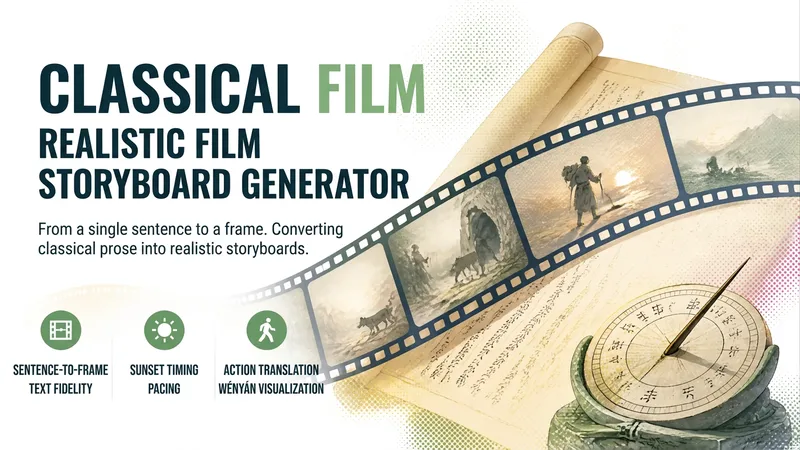
Classical Short Cinematic Storyboarder
Transform a 60–200 character classical Chinese short text (such as The Wolf, The Donkey of Qian, or The Mantis Stalks the Cicada) into a 1.5 to 3-minute realistic cinematic storyboard split sentence by sentence. It keeps the original text intact, uses a single setting, advances the plot through the distance between humans and beasts, uses the position of the sunset as a timer, and translates classical grammar like wolf-like sitting, holing up, or dropping burdens and holding blades into specific physical actions. Suitable for Chinese teaching short films, classical text situational readings, and the visualization of classical short pieces. Triggered when users mention turning classical texts into movies, one shot per sentence, single-scene short films, or realistic storyboards. Not applicable to adapting into vernacular dialogue short dramas (use 3D animation shorts instead), modern prose texts, multi-scene multi-character ensemble pieces like The Banquet at Swan Goose Gate or Ode to the Red Cliff, or cartoon animation styles.
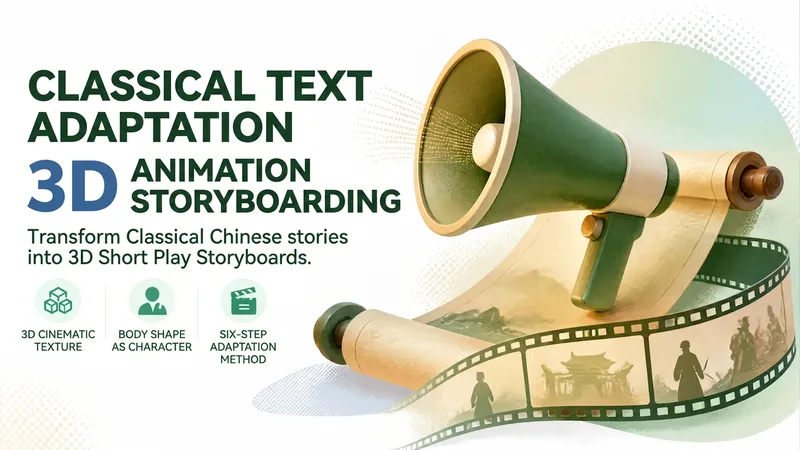
Classical Short 3D Storyboard
Transform classical Chinese texts, historical anecdotes, and textbook pieces into domestic 3D animated film-style storyboards. It features adult skeletal proportions, simplified surface details, chunky hair, clear textures, soft single-source lighting, and doorway framing. It includes a character design method based on body type reflecting personality, along with a six-step adaptation framework for turning classical prose into vernacular short dramas. It is well-suited for dramatic interpretations, Chinese language teaching shorts, and historical science popularization storyboards for texts like 'Zou Ji Satirizing the King of Qi', 'Cao Gui Lun Zhan', 'The Feast at Hong Gate', and 'The Jade Ring Returned to Zhao'. Triggered when users mention converting classical texts into animation, making short dramas out of classical Chinese, textbook play storyboards, or 3D ancient-style animation. Not suitable for realistic live-action video, hand-drawn 2D animation, fantasy special effect films, documentary reconstructions requiring strict historical accuracy, or images containing heavy Chinese text.
 Video
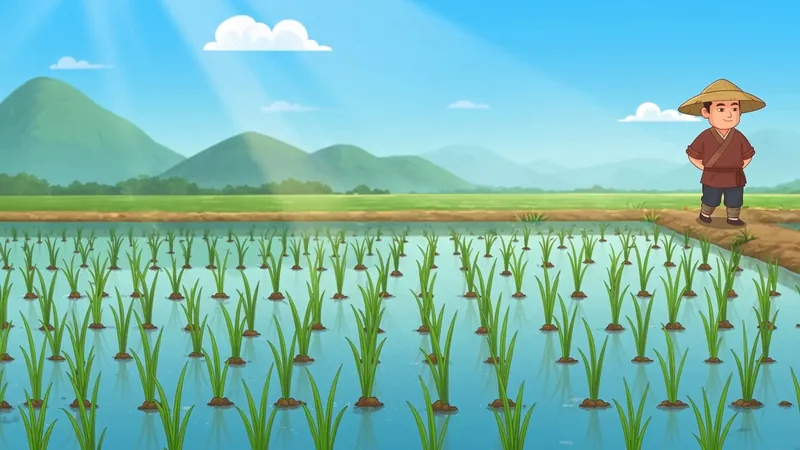
Idiom & Fable Video Maker
Quickly turn an idiom, historical anecdote, or fable into a continuous narrative storyboard script ready for video generation. Whether it’s “Waiting by a Tree Stump for a Rabbit,” “Plugging One’s Ears While Stealing a Bell,” “Sima Guang Smashes the Vat,” or an idiom you enter yourself, the Skill reconstructs the story’s setting, character relationships, key actions, and moral, then organizes them into a clear, tightly paced short-video plot. Two versions are provided by default: 15 seconds and 30 seconds. The 15-second version is ideal for quickly presenting the core plot, while the 30-second version adds environmental setup, character reactions, and climactic actions for a more complete and dramatic story. Each shot clearly specifies the emotion, framing, camera movement, and any necessary narration. Characters are given consistent visual traits to help maintain continuity across shots and work with common video generation models. All narration is written in a voiceover format—off-screen narration or spoken character dialogue—so the video model actually speaks the lines instead of rendering them as on-screen text. The default style is cartoon animation, but you can also request ink wash, paper cut, shadow puppetry, realistic, or other visual styles, or ask for only one duration. The final script is written entirely in Chinese and includes the scene atmosphere, character designs, shot descriptions, and continuity requirements. It is suitable for idiom animations, fable stories, Chinese-style short films, and traditional culture videos for children or general audiences.
Information
- Version
- v3
- Last updated
- Runtime credits
- Usage-based
- Models
- Auto
- Use cases
- Images & designVideo & audioLearning & education
- What you get
- DocumentScriptPrompt
- Visual styles
- CinematicPhotorealistic
