
Ad Creative Drop-Off Diagnosis
Diagnose declining short video ads and iterate
Ad Creative Drop-Off Diagnosis
Diagnose declining short video ads and iterate
Showcase
Description
Help you identify short video ad creatives that are underperforming, experiencing drop-offs, or suffering from fatigue after launch. Determine whether the issue stems from the first 3-second hook, middle narrative, scene homogenization, ending conversion, or external factors such as targeting bids and account environments. You can provide a single symptom or submit metrics like CTR, 3-second drop-off rate, watch-through rate, conversion rate, ROI, drop-off inflection point, script, storyboard, or backend screenshots to receive an evidence-based creative diagnosis. It combines the creative's lifecycle, advertising objectives, narrative perspective, scene angles, and account benchmarks to provide clear issue locations, evidence, and items to confirm. If an iteration is confirmed, it selects only a single-variable action: changing the hook, script delivery, visual setting, or core structure, while explaining why this was chosen and why the other three are deferred. The prescription specifies what to change, what to retain, and what must remain completely untouched for every section, avoiding the need to overturn a validated structure just to fix one issue. Finally, you receive an actionable experiment card detailing the scope of changes, expected metric directions, comparison methods between variants and originals, and next steps if the tweak fails. Suitable for short video sales, lead generation, and product seeding scenarios, transforming creative iteration from guesswork into reviewable, verifiable single-variable experiments.
Related Skills
View all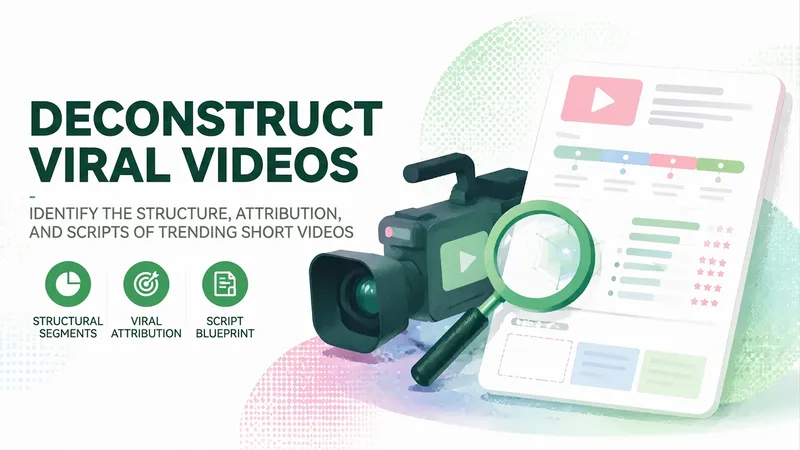 Research
Viral Video Breakdown
Turn a popular short video into clear, learnable, and practical content methods. Whether you provide a link from Douyin, WeChat Channels, YouTube, Xiaohongshu, or another platform, a local video, screenshots, or existing dialogue and descriptions, the analysis reconstructs the material needed to examine the video itself. It also marks information that is complete or missing, so guesses are not mistaken for facts. The report includes a video profile, a time-coded transcript, structural sections, and audiovisual techniques. It further explains why the video holds viewers' attention and where it loses momentum in the middle or focus at the end. Content attribution distinguishes replicable topic and presentation methods from external factors such as account history, posting time, and platform environment. Six-dimensional scoring uses timecodes, public data, or comment evidence to evaluate hook strength, structural strength, information value, emotional tension, communication, and reach—while clearly identifying weaknesses. You will receive a Markdown breakdown report for content planning and short-video creation. It includes transferable strategies, risks that make direct imitation unsuitable, and a fill-in-the-blank script framework that can be used with replacement topics, helping you move from understanding a viral video to deciding how to shoot your next one.
 Write
Hit Script Breakdown and Scoring
Organize short video links, spoken scripts, or image text into analyzable content profiles while restoring the original text, platform, word count, speaking rate, and estimated duration. Whether for Douyin, Kuaishou, Xiaohongshu, Channels, Bilibili, or YouTube, it identifies e-commerce, science popularization, storytelling, tutorial, emotional, or paid knowledge types based on specific signals in the script. When the original text is unavailable, it explicitly states so without guessing based on titles or covers. On this basis, the Skill breaks down short video structures across five stages: hook, setup, core, pivot, and CTA. It diagnoses the function of each segment, the performance of key seconds, and structural order. It scores dimensions such as hook strength, information density, emotional tension, and action guidance, providing clear score deduction reasons and actionable improvement steps. Compliance screening flags risks such as absolute expressions, false promises, earnings and efficacy claims, and private traffic redirection, while offering directly replaceable wording. When script revision is needed, it generates 15-second, 30-second, and 60-second spoken versions tailored to different video durations based on the original text, retaining core information and explaining compression trade-offs without inventing facts or promises. It supports batch comparison of multiple scripts, horizontal analysis of competing or reference drafts, and delivery in Markdown, JSON, CSV, and plain text. This makes it suitable for content operations, directors, media buyers, and independent creators to review hit content, conduct compliance checks, and revise scripts before shooting.

Game UA Creative Teardown
Analyze game user acquisition creatives, including Guangdiantong/Tencent Ads, from two perspectives: the seven-module emotional psychology framework and the four-part campaign diagnosis framework. First, complete a factual creative checklist and grade the evidence. Then analyze emotional psychology—first-three-second hook, emotional curve, closing call to action, monetization points, psychological needs, human insights, and iteration direction—before applying C-E-B-A labels and a seven-layer diagnosis to identify problems and turn them into campaign actions (targeting, bidding, and a promise-reduction SOP). The final output is a nine-section teardown report. Core principles: conclusions at the creative level must be supported by A-grade visual-frame evidence; dual-layer conclusions must be based on actual user experience; users brought in by the creative must not be treated as the game's true target audience; and the main text should use plain campaign-buying language.
Information
- Version
- v2
- Last updated
- Runtime credits
- Usage-based
- Models
- Auto
- Use cases
- Research & analysisMarketing & growthBusiness & strategy
- What you get
- ReportPlan
