
Six Degrees of Connection
Explore the link between two real people
Six Degrees of Connection
Explore the link between two real people
Showcase
Description
Enter the names of two real people. Using bidirectional research and timeline-overlap checks, the Skill finds the real interpersonal connection chain linking them through the fewest possible intermediaries. Each link includes a relationship-strength label (strong/medium/weak) and verifiable sources. It first provides copy for review; after you approve it, the Skill generates a vertical, shareable long image. If the chain cannot be completed within six degrees, it does not force a match—it honestly reports the fewest number of links found and explains that the six-degree limit was exceeded. If you enter a legendary, mythical, or fictional figure, such as He Xiangu or Sun Wukong, it does not run a connection search or create an image; instead, it produces an explanatory document labeled “Not a Six-Degrees Chain.” For cross-country pairings, three additional rules apply: first anchor each person to their original-language name to avoid transliteration differences being mistaken for two people; remove links based solely on written media; and exclude circulating anecdotes that appear only in commemorative articles. The image-generation stage follows version-control rules: for text-heavy images, it prioritizes a text-free background plus a separate text layer to avoid typos, and saves only the final proofread version to the canvas—not discarded drafts.
Recommended by
Shuting@YouMind
Why we love this skill
Identity anchoring, timeline checks, and source gates trace the shortest chain between real people while excluding rumors and media-only links before creating a proofread infographic.
Best for
For users who want to document the verifiable connection between two real people and create a shareable image after reviewing the copy.
How to use this Skill
Provide your input
Enter the names of two people; you may add their era, field, or preferred type of connection. Be as specific as possible.
Run the Skill
The system verifies identities and public sources, organizes a sourced chain of personal connections, and flags uncertain details. After you approve the copy, it can generate a vertical shareable image.
Review your result
First, review the relationship-chain copy; after approval, receive a final, proofread vertical image with accompanying text. Legendary or fictional figures do not produce a relationship-chain image.
Related Skills
View all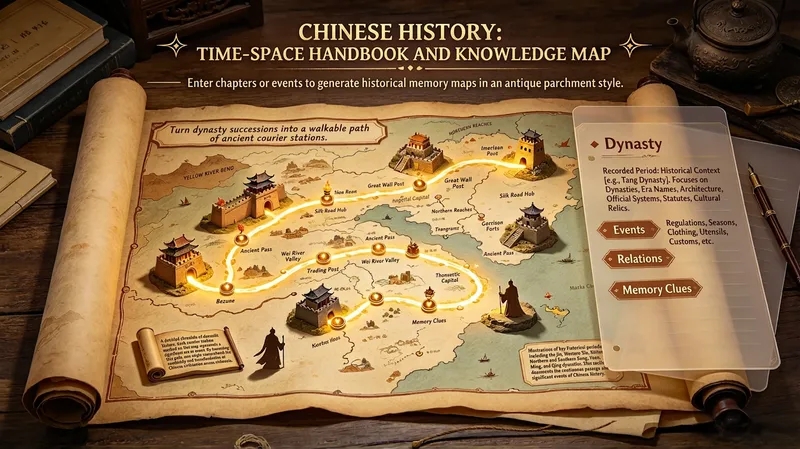 Image
China History · Time & Map
Post-road format: Turn the timeline into a route of “post road—stations—passes,” with each dynasty as a city and each major transformation as a pass. Ancient and modern place names: Automatically label historical and present-day names (such as Chang'an → Xi'an, Lin'an → Hangzhou, and Jianye → Nanjing), showing both names on the map. Automatic fact-checking: Detect reign-title errors, mixed imperial temple and posthumous titles, reversed dynastic order, and misidentified figures. Correct errors before drawing the map. Longitudinal threads for institutional change: Trace systems such as civil service selection, taxation, and central government offices as standalone lines for cross-dynasty comparison without mixing their contexts. Character relationship map: Turn key figures into “travel companions,” with their factions, positions, and rivalries, helping solve the problem of forgetting names. Layered exam-point output: Separate recall-level content (dates, people, and places) from comprehension-level content (causes, effects, and comparisons), with mnemonics or comparison tables. Image-text cross-checking: The image handles routes and landmarks, while the text handles dates and conclusions. Neither repeats nor depends on the other. Multiple versions: Choose among three information-density levels: middle school general history, high school curriculum outline, or advanced preparation for graduate entrance and civil service exams. Recommended prompts Draw “the establishment and consolidation of unified Qin and Han rule” as a parchment map in an itinerary-on-the-post-road style. Turn “the evolution of ancient Chinese civil service selection systems” into a longitudinal institutional-change chart with a comparison table. Draw an ink-wash handscroll of “the Silk Road and Tang foreign relations,” with ancient and modern place names. Help me organize “the strengthening of autocratic monarchy in the Ming and Qing dynasties” at the high school curriculum-outline level, with a mnemonic.
 Image
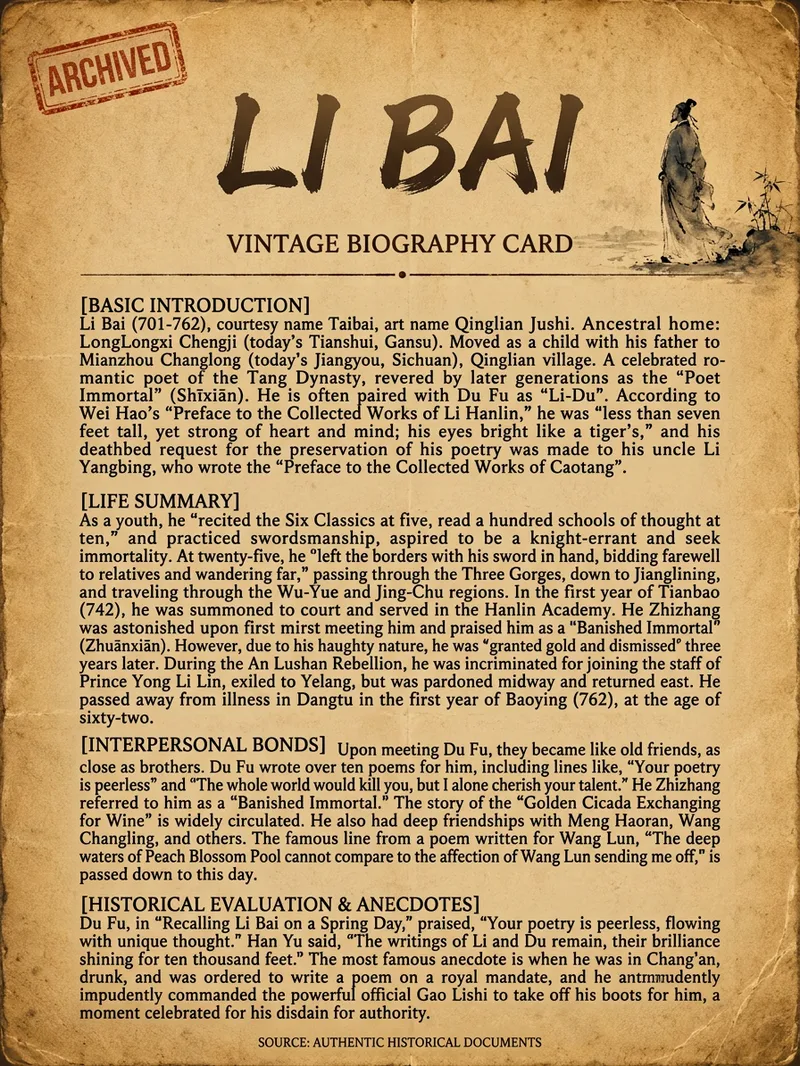
Create Vintage Biography Cards
Enter the name of any historical figure or celebrity, and xiaoxiaodong will research reliable historical sources online to create a finished 3:4 portrait biography card with an aged kraft-paper texture. The body uses a coherent, flowing paragraph layout (large name heading → basic introduction → brief life story → personal connections → historical assessment and anecdotes), like an inner page from an old book, ready to save and share. It firmly avoids line charts, progress bars, pie charts, radar charts, and all other charts; when historical sources are unavailable, it truthfully notes “Not recorded in historical sources” and never fabricates years or evaluations.
Information
- Version
- v6
- Last updated
- Runtime credits
- Usage-based
- Models
- Auto
- Use cases
- Writing & contentImages & designResearch & analysis
- What you get
- DocumentImageSocial post
- Visual styles
- MinimalistInk washPrintmaking
