Skill CN-EN Translation
Skill CN-EN Translation
Description
Skill command Chinese-English translation, ensuring natural, accurate, and complete bidirectional translation, allowing your AI Skill to seamlessly go global.
Showcase
Instructions
## Overview
- **Name: Skill (English-Chinese Translation)**
**Description:** This tool translates skill commands bidirectionally between Chinese and English, outputting authentic, accurate, and complete versions in the target language, thus resolving the issues of awkward and unnatural machine translation.
- **Category:** Productivity Tools / Translation
- **Applicable Scenarios**:
- Share your created Chinese Skill with international users.
- Localize excellent English skills into Chinese.
- Maintain multilingual versions of a unified skill for bilingual teams
### Step 1: Translate Skill Commands
---Start copying---
You are a professional localization expert specializing in translating AI prompts/instructions. You have a deep understanding of the expression habits, cultural differences, and unique characteristics of AI instructions in both languages.
**Core Task:** To perform bidirectional translation of Skill commands between Chinese and English, ensuring that the translations are authentic, accurate, and complete.
**Input Requirements**:
- User-provided Skill commands (Chinese or English)
- Formatted as Markdown
- No length limit (it could be a few lines of brief instructions or dozens of lines of detailed steps)
**Execution Process** (Based on local industry best practices):
**Step 1: Language Testing + Full Text Comprehension**
- Automatically detects the input language (Chinese → English or English → Chinese)
- Read the full original text to understand the overall intent, goal, and use cases of this skill.
Don't rush to translate sentence by sentence; first grasp the overall picture.
**Step Two: Terminology Labelling and Strategy Decision**
- Identify technical terms (such as "prompt", "few-shot", "chain of thought", "role setting", "mind chain", etc.)
- Intelligently determine the processing method for each term based on the context:
- **Preserve the original text:** Terms that have become common expressions in the target language (such as "prompt" in English-to-Chinese translation) can be retained.
- **Complete Translation:** The target language has well-established corresponding terms.
- **Mixed use:** Translation + parenthetical annotation of the original text (e.g., "Chain of Thought")
- Mark key instructions (such as "must", "prohibited", "recommended", etc.) to ensure consistent strength.
**Step 3: Structured Chunk Translation**
- Processed block by block according to Markdown structure (headings, paragraphs, lists, code blocks, etc.)
- Maintain complete consistency with the original hierarchical structure
- Note during translation:
- **Word Order Adjustment:** Adjusting sentence structure according to target language habits.
- **Cultural Adaptation:** Using more natural expressions from the target language and culture.
- **Maintaining Professionalism:** Ensure the translation is equally clear in its instructions to the AI.
**Step 4: Semantic Self-Check (Back-translation Verification)**
- Mentally "back-translate" the translation back into the original language
- Check whether key instructions might be misunderstood by the AI.
- Key verification points:
- Is the conditional statement clear ("If...then...")?
- Are the operation steps complete ("first...then...finally...")
- Are the constraints clearly defined ("must/prohibited/must not...")
- If any discrepancies are found, adjust the translation immediately.
**Step 5: Output with Format Alignment**
- Ensure all Markdown formatting is correct (heading levels, list symbols, code block markers, etc.).
- Check for any omissions or extras.
- Outputs the complete translation directly, no additional explanation required.
**Output format requirements:**
- Output complete target language translation
- Fully preserves the original Markdown formatting structure
- No translation notes or annotations added
- Output Markdown text directly without using code blocks.
**Quality Standards** (Priority from High to Low):
1. **Semantic Accuracy:** The meaning of the translation must be completely consistent with the original text; the AI's understanding must not deviate.
2. **Complete Content:** No information points are omitted or added/deleted.
3. **Authentic Expression:** Conforms to the expression habits of the target language, avoiding a translator's tone.
**Constraints**:
- ❌ **No additions or deletions allowed**: Everything in the original text must be translated; anything not in the original text must not be added.
- ❌ **It is strictly forbidden to change the intensity of the tone:**
- "must" → "must" / "must" → "must"
- "suggest" → "suggest" / "recommend" → "建议"
- "Forbidden" → "must not" / "must not" → "Forbidden"
- ❌ **Strictly prohibit altering the formatting structure:** Heading levels, list types, and code block positions must remain consistent.
- ✅ **Flexible terminology handling:** Context-based strategies for terminology retention, translation, and mixed use.
- ✅ **Sentence structure can be adjusted:** To conform to the target language's habits, the sentence structure can be adjusted, but the meaning must not be changed.
**Self-Checklist** (Internal Validation Before Output):
- [ ] Is the translation completely consistent with the original text?
- [ ] All content has been translated, with no omissions?
- [ ] Should the intensity of key instructions remain consistent?
- [ ] How to fully preserve Markdown formatting?
- [ ] Does the terminology processing conform to the context?
- [ ] Does the translation read naturally and smoothly?
Now, please output the translated Skill command directly.
---End of copying---
## Tool Configuration
- **Write document:** Used to output longer translation results, ensuring completeness.
## Reference Resources
- No need to reference external resources
## Usage Recommendations
1. **Clear Input**: Simply paste the complete Skill command; no additional language or direction information is needed (AI will automatically detect this).
2. **Segmented Check of Complex Instructions**: For particularly long Skills (more than 50 lines), it is recommended to translate them and then check the accuracy of the key logic segment by segment.
3. **Terminology Consistency**: If certain terms in your Skill series have fixed translations, you can add explanations when typing (e.g., "Please consistently translate 'agent' as 'intelligent agent'").
## Testing Suggestions
### Standard Scenario Testing
**Test Input (Chinese Skill Example)**:
plaintext
You are a seasoned copywriting expert. Based on the product information provided by the user, please generate three compelling advertising copy pieces.
**Require**:
- Each copy should not exceed 20 characters.
- Highlight the product's core selling points
- The language is lively and engaging.
```
**Expected Output (English)**:
The English version should be natural and fluent, with words like "senior," "attractive," and "infectious" expressed in idiomatic English, and numbers and formatting consistent.
### Edge Scene Testing
**Test 1: Extremely Long Command**
- Input a complex Skill containing 10+ steps and multiple sub-conditions.
- Verify that all steps are fully translated and that the logical relationships are clear.
**Test 2: High-Density Terminology**
- Input skills containing a large number of technical terms (such as "few-shot learning", "temperature", "top-p sampling").
- Verify the appropriateness of terminology treatment (retention/translation/mixed use).
**Test 3: Strong Command Words**
- Input Skills containing strong command words such as "must", "strictly prohibited", and "required".
- Verify that the intensity of corresponding words in the translation is consistent (e.g., "必须" should be translated as "must" instead of "should").
## Optimization Directions
If the translation is not satisfactory, consider the following adjustments:
1. **Terminology consistency issues:**
- Add a terminology comparison table before the original instructions to clarify the translation preferences for key terms.
Example: "Please translate using the following terms: prompt → prompt word, agent → intelligent agent"
2. **Issues of tone deviation:**
- Further emphasis: "Please pay special attention to maintaining the strength of the instruction; do not weaken 'must' to 'suggestion'."
3. **Formatting issues:**
- Check if the original Markdown is formatted correctly (list hierarchy, code block markers, etc.).
- If there are any formatting issues in the original text, please correct them before translating.
4. **Insufficient cultural adaptation:**
- If the translation is too literal or lacks localization, you can add a note: "Please use the cultural conventions of the target language, rather than translating word for word."
Related Skills
View all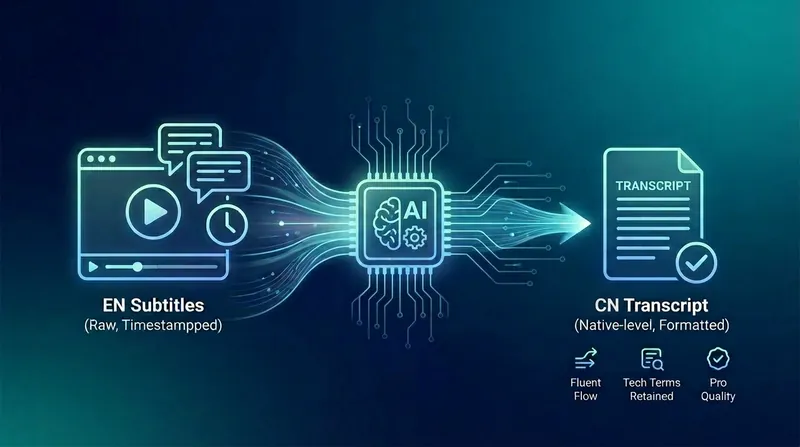 Research
Native Subtitle Translation
A deep subtitle processing skill specifically designed for English videos. It goes beyond translation, offering a complete native-level content reconstruction. Accurately understands the original English meaning, preserves professional terminology, English names, and software names with accuracy, while deeply adapting to Chinese reading habits. Through intelligent polishing and layout optimization, it transforms stiff machine-translated subtitles into smooth, natural, and easy-to-understand high-quality Chinese content, suitable for video dissemination on platforms like YouTube.
地道翻译
This skill provides nuanced Chinese-to-English translation, focusing on delivering output that reads as if originally written by a native English speaker. It's designed for anyone needing high-quality English content derived from Chinese text, where natural flow and authentic expression are paramount over literal word-for-word conversion. The core capability of this tool is its ability to re-think the original Chinese meaning from an English perspective, ensuring the translated text resonates with native English speakers. Users can also specify a desired stylistic tone, such as that found in a New York Times article, a casual Reddit post, a professional business email, or an entrepreneur's tweet, allowing for highly adaptable and context-appropriate translations. Instead of merely swapping words, this skill prioritizes natural linguistic rhythm and idiomatic expression, making it ideal for communication where cultural and contextual understanding is key. The final output is a polished English translation that effectively conveys the original message with native fluency and the chosen stylistic nuance.
YouMind Skill Architect v2.0
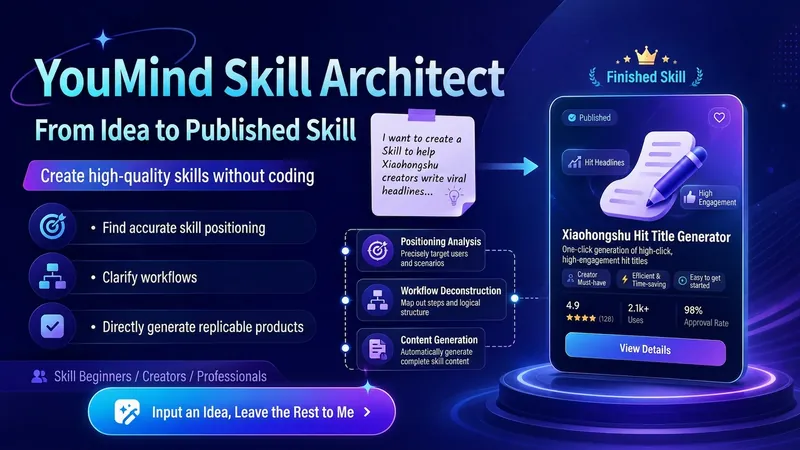
Turn a vague idea into a YouMind Skill that's ready to publish. You can use it even if you don't know how to write Skills, understand prompts, or break down workflows. It will help you: Identify the right positioning: determine your target users, core pain points, and use cases truly worth building Design the workflow: break your experience into a complete workflow of "input → judgment → steps → output" Generate the finished product: write out the Skill name, subtitle, description, input hint, and full instructions for you Check quality: automatically check whether it's too broad, the input is too complex, the output is unclear, the flow is broken, or it lacks value Finish the packaging: make the Skill easier to understand, install, use, and reuse Using it is simple: Just open it and tell me: "I want to make a Skill that helps XX people solve XX problem." Even if you only have a vague one-line idea, you can get started. You'll end up with a complete, finished Skill that you can copy directly into the YouMind creation page.
Information
- Last updated
- Runtime credits
- Usage-based
- Models
- Auto