
Teacher Essay Polisher
Shape drafts into ~3,000-word essays
Teacher Essay Polisher
Shape drafts into ~3,000-word essays
Showcase
Description
Turn an uploaded first draft of a teacher essay—which may also be teaching notes, fragments, or scattered thoughts—into a high-quality teacher essay of about 3,000 words, ready to publish or submit. It first identifies the draft’s true core, rebuilds its throughline and structure, turns abstract reflections into concrete classroom scenes and details, establishes the author’s own judgment and voice, removes AI-sounding phrasing and formulaic “education feel-good” clichés line by line, and delivers a complete manuscript with a summary of the main revisions. Ideal for frontline teachers organizing teaching stories, educational reflections, teacher-student records, and professional insights.
Recommended by
淡苍
Why we love this skill
Goes beyond copyediting to uncover compelling classroom moments, rebuild the narrative, preserve the teacher’s authentic voice and uncertainty, remove vague platitudes and AI-sounding language, and shape a publishable essay of roughly 3,000 words.
Related Skills
View all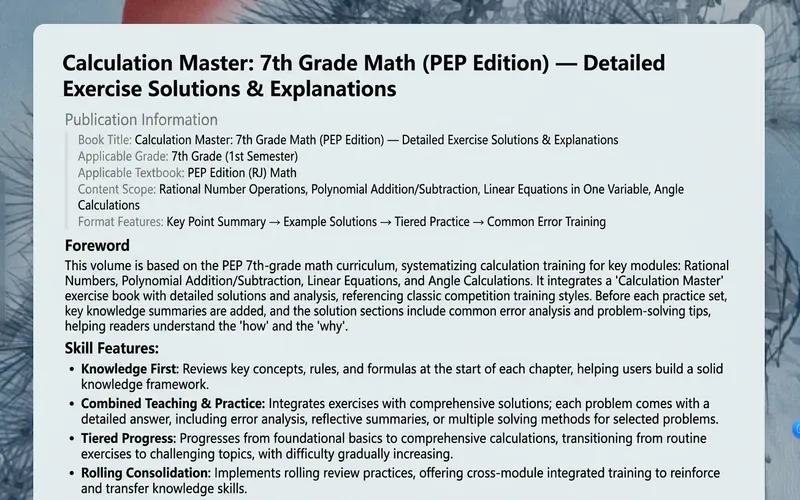
Publishing Skill
Transform scattered exercises, answers, handouts, and teaching notes into a well-structured, publication-ready supplementary book. This is not 'AI organizing your documents'. It is a five-step publishing-grade workflow: Data inventory and multi-source reading → Target book style analysis → Content integration and structure design → Chapter-by-chapter writing → Full book quality check and delivery. Each step involves professional judgment, not a one-time prompt generation. Core capabilities: • Multi-source data integration: Extract exercises, answers, knowledge points, and teaching sections from PDFs, images, and documents. Identify their relationships (which is the question, which is the answer, which is the style reference) and reorganize them into a complete book. • Internalized supplementary book structure: Built-in typical organization logic—knowledge point review → typical example explanation → leveled practice → answer key with detailed solutions → error analysis/reflection summary/guidance/multiple solution methods → rolling review. • Formula repair: Mathematical formulas extracted from PDFs may become garbled. The skill infers the original expression from context and rewrites it in standard LaTeX. This is one of the most painful parts of publishing supplementary books. • Question-answer matching and merging: Automatically match exercises and answers scattered across different files. Supports two organization modes: integrated instruction and practice, or separate question and answer sections. • Publication-grade structure: Output includes title page, preface, table of contents, chapter-by-chapter text (knowledge points + practice + detailed solutions + teaching sections), and afterword. Use cases: - Middle school math teachers organize years of accumulated exercise handouts into formal supplementary books. - Supplementary book authors/editors quickly integrate scattered materials into a manuscript. - Training institution internal handouts upgraded to standardized publications. Upload your materials, tell it the positioning of the target book, and let it handle the rest. The output is a high-quality Markdown manuscript, including preface, table of contents, chapter-by-chapter content, detailed solutions, and explanations.
90-Hour Training Reflection
Transform training PPTs and lecture notes into a 90-hour training reflection with theoretical depth, personal reflection, and ready-to-submit quality. This is not "AI writing reflections for you." It is a professional two-step confirmation workflow: first, systematically extract each expert's core theory, key viewpoints, typical cases, and memorable quotes from the training materials, generating a structured summary for your confirmation—only after you confirm does it proceed to writing. The theoretical framework names must remain consistent with the original materials and cannot be fabricated. Core capabilities: • Accurate extraction of expert viewpoints: Read each PPT/PDF/Word/image file individually, extract core theoretical frameworks, 2–3 key statements, typical cases, and memorable quotes by expert, not superficial generalization. • Analysis of inter-theory connections: Identify internal correspondences between different experts' viewpoints (e.g., the correspondence between Bloom's cognitive taxonomy and the three levels of knowledge, ability, and competency), demonstrating systematic understanding—this is the key to distinguishing a deep reflection from a mere record. • Practice transformation section: Select specific teaching units, integrate training theory into assignment design practice, and generate conversion cases from training to classroom—this is the part that reviewers value most. • Complete five-part structure: Training overview and overall feelings → Expert-specific reflections → Internal connections between theories → From training to practice → Reflection and outlook, 3,000–6,000 words. • Reflective writing style: First-person, interweaving theory with personal teaching experience, language with warmth, avoiding empty clichés and slogans. • Word format download: Simultaneously generates a Word download tool, allowing one-click export of a directly submittable document. Applicable scenarios: - Reflection essay writing for middle school math teachers after completing 90-hour training - Reflective article writing for teacher professional development training - Any scenario that requires extracting theory from training materials and transforming it into practical reflection Upload your training materials, confirm the extracted expert viewpoints, and it will generate a complete, well-grounded, and deeply reflective reflection document, along with a Word download tool.
AI Textbook Quality Inspector
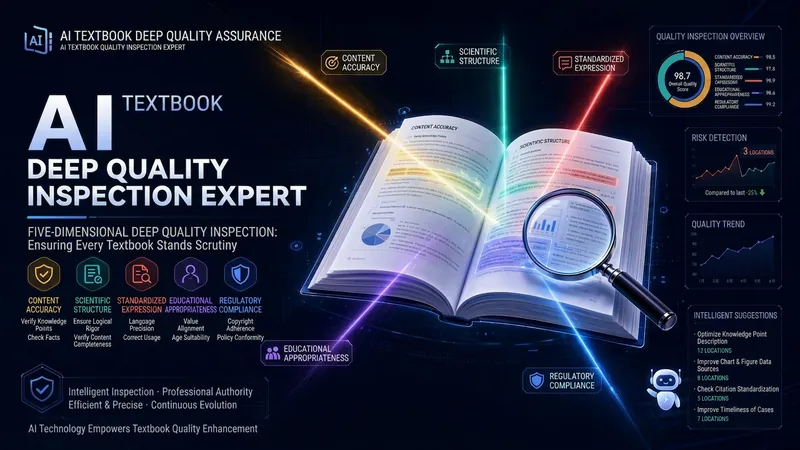
📚 AI Textbook Quality Inspector — Five-dimensional scan to make AI-written textbooks withstand review Textbooks written with AI assistance suffer from five common problems: hard-to-detect knowledge errors, instructional design lacking classroom feel, excessive 'correct but empty' statements, templated writing that feels robotic, and obscure language that makes students give up reading. This system performs a five-dimensional in-depth quality check chapter by chapter, examining each chapter from the perspectives of four roles: subject matter expert, instructional designer, fact-checker, and style reviewer. It outputs quantitative scores and directly replaceable modification suggestions. Five Dimensions: 📐 Knowledge Accuracy — Trace and correct concepts, models, and data one by one, with each error annotated with a source 🎯 Instructional Design — Review difficulty curve, prerequisite preparation, and chapter connections like a seasoned teacher 💎 Content Substantiveness — Expose 'correct but empty' statements, calculate real information gain per section 🤖 AI-Flavor Detection — Textbook-specific standards to distinguish normal writing from AI template patterns 📖 Readability — Paragraph rhythm, term density, assess whether students can read smoothly Highlight Features: 🔗 Cross-Chapter Consistency — Automatically generate knowledge profile, detect conceptual contradictions, inconsistent terminology, and duplicate definitions 🔄 Closed-Loop Iteration — After revision, resubmit and automatically track improvements, remaining issues, and new problems 📊 Layered Report — First see overview score + top 3 issues, then expand section-by-section analysis as needed 🎤 Sharp Commentary — No sugarcoating; if a definition is wrong, it says so bluntly, with each criticism accompanied by a revision reference Applicable to: AI-assisted undergraduate and graduate textbooks, academic monographs, and course handouts. Current version is optimized for undergraduate textbooks, but also works for graduate textbooks. Paste chapter → Get score → Make targeted revisions → Re-test until quality passes.
Information
- Version
- v2
- Last updated
- Runtime credits
- Usage-based
- Models
- Auto
- Use cases
- Writing & contentLearning & education
- What you get
- ArticleBrief