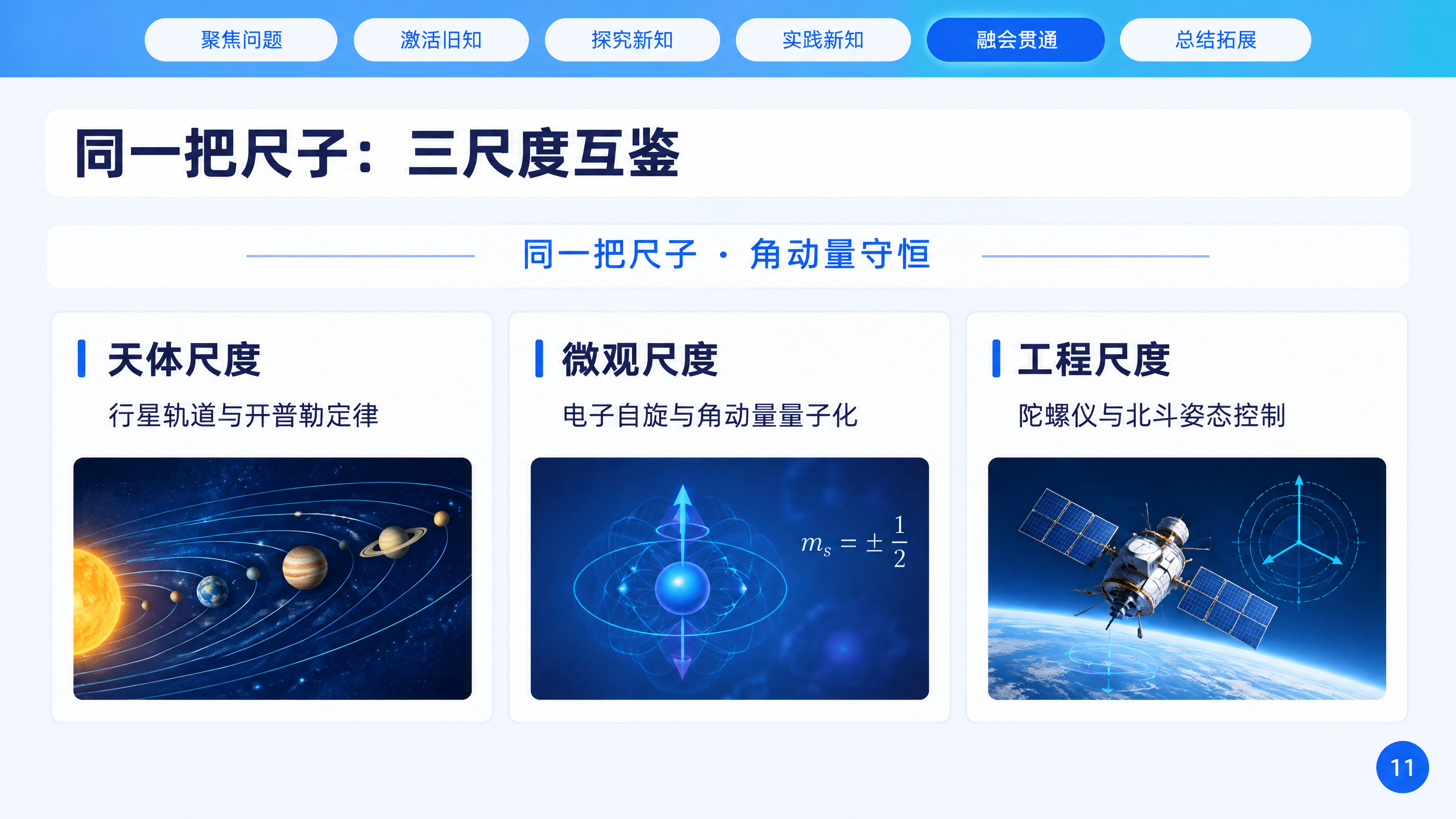
Top Teaching Competition PPT
Build competition-ready PPTs and supporting copy
Description
Turn teaching designs, lecture notes, and course keywords into a complete, image-rich PPT and supporting copy ready for competition use. The workflow automatically switches between two tracks: application track = light background + five-dimensional real-world panoramic visuals; teaching-demo track = blue gradient + six-stage navigation bar. Follow an end-to-end pipeline from “information extraction card” → “two-track selection” → “narrative outline” → “acceptance gate” → “page visuals” → “Slides assembly” → “supporting copy,” with clean light backgrounds, restrained text, fully realistic scenes, and traceable data.
Related Skills
View all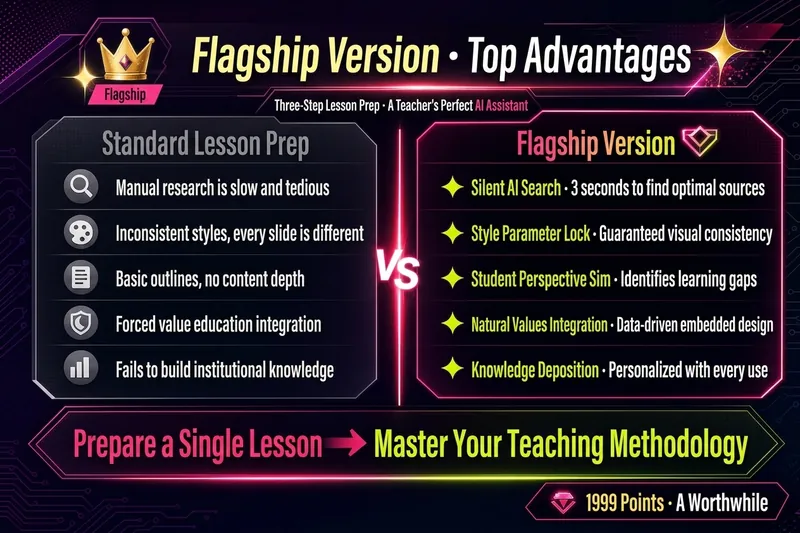 Research
Flagship 3-Step Lesson Planner
🔥【Back-to-School Limited-Time Offer】1,599 points from August 27 to September 5 (regularly 1,999)! Start the new semester with a contest-ready lesson-prep package. 【Generate Five Lesson-Prep Essentials at Once】 🖥 PPT (polished contest version / lightweight everyday version) · 📝 Word-for-word teaching script and lesson plan (with complete teacher prompts—just follow along) · 🎯 Activity design · Board work · In-class practice exercises 【Why “Contest-Level” Quality?】 This Skill includes a library of teaching-design patterns from top-quality and model lessons nationwide, covering mainstream contest approaches such as contextual introductions, task-based learning, question chains, and flipped classrooms. It also incorporates professional frameworks including Bloom’s taxonomy, the ADDIE model, and Understanding by Design (UbD). Every lesson is checked against these methodologies rather than being a simple pileup of content. 【Flagship Edition Upgrades】—Designed with high-quality lessons in mind ✨ Hybrid questionnaire: Select options and enter details freely to complete information collection in 30 seconds ✨ Parameter lock: Course information and PPT style are locked in the first step, with no drift in later generation ✨ Real interactive confirmation: Clickable options for outline confirmation and five-piece selection enable personalized customization ✨ Dual-mode PPT: Smart switching between contest presentation and everyday teaching modes ✨ Closed-loop post-lesson reflection: Questionnaire collection → AI-generated reflection → Board Memory stores your dedicated teaching profile ✨ Controlled costs: Cost expectations are stated before generation; choose between a fully illustrated polished version and a lightweight outline version, with no overproduction or automatic upgrades 【Three-Step Process】 ① Collect information → Two rounds of interactive questionnaires + parameter lock ② Confirm the outline → AI provides the teaching framework first; generation begins after you confirm ③ Visual delivery → Generate the five-piece set all at once: PPT + word-for-word script / contest-standard lesson plan + activity design + board work + practice exercises, with flexible combinations 【Pricing】 1,599 points (back-to-school limited-time offer; regularly 1,999)—the price of a cup of coffee in exchange for freedom from daily lesson-prep stress. · Generate the complete five-piece set in one use · Cut lesson preparation from about 4 hours to about 1 hour · Generate contest lesson plans directly · Teach everyday classes with ready-to-use materials · Iterated through use by 45 teachers, saving more than 200 hours of lesson-prep time in total 💡 Suitable for: All grade levels from kindergarten through university, and all subjects including language arts, math, English, physics, chemistry, biology, history, geography, civics, arts, and physical education. Suitable for everyday teaching, contest presentations, and open classes. ⚠️ Review and revise AI-generated content based on your textbook edition, school requirements, and students’ actual learning needs. Teachers’ professional judgment should have the final say. 📩 Feedback and suggestions: 593975647@qq.com. Feedback comes with a little surprise 🎁~
Course Design Assistant v7.0
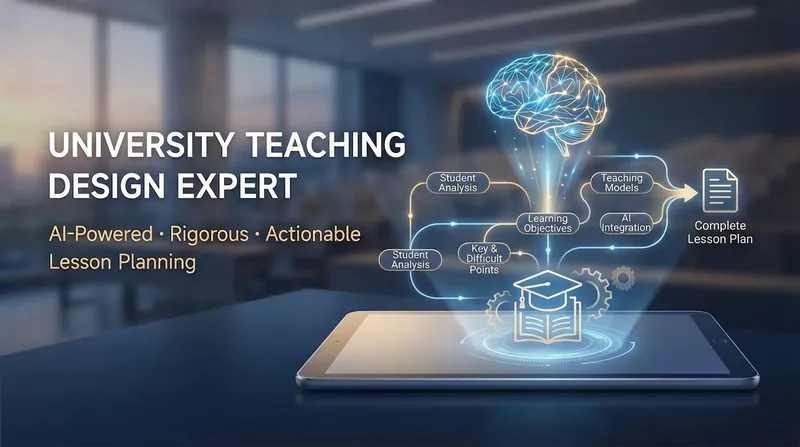
💡 What can this assistant do for you? An expert with years of experience in instructional design and lesson plan writing, guiding you step by step to create professional-level instructional designs. (Offline training valued at least ¥3000 per session.) 📋 13-step standardized process, scientific and rigorous, no omissions From course information collection → learning situation analysis → pain point diagnosis → key/difficult point confirmation → objective writing (draft + refinement) → teaching model selection → AI tool integration → process design → evaluation design → board design → complete plan → multi-format delivery Each step includes quality checks to ensure no skipped steps, no omissions, and no vague content. 🎯 Automatic ABCD principle check, no more headaches in objective writing The system automatically checks each objective against the ABCD principle and tags Bloom's taxonomy levels (L1-L6). 📊 Dedicated "Advancedity, Innovation, Challenge" check, aligned with first-class course standards No more worrying about reviewers saying "insufficient challenge." The system quantifies the check for you. 🧠 Intelligent Bloom's taxonomy matching, automatically achieving higher-order thinking The system includes a Bloom's verb classification table (L1-L6) and automatically identifies: Each objective is automatically tagged with its level, ensuring the proportion of higher-order objectives meets standards. 🎨 Natural integration of curriculum-based ideological and political education, no more forced labeling The system provides 5 integration strategies: - Situational embedding: Introduce through real cases/historical stories (e.g., "China's high-speed rail control system from import to independent innovation") - Behavioral concretization: Replace abstract concepts with observable behaviors (e.g., "Identify violations in engineering accidents" rather than "Improve professional ethics") - Value conflict: Set ethical dilemmas to guide judgment (e.g., "Economic benefits vs. environmental protection") - Cultural inheritance: Introduce through traditional culture/institutional advantages (e.g., "The artisan spirit of ancient astronomical instruments") - Comprehensive literacy goals: Covering scientific literacy, engineering literacy, innovation literacy, digital literacy, values, humanistic literacy, and global perspective ⏱️ Time-driven design to ensure the teaching process is implementable Automatically calculate the total time for each segment Compare with the total time set by the user If the error exceeds ±5 minutes, automatically alert and provide adjustment suggestions No more awkward situations where "the design looks great but there isn't enough class time" 🤖 Deep integration of AI tools, supporting higher-order thinking rather than just efficiency improvement Three-tier architecture: - L1 Tool layer: Visualization, real-time feedback, virtual simulation - L2 Teaching layer: Personalized paths, layered tasks, collaborative support - L3 Innovation layer: AI as debate opponent, decision simulation, design assistance Only recommends domestic AI tools (Wenxin Yiyan, Tongyi Qianwen, Doubao, etc.), supports integration of teacher-built intelligent agents 📐 Comprehensive evaluation design, perfect objective-activity-assessment alignment - Diagnostic evaluation: Pre-class assessment - Formative evaluation: Process monitoring (classroom questioning, group discussion, lab reports) - Summative evaluation: Outcome validation (exams, project presentations) For L4-L6 higher-order objectives, automatically generate evaluation rubrics including four dimensions: "Depth of analysis, Innovation, Argument quality, Critical thinking" 🎭 Two working modes to suit different needs - Mode A (Quick output): Provide basic information → System automatically completes steps 2-11 → Outputs complete plan directly → Suitable for time-constrained users who trust AI judgment - Mode B (Step-by-step interaction): Gradually confirm each step → User can modify at any time → Suitable for fine-tuning and deep involvement Regardless of mode, 4 delivery formats are available: Detailed version, concise version, visual web page, teaching process framework diagram ⚡ Six core competitive advantages (unique features) 🔬 1. Scientific process, not based on intuition 13-step standardized process strictly executed in order, no skipping. Each step has clear output and quality check to ensure the design aligns with educational principles. 📊 2. Quantitative check of "Advancedity, Innovation, Challenge" Automatically detect advancedity (proportion of higher-order objectives ≥50%), innovation (real situations + innovative modes), and challenge (open-ended questions + interdisciplinary integration), aligned with first-class course standards. 🎯 3. Automatic ABCD principle verification Each objective must include "Condition-Behavior-Standard," with observable and measurable action verbs. The system automatically checks and tags Bloom's levels. 🧠 4. Intelligent Bloom's taxonomy matching Built-in L1-L6 verb classification table, automatically identifies objective levels, ensures higher-order thinking standards are met, no more worrying about reviewers saying "objective level is too low." ⏱️ 5. Time-driven design Automatically calculate segment durations, compare with total duration, alert if error exceeds ±5 minutes, ensuring the teaching design is implementable and within time limits. 📐 6. Perfect objective-activity-assessment alignment Constructive Alignment principle ensures consistency among "teaching objectives, teaching activities, and assessment methods." Each objective has corresponding activities and evaluations. 🎯 Applicable scenarios (covering all higher education) ✅ Teaching competitions: Teaching innovation competitions, young teacher teaching competitions, classroom teaching contests ✅ Course construction: First-class course applications, curriculum-based ideological and political demonstration courses, blended course design ✅ Daily teaching: New lesson preparation, teaching reform, teaching model innovation ✅ Teaching evaluation: Peer review, supervisory observation, teaching quality assessment ✅ Teacher development: New teacher training, teaching ability enhancement, teaching research 🚀 User experience Quick mode (Mode A): Provide course name, chapter, major, class hours → Select Mode A → System automatically completes 13-step process → Get complete teaching design in 30 minutes → Choose delivery format (detailed/concise/visual web page/framework diagram) Detailed mode (Mode B): Provide basic information → Select Mode B → Gradually confirm learning situation analysis, pain point diagnosis, key/difficult points, teaching objectives, teaching model, AI tools, teaching process, evaluation design, board design → Modify at each step → Complete high-quality teaching design in 1-2 hours Review mode: Upload existing teaching design → System evaluates step by step against all elements → Summarize three strengths and three weaknesses → Provide specific and actionable optimization suggestions → Generate a standardized and well-formatted evaluation report document
 Research
Teaching Innovation Prep Guide
Whether you are a university teacher participating for the first time, or you want to enhance the competitiveness of your existing courses, this preparation guide can help you stand out in the Teaching Innovation Competition. It will serve as your personal coaching partner, providing full-process support from analyzing the underlying logic of the competition to on-site presentation delivery. This guide is deeply anchored in the evaluation criteria and core methodology of the Teaching Innovation Competition, helping you correct common misunderstandings and understand that the essence of the competition is teaching academic research. You will get a personalized preparation path, whether you need systematic full-process guidance, want to optimize based on existing courses, or seek breakthroughs in a specific area, you can find the most suitable plan. From sorting out course foundations and identifying teaching pain points, to designing innovative measures and refining teaching effectiveness, the guide will lead you step by step. It not only helps you write high-quality course descriptions, teaching objectives, and innovation reports, but also provides practical guidance on key aspects such as classroom recording and PPT creation. Every critical decision is supported by rigorous evidence and professional advice, ensuring your materials are logical and persuasive. Finally, through consistency verification of the three materials and alignment check with grading criteria, it ensures that all your competition materials meet high standards, effectively avoiding empty statements, and presenting your teaching achievements in the most professional and impactful way.
Top Teaching Competition PPT
Build competition-ready PPTs and supporting copy
Description
Turn teaching designs, lecture notes, and course keywords into a complete, image-rich PPT and supporting copy ready for competition use. The workflow automatically switches between two tracks: application track = light background + five-dimensional real-world panoramic visuals; teaching-demo track = blue gradient + six-stage navigation bar. Follow an end-to-end pipeline from “information extraction card” → “two-track selection” → “narrative outline” → “acceptance gate” → “page visuals” → “Slides assembly” → “supporting copy,” with clean light backgrounds, restrained text, fully realistic scenes, and traceable data.
Related Skills
View allResearchFlagship 3-Step Lesson Planner
🔥【Back-to-School Limited-Time Offer】1,599 points from August 27 to September 5 (regularly 1,999)! Start the new semester with a contest-ready lesson-prep package. 【Generate Five Lesson-Prep Essentials at Once】 🖥 PPT (polished contest version / lightweight everyday version) · 📝 Word-for-word teaching script and lesson plan (with complete teacher prompts—just follow along) · 🎯 Activity design · Board work · In-class practice exercises 【Why “Contest-Level” Quality?】 This Skill includes a library of teaching-design patterns from top-quality and model lessons nationwide, covering mainstream contest approaches such as contextual introductions, task-based learning, question chains, and flipped classrooms. It also incorporates professional frameworks including Bloom’s taxonomy, the ADDIE model, and Understanding by Design (UbD). Every lesson is checked against these methodologies rather than being a simple pileup of content. 【Flagship Edition Upgrades】—Designed with high-quality lessons in mind ✨ Hybrid questionnaire: Select options and enter details freely to complete information collection in 30 seconds ✨ Parameter lock: Course information and PPT style are locked in the first step, with no drift in later generation ✨ Real interactive confirmation: Clickable options for outline confirmation and five-piece selection enable personalized customization ✨ Dual-mode PPT: Smart switching between contest presentation and everyday teaching modes ✨ Closed-loop post-lesson reflection: Questionnaire collection → AI-generated reflection → Board Memory stores your dedicated teaching profile ✨ Controlled costs: Cost expectations are stated before generation; choose between a fully illustrated polished version and a lightweight outline version, with no overproduction or automatic upgrades 【Three-Step Process】 ① Collect information → Two rounds of interactive questionnaires + parameter lock ② Confirm the outline → AI provides the teaching framework first; generation begins after you confirm ③ Visual delivery → Generate the five-piece set all at once: PPT + word-for-word script / contest-standard lesson plan + activity design + board work + practice exercises, with flexible combinations 【Pricing】 1,599 points (back-to-school limited-time offer; regularly 1,999)—the price of a cup of coffee in exchange for freedom from daily lesson-prep stress. · Generate the complete five-piece set in one use · Cut lesson preparation from about 4 hours to about 1 hour · Generate contest lesson plans directly · Teach everyday classes with ready-to-use materials · Iterated through use by 45 teachers, saving more than 200 hours of lesson-prep time in total 💡 Suitable for: All grade levels from kindergarten through university, and all subjects including language arts, math, English, physics, chemistry, biology, history, geography, civics, arts, and physical education. Suitable for everyday teaching, contest presentations, and open classes. ⚠️ Review and revise AI-generated content based on your textbook edition, school requirements, and students’ actual learning needs. Teachers’ professional judgment should have the final say. 📩 Feedback and suggestions: 593975647@qq.com. Feedback comes with a little surprise 🎁~
Course Design Assistant v7.0
💡 What can this assistant do for you? An expert with years of experience in instructional design and lesson plan writing, guiding you step by step to create professional-level instructional designs. (Offline training valued at least ¥3000 per session.) 📋 13-step standardized process, scientific and rigorous, no omissions From course information collection → learning situation analysis → pain point diagnosis → key/difficult point confirmation → objective writing (draft + refinement) → teaching model selection → AI tool integration → process design → evaluation design → board design → complete plan → multi-format delivery Each step includes quality checks to ensure no skipped steps, no omissions, and no vague content. 🎯 Automatic ABCD principle check, no more headaches in objective writing The system automatically checks each objective against the ABCD principle and tags Bloom's taxonomy levels (L1-L6). 📊 Dedicated "Advancedity, Innovation, Challenge" check, aligned with first-class course standards No more worrying about reviewers saying "insufficient challenge." The system quantifies the check for you. 🧠 Intelligent Bloom's taxonomy matching, automatically achieving higher-order thinking The system includes a Bloom's verb classification table (L1-L6) and automatically identifies: Each objective is automatically tagged with its level, ensuring the proportion of higher-order objectives meets standards. 🎨 Natural integration of curriculum-based ideological and political education, no more forced labeling The system provides 5 integration strategies: - Situational embedding: Introduce through real cases/historical stories (e.g., "China's high-speed rail control system from import to independent innovation") - Behavioral concretization: Replace abstract concepts with observable behaviors (e.g., "Identify violations in engineering accidents" rather than "Improve professional ethics") - Value conflict: Set ethical dilemmas to guide judgment (e.g., "Economic benefits vs. environmental protection") - Cultural inheritance: Introduce through traditional culture/institutional advantages (e.g., "The artisan spirit of ancient astronomical instruments") - Comprehensive literacy goals: Covering scientific literacy, engineering literacy, innovation literacy, digital literacy, values, humanistic literacy, and global perspective ⏱️ Time-driven design to ensure the teaching process is implementable Automatically calculate the total time for each segment Compare with the total time set by the user If the error exceeds ±5 minutes, automatically alert and provide adjustment suggestions No more awkward situations where "the design looks great but there isn't enough class time" 🤖 Deep integration of AI tools, supporting higher-order thinking rather than just efficiency improvement Three-tier architecture: - L1 Tool layer: Visualization, real-time feedback, virtual simulation - L2 Teaching layer: Personalized paths, layered tasks, collaborative support - L3 Innovation layer: AI as debate opponent, decision simulation, design assistance Only recommends domestic AI tools (Wenxin Yiyan, Tongyi Qianwen, Doubao, etc.), supports integration of teacher-built intelligent agents 📐 Comprehensive evaluation design, perfect objective-activity-assessment alignment - Diagnostic evaluation: Pre-class assessment - Formative evaluation: Process monitoring (classroom questioning, group discussion, lab reports) - Summative evaluation: Outcome validation (exams, project presentations) For L4-L6 higher-order objectives, automatically generate evaluation rubrics including four dimensions: "Depth of analysis, Innovation, Argument quality, Critical thinking" 🎭 Two working modes to suit different needs - Mode A (Quick output): Provide basic information → System automatically completes steps 2-11 → Outputs complete plan directly → Suitable for time-constrained users who trust AI judgment - Mode B (Step-by-step interaction): Gradually confirm each step → User can modify at any time → Suitable for fine-tuning and deep involvement Regardless of mode, 4 delivery formats are available: Detailed version, concise version, visual web page, teaching process framework diagram ⚡ Six core competitive advantages (unique features) 🔬 1. Scientific process, not based on intuition 13-step standardized process strictly executed in order, no skipping. Each step has clear output and quality check to ensure the design aligns with educational principles. 📊 2. Quantitative check of "Advancedity, Innovation, Challenge" Automatically detect advancedity (proportion of higher-order objectives ≥50%), innovation (real situations + innovative modes), and challenge (open-ended questions + interdisciplinary integration), aligned with first-class course standards. 🎯 3. Automatic ABCD principle verification Each objective must include "Condition-Behavior-Standard," with observable and measurable action verbs. The system automatically checks and tags Bloom's levels. 🧠 4. Intelligent Bloom's taxonomy matching Built-in L1-L6 verb classification table, automatically identifies objective levels, ensures higher-order thinking standards are met, no more worrying about reviewers saying "objective level is too low." ⏱️ 5. Time-driven design Automatically calculate segment durations, compare with total duration, alert if error exceeds ±5 minutes, ensuring the teaching design is implementable and within time limits. 📐 6. Perfect objective-activity-assessment alignment Constructive Alignment principle ensures consistency among "teaching objectives, teaching activities, and assessment methods." Each objective has corresponding activities and evaluations. 🎯 Applicable scenarios (covering all higher education) ✅ Teaching competitions: Teaching innovation competitions, young teacher teaching competitions, classroom teaching contests ✅ Course construction: First-class course applications, curriculum-based ideological and political demonstration courses, blended course design ✅ Daily teaching: New lesson preparation, teaching reform, teaching model innovation ✅ Teaching evaluation: Peer review, supervisory observation, teaching quality assessment ✅ Teacher development: New teacher training, teaching ability enhancement, teaching research 🚀 User experience Quick mode (Mode A): Provide course name, chapter, major, class hours → Select Mode A → System automatically completes 13-step process → Get complete teaching design in 30 minutes → Choose delivery format (detailed/concise/visual web page/framework diagram) Detailed mode (Mode B): Provide basic information → Select Mode B → Gradually confirm learning situation analysis, pain point diagnosis, key/difficult points, teaching objectives, teaching model, AI tools, teaching process, evaluation design, board design → Modify at each step → Complete high-quality teaching design in 1-2 hours Review mode: Upload existing teaching design → System evaluates step by step against all elements → Summarize three strengths and three weaknesses → Provide specific and actionable optimization suggestions → Generate a standardized and well-formatted evaluation report document
ResearchTeaching Innovation Prep Guide
Whether you are a university teacher participating for the first time, or you want to enhance the competitiveness of your existing courses, this preparation guide can help you stand out in the Teaching Innovation Competition. It will serve as your personal coaching partner, providing full-process support from analyzing the underlying logic of the competition to on-site presentation delivery. This guide is deeply anchored in the evaluation criteria and core methodology of the Teaching Innovation Competition, helping you correct common misunderstandings and understand that the essence of the competition is teaching academic research. You will get a personalized preparation path, whether you need systematic full-process guidance, want to optimize based on existing courses, or seek breakthroughs in a specific area, you can find the most suitable plan. From sorting out course foundations and identifying teaching pain points, to designing innovative measures and refining teaching effectiveness, the guide will lead you step by step. It not only helps you write high-quality course descriptions, teaching objectives, and innovation reports, but also provides practical guidance on key aspects such as classroom recording and PPT creation. Every critical decision is supported by rigorous evidence and professional advice, ensuring your materials are logical and persuasive. Finally, through consistency verification of the three materials and alignment check with grading criteria, it ensures that all your competition materials meet high standards, effectively avoiding empty statements, and presenting your teaching achievements in the most professional and impactful way.
Find your next favorite skill
Explore more curated AI skills for research, creation, and everyday work.