
Three Kingdoms People & Events
History & fiction of Three Kingdoms figures
Three Kingdoms People & Events
History & fiction of Three Kingdoms figures
Showcase
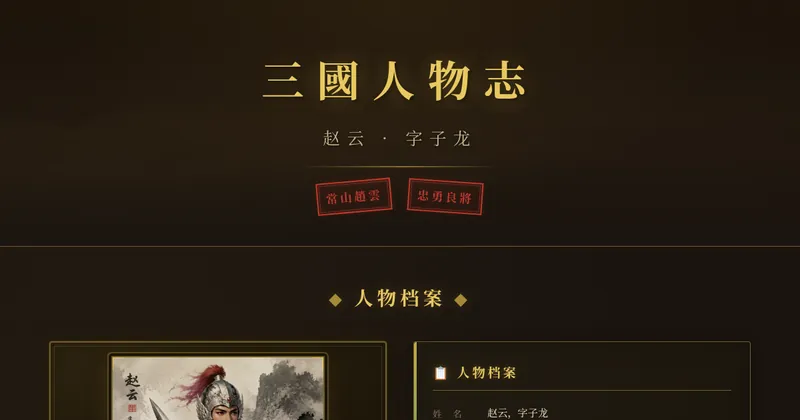
三国人物与经典事件导览
赵云:水墨三国人物志
三国人物与经典事件导览
赵云:水墨三国人物志
Description
Enter the name of a Three Kingdoms character or click on a popular figure. The AI generates realistic character portraits (inspired by Koei's Romance of the Three Kingdoms game series), and displays an interactive webpage showing relationship networks, faction affiliations, and a comparison of classic events from the historical Records of the Three Kingdoms (Sanguozhi) and the novel Romance of the Three Kingdoms. Related characters can be clicked for more details, distinguishing historical fact from fiction.
Related Skills
View all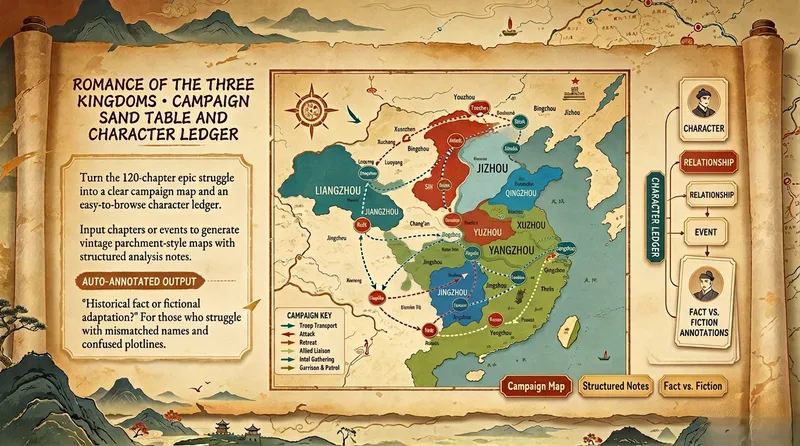
Three Kingdoms Campaign Guide
SKILL Features Chapter-by-chapter routes: Connect the chapter titles into a “campaign route,” with each chapter represented as a city or skirmish. Mark the starting and ending chapters, causes, and consequences to prevent losing track of earlier events. Character lineage trees: Organize the main characters by faction (Wei / Shu / Wu / other warlords / Han imperial house), showing lord–strategist–general relationships and identifying those who switched allegiance, such as Zhang Liao, Jia Xu, and Fa Zheng—the easiest relationships to confuse. Four elements for every campaign sandbox: Every major battle includes “time—location (ancient name + modern location)—troop strength and commanders on both sides—key to victory or defeat,” plus terrain and tactical notes such as fire attacks, water attacks, cutting off supplies, and feigned surrender. Strategy breakdown cards: Break down Thirty-Six Stratagems-style episodes into “plotter—bait—opponent’s psychology—flaw—result—what if the opponent had seen through it?” Build strategic thinking and create material that can also be adapted for writing. History and novel side by side: Mark each point as “recorded in Records of the Three Kingdoms / added in Pei’s annotations / fictionalized or adapted in the novel,” including examples such as borrowing arrows with straw boats, the Empty Fort Strategy, the oath of the Peach Garden, and borrowing the east wind. Avoid treating the novel as historical fact. Ancient and modern place-name and route correction: Jingzhou, Hanzhong, Jieting, Chibi, and other ancient place names always include their modern locations and strategic significance, with both names shown on the map. Classical and plain-language reading: For classic passages such as the Longzhong Plan, Memorial on Dispatching the Army, and proclamation against the rebels, provide excerpts of the original text, plain-language translations, and key-term notes while preserving the feel of the original. Thematic throughlines: Pull out themes such as loyalty and righteousness, power and strategy, talent movement, female characters, and fate versus human action to support reading the entire book and building material for argumentative essays. Multiple reading depths: Children’s story version (plot-focused, lighter on strategy) / Full original-text version / Deep study version (including narrative perspective, foreshadowing and callbacks, and key points from Mao Zonggang’s commentary). Recommended prompts Turn the Battle of Guandu into a campaign sandbox with the four battle elements and a historical comparison Map the chapter route around the Battle of Red Cliffs (Chapters 43–50), including ancient and modern place names Create a Shu-Han character lineage chart showing those who switched allegiance and their family relationships Turn Zhuge Liang’s “Longzhong Plan” into a thematic journal with original excerpts and plain-language translations Break down the “Chain Stratagem / Self-Injury Stratagem” into strategy cards and mark which parts are fictionalized in the novel Create a thematic chart of female characters in the Three Kingdoms, using the deep study version
 Image
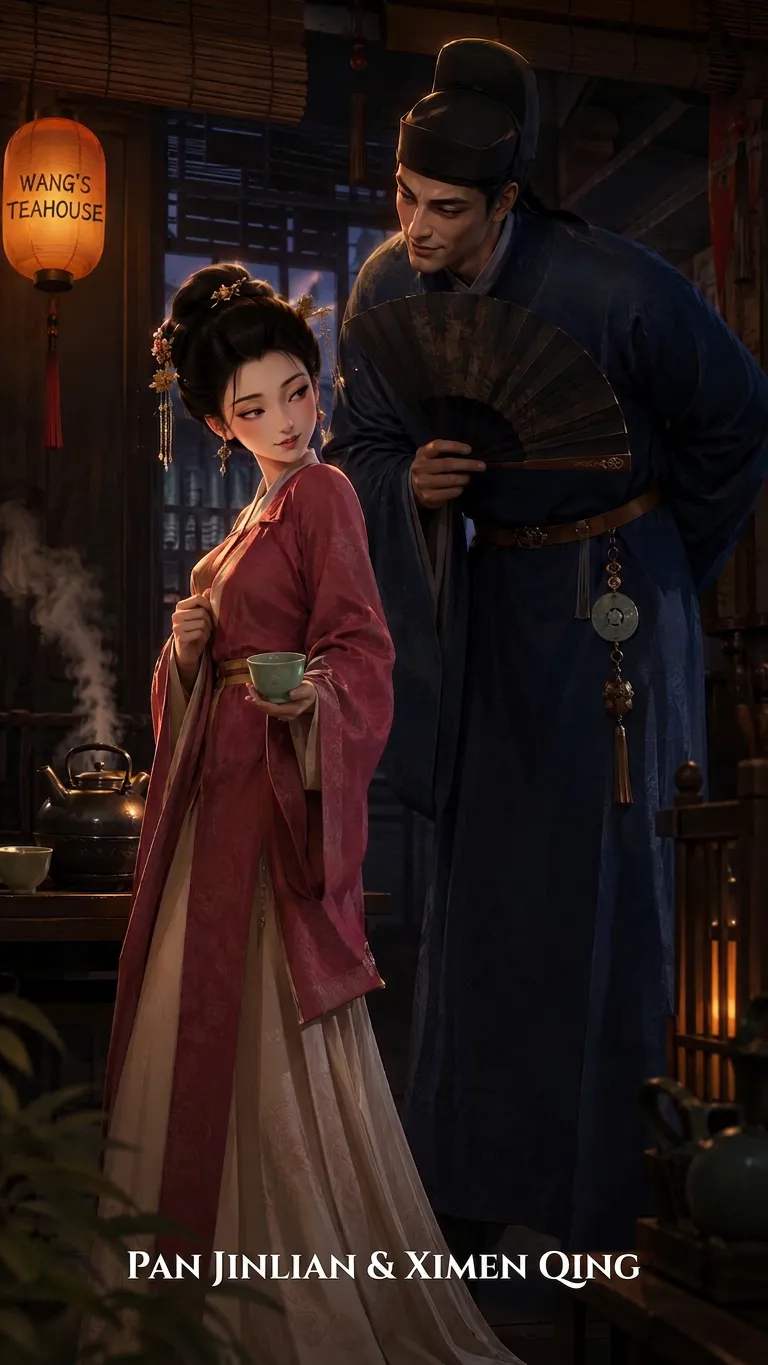
Dark 3D Literary Characters
Transform characters from *Romance of the Three Kingdoms*, *Water Margin*, *Journey to the West*, *Dream of the Red Chamber*, and other Chinese classical works into polished 3D cartoon game characters that remain recognizable without written labels. Whether depicting generals, warriors, monks, scholars, women, immortals, or monsters, the skill combines each character’s identity, stage of life, and defining experiences with visual designs grounded in the historical setting—reducing timeline errors, lookalike characters, and cultural mismatches. You’ll receive a complete character-recognition-focused design plan covering silhouette, signature weapons and accessories, clothing materials, color palettes, pose and expression, environmental mood, and differentiation from similar characters. It also accounts for common image-generation inaccuracies involving ancient Chinese clothing, weapons, and character types. When the source material is uncertain, references are checked first to determine the appropriate period and visual direction. The skill supports both character illustration and scene-based requests. It can produce reusable, copyable image-generation Prompts, specify image dimensions, and review the result for period accuracy, key symbols, colors, cultural traits, pose and structure, and overall recognizability—making corrections and iterations when needed. It is suitable for classical literature character concepts, game character development, visual design, and Chinese-style AI image generation.
Information
- Version
- v3
- Last updated
- Runtime credits
- Usage-based
- Models
- Auto
