
On This Day
Every day is a fold in history
On This Day
Every day is a fold in history
Showcase
Description
📅 Every day is a fold in history. Enter a date and instantly travel through time—from ancient to modern, East to West. 6–10 world-changing events unfold along a golden timeline. 🔍 Core Features: - Searches real historical events online, covering politics, technology, culture, military, exploration, and more. - Vertical timeline long-image with alternating event cards in an elegant, classic design. - Each event includes year, title, brief description, and domain tag for easy scanning. - Entrance animation brings the sense of unrolling a scroll. 🎯 Use Cases: - Daily morning curiosity: 'What happened in history today?' - Birthday/anniversary special: 'What was the world like on the day I was born?' - History class material, social media post inspiration, WeChat moments sharing. - Pure curiosity satisfaction—history is closer than you think. Enter a date and start your time travel. ⏳
Related Skills
View all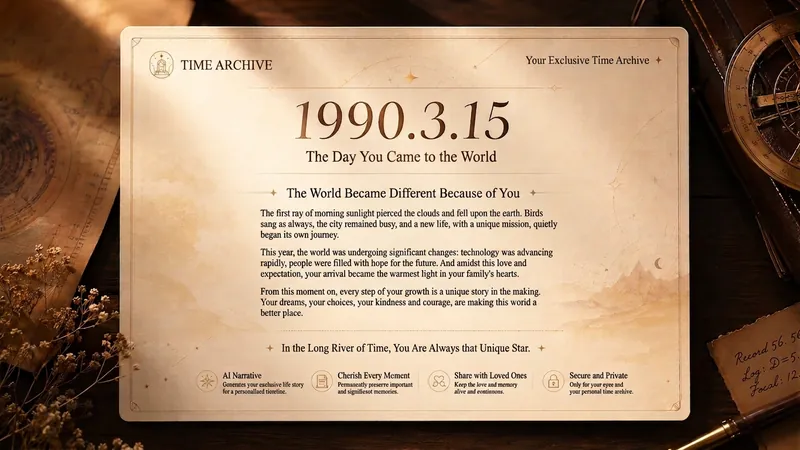
Time Archive
Enter a date, and AI recreates the complete world slice of that day — what happened in history, what song was playing on the street, how much a bowl of noodles cost, where the moon was. Then it weaves everything into a beautiful narrative webpage. · Internet-verified history — we don't fabricate uncertain facts · Covers six emotional scenarios — for yourself, for a child, for parents, for a partner, for someone you miss, for an anniversary · Automatically generates beautiful narrative web pages — each scenario has its own color scheme and decorations, shareable with one click · Different content each time — the same date can be reused repeatedly, like browsing different time archives Open it, choose a scenario, enter a date, and it auto-generates. No manual operation needed throughout. After dozens of optimization iterations · facts cross-verified via googleSearch
 Image
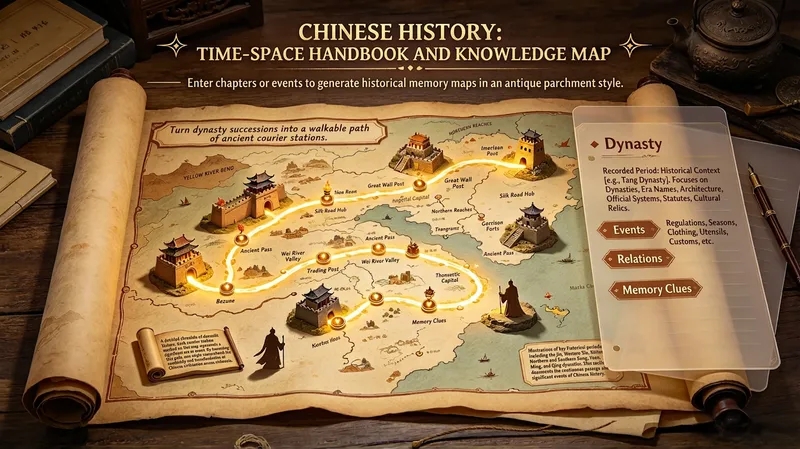
China History · Time & Map
Post-road format: Turn the timeline into a route of “post road—stations—passes,” with each dynasty as a city and each major transformation as a pass. Ancient and modern place names: Automatically label historical and present-day names (such as Chang'an → Xi'an, Lin'an → Hangzhou, and Jianye → Nanjing), showing both names on the map. Automatic fact-checking: Detect reign-title errors, mixed imperial temple and posthumous titles, reversed dynastic order, and misidentified figures. Correct errors before drawing the map. Longitudinal threads for institutional change: Trace systems such as civil service selection, taxation, and central government offices as standalone lines for cross-dynasty comparison without mixing their contexts. Character relationship map: Turn key figures into “travel companions,” with their factions, positions, and rivalries, helping solve the problem of forgetting names. Layered exam-point output: Separate recall-level content (dates, people, and places) from comprehension-level content (causes, effects, and comparisons), with mnemonics or comparison tables. Image-text cross-checking: The image handles routes and landmarks, while the text handles dates and conclusions. Neither repeats nor depends on the other. Multiple versions: Choose among three information-density levels: middle school general history, high school curriculum outline, or advanced preparation for graduate entrance and civil service exams. Recommended prompts Draw “the establishment and consolidation of unified Qin and Han rule” as a parchment map in an itinerary-on-the-post-road style. Turn “the evolution of ancient Chinese civil service selection systems” into a longitudinal institutional-change chart with a comparison table. Draw an ink-wash handscroll of “the Silk Road and Tang foreign relations,” with ancient and modern place names. Help me organize “the strengthening of autocratic monarchy in the Ming and Qing dynasties” at the high school curriculum-outline level, with a mnemonic.
 Video
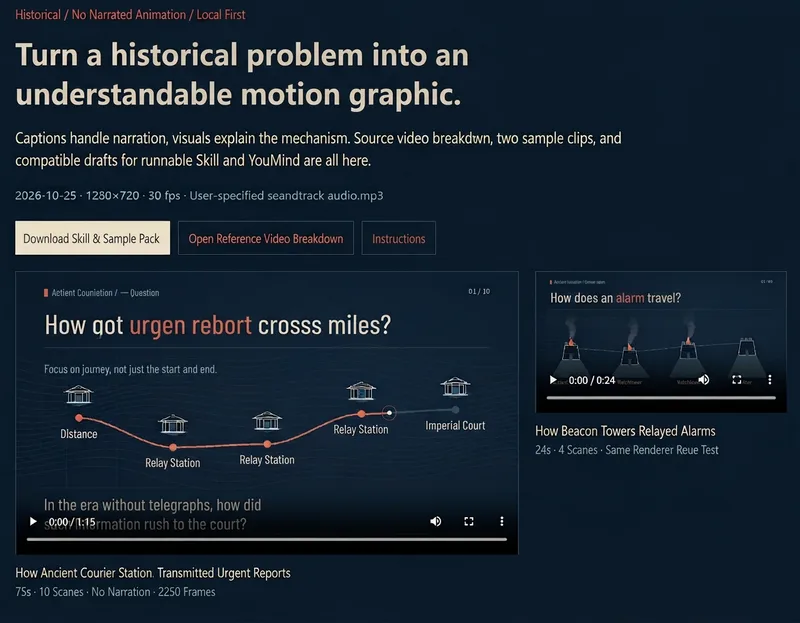
History in Motion
Enter a historical question to create a 60–90 second Chinese knowledge short video. From fact-checking and storyboard arrangement to screen narration, it uses a dark blue background, off-white text, vermilion highlights, and line-drawing animations to gradually unfold historical transmission processes, collaboration methods, and institutional operations. Without voiceover, it relies on subtitles and dynamic diagrams to explain the whole story clearly, paired with your favorite background music so it can be understood even on mute. Especially suitable for explaining ancient communications and historical mechanisms, it can be used for historical science popularization, classroom demonstrations, and website displays. It includes fact sources and supports local MP4 export.
Information
- Version
- v2
- Last updated
- Runtime credits
- Usage-based
- Models
- Auto
