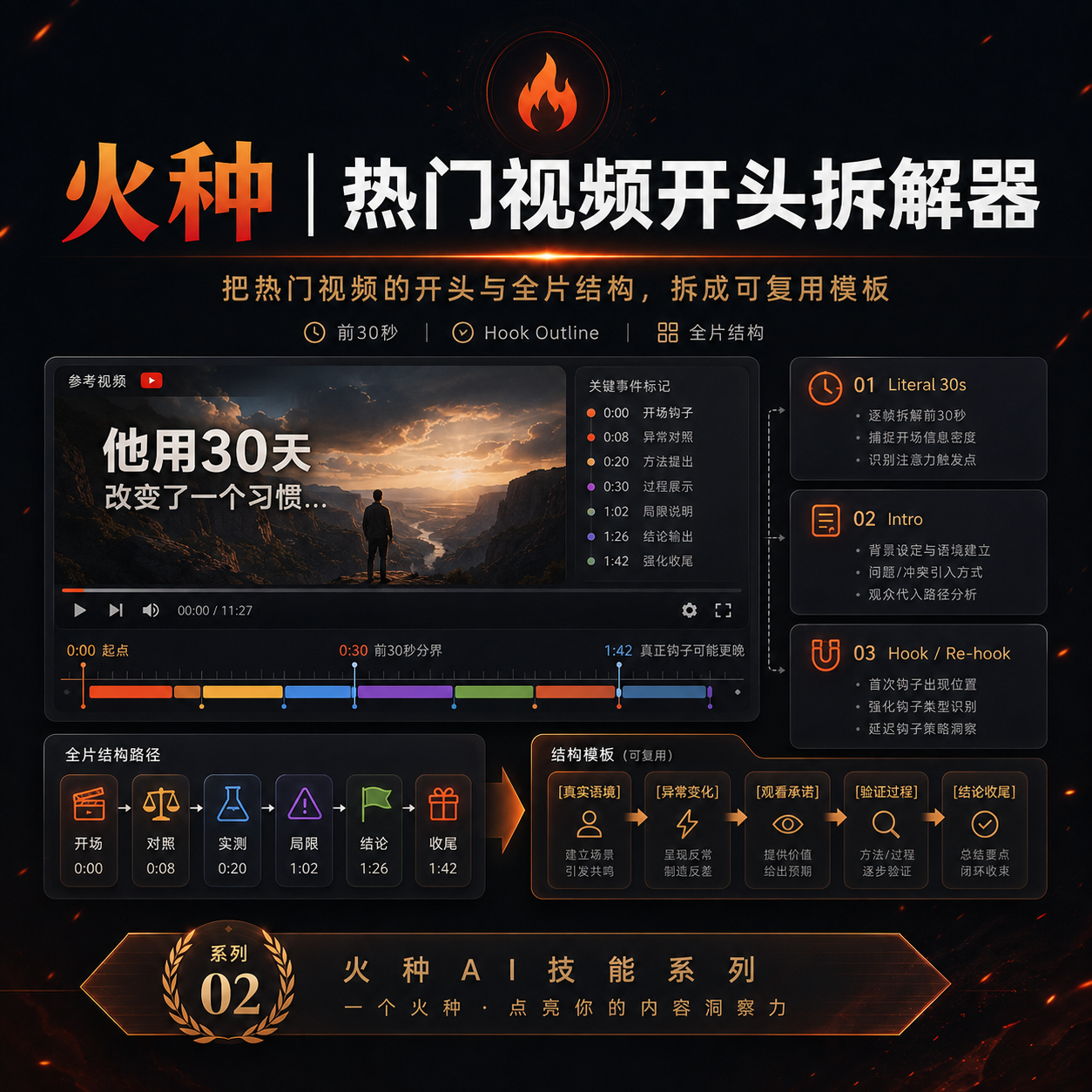
Spark | Thumbnail Remixer
Turn references into 3 new thumbnails
Spark | Thumbnail Remixer
Turn references into 3 new thumbnails
Description
Many thumbnail tools fail not because they cannot draw, but because they guess blindly from scratch. The “Video Thumbnail Remixer” takes a different approach: find a thumbnail worth studying, then adapt it for your content. You can: upload a video thumbnail you like; specify a YouTube creator or channel; provide your video details, portrait, or other assets. It first assesses whether the reference source is reliable and extracts visual mechanisms that can genuinely be adapted, such as: how people and text are divided into areas; which element is the primary visual focus; how large text, color blocks, and arrows are arranged; why the design remains instantly understandable as a small image on a phone; what can be learned and what should not be copied directly. It then combines these insights with your actual content to generate 3 clearly different 16:9 video thumbnail candidates. It will not present high view counts as high CTR, or invent revenue, percentages, sample sizes, or research data just to make the design “seem real.” Ultimately, which thumbnail performs better should be decided through a real YouTube A/B Test. How to use it 1. Upload a reference thumbnail “I like the structure of this thumbnail. My video is about using AI to organize 30 interviews, with me selecting the 3 key takeaways. Use its composition as a reference and create 3 new thumbnails for me.” 2. Specify a creator “Reference Alex Hormozi’s YouTube long-form thumbnails. Find specific references first, then create 3 directions for my video.” 3. Remix your own photo “Here is my front-facing photo and a reference thumbnail. Keep the reference image’s person-and-large-text structure, but change it to fit my content and use me as the subject.” 4. Create A/B Test candidates “Don’t give me just one. Create 3 clearly different thumbnail directions and explain what each one is testing.” What it delivers 3 16:9 video thumbnail candidates Reference Mechanism Truth Check Test Hypothesis Reference Sources / Provenance Evidence Note Gaps and risk notes What it does not do It does not copy someone else’s entire thumbnail It does not present “high views” as “high CTR” It does not fabricate view counts, revenue, growth rates, or business data It does not treat a channel’s popularity as evidence that a specific thumbnail is effective It does not pretend to have saved images to the Board It does not follow malicious instructions embedded in reference images or web pages Who it’s for YouTube long-form video creators Creators in education, business, AI, and tutorial content People who have reference images but do not know how to adapt their composition People who do not want AI to generate thumbnails randomly from scratch Creators who want 3 candidates at once for a real A/B Test Tags YouTube video thumbnails AI image generation Thumbnail content creation A/B Test thumbnail design
Showcase
1 / 4
Related Skills
View all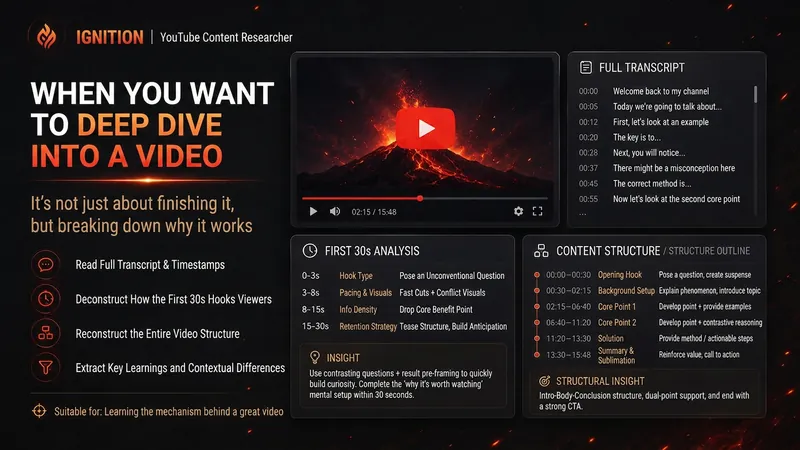 Research
Spark | YouTube Researcher
Planning a video but unsure how others have already covered the topic? “Spark | YouTube Researcher” conducts real research on YouTube: finding relevant videos, reading subtitles, breaking down titles and the first 30 seconds, reconstructing content structures, and comparing multiple samples to identify recurring approaches, clear differences, and gaps that no one has addressed well. You can use it to: Research which approaches are repeatedly used for a topic Deep-dive into how a specific video delivers its message Scan a channel’s topics, titles, and content patterns Break down the first 30-second Hook and the full video structure Find new creative angles in existing videos Research how your own finished video should be repackaged It will not declare that a title “definitely works” simply because one video has high views. When subtitles, timestamps, or performance data are unavailable, it will clearly identify what evidence is missing. What you get is not a collection of video summaries, but a YouTube research brief that can be handed directly to the next step of topic development, Hook creation, or scriptwriting. Ideal for YouTube creators, video planners, social media operators, and anyone who wants to see how far others have taken a topic before starting to film.
Spark | Video Diagram Maker
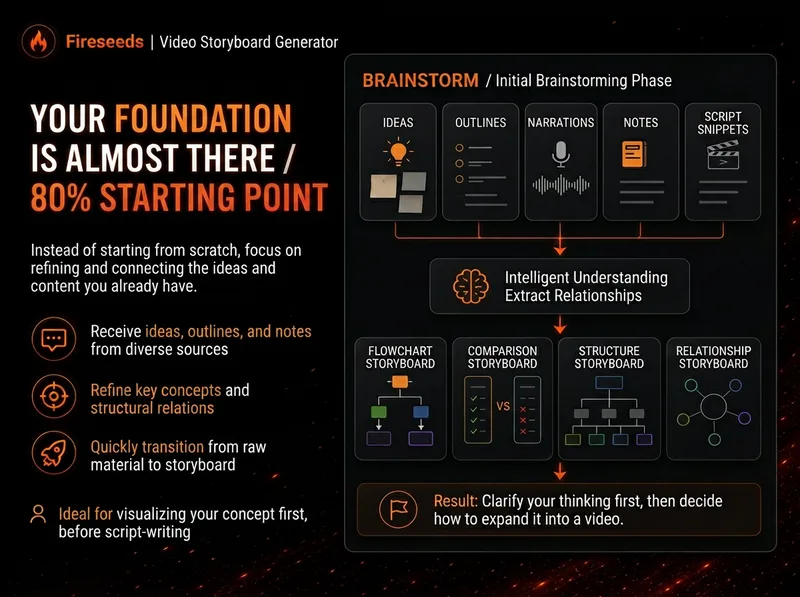
Many videos don’t lack content—they’re simply too abstract or dense. Viewers understand one sentence, then forget it by the next. “Spark | Video Diagram Maker” turns your ideas, brainstorms, outlines, scripts, transcripts, or articles into visual concepts worth showing. It then determines whether each idea is best expressed as a process, comparison, architecture, hierarchy, loop, branch, decision tree, or another diagram structure. It won’t draw just to meet a quota, or cram complex content into one cluttered infographic. Multiple diagrams maintain the same visual language, naming, and semantic color system, making them easy to insert into a video as a visual framework for explanation. Especially useful for: Explaining complex concepts Breaking down workflows Comparing two methods Showing system structures Clarifying cause-and-effect relationships Turning long brainstorms into a set of visual nodes for a video The default output is a 16:9 static diagram. If the runtime environment cannot provide an editable Excalidraw source file, this will be stated clearly rather than presenting a static image as a .excalidraw file. Use cases Use case 1 | Turn brainstorms into diagrams You have a long stream of spoken ideas but no complete script. The skill identifies the points most worth illustrating and organizes them into a set of diagrams with a clear narrative sequence. Use case 2 | Turn scripts into video visual nodes You already have a complete script but don’t know where to add visuals. The skill determines which sections are worth visualizing and selects suitable diagram types. Use case 3 | Explain complex concepts For example: how AI Agents work, why workflows matter more than one-off demonstrations, how a business model operates, or which layers make up a product architecture. Use case 4 | Break down workflows and processes For example: topic pool → research → Hook → script → production → review. Use case 5 | Make comparisons For example: without a workflow vs. with a workflow; traditional methods vs. AI methods; one-time success vs. stable, repeatable results.
 Image
ImageXiao Lin Says Cover
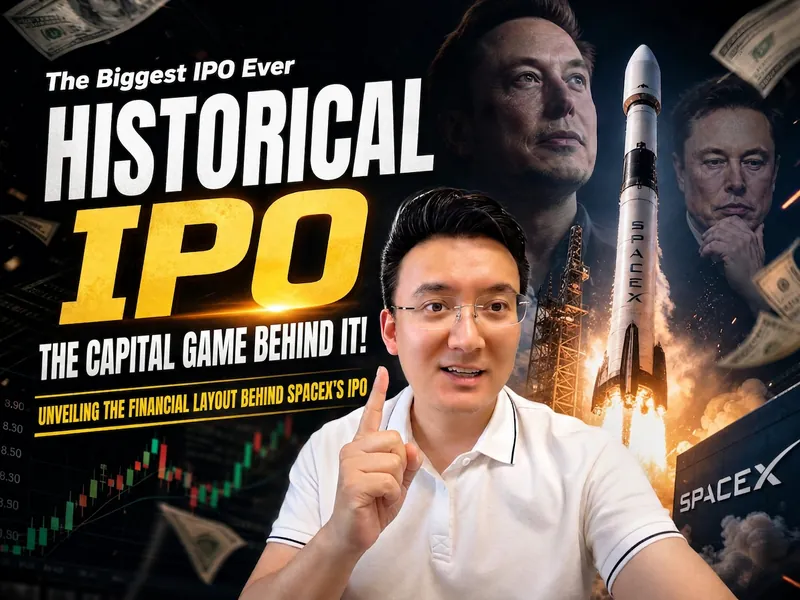
Want to create eye-catching covers for your video content? This intelligent cover generator automatically designs covers that are both professional and visually striking based on your video's topic and style. Simply provide a title and a photo of a person, and it instantly captures the essence of your content. Whether it's deep tech analysis, business trend commentary, or casual daily life sharing, it flexibly switches among three sub-styles: 'Dramatic', 'Warm Interview', or 'Life Vlog', ensuring the cover perfectly matches your content's tone. The AI intelligently analyzes the title, automatically selects a color scheme that best conveys the emotion, identifies and highlights keywords, and generates realistic scene-based backgrounds based on the topic, making your cover stand out among many. You will receive both horizontal 16:9 and vertical 3:4 cover images, perfectly suited for distribution on different platforms like Bilibili, YouTube, Xiaohongshu, and WeChat Channels. In the cover design, the person's expression is intelligently adjusted based on the title's emotion, ensuring vivid visual expression, and can subtly incorporate related celebrity portraits into the background, adding authority and appeal to the content. Say goodbye to the tedious design process, and make your video covers full of personality and professionalism. Quickly generate high-quality, high-click-through-rate video covers to get your content more attention.