中文标点修改|Chinese punctuation correction
Instructions
No instructions.
Description
检查全文的中文标点,同时保障内容完整性。
Related Skills
View all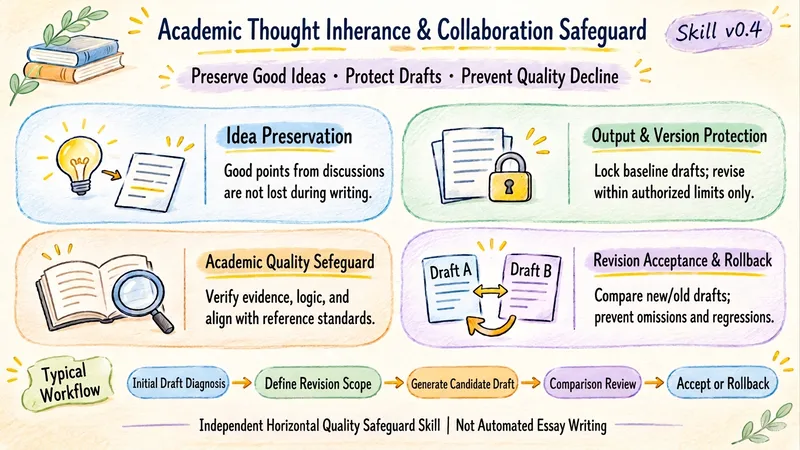 Write
Paper Revision Quality Guard
Keep great insights and content intact so your paper improves with every draft. This tool checks your paper's logic, evidence, literature, and expression quality, protects existing work, tracks important ideas, and compares old and new drafts to catch omissions and issues during revision.
 Write
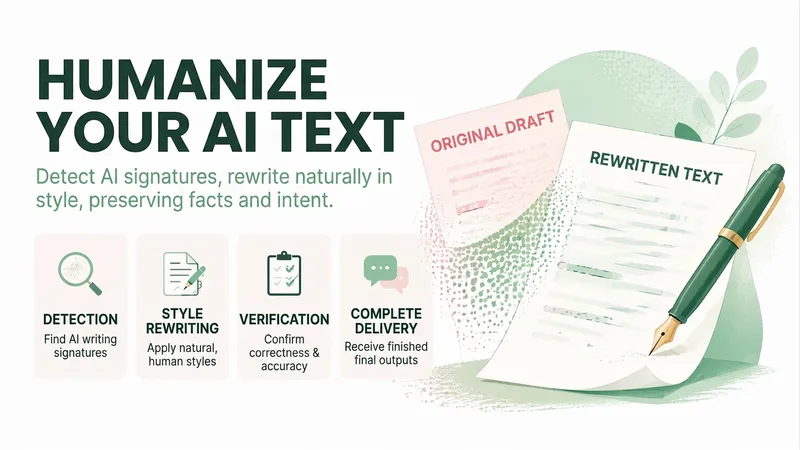
De-AI Chinese Rewriter
Make your Chinese drafts sound more like they were written by a real person in a specific scenario, while preserving the original facts, stance, and tone strength. Whether it is WeChat messages, emails, Xiaohongshu posts, work reports, or academic papers, it first identifies the style and expression issues, then targets clichés, empty phrasing, mechanical structures, nominalizations, and inappropriate tones. This makes the text more specific, natural, and smooth without becoming overly colloquial. It strictly guards factual boundaries during rewriting: it does not arbitrarily add numbers, dates, names, organizations, cases, promises, or effects, nor does it change "might" to "will," or delete key qualifiers and conclusions. Where necessary information is missing, it clearly marks content to be added to avoid fabricating details for completeness. Formal expressions in academic papers and work reports are not misjudged as "AI-sounding" and overly altered. You will receive a fact-checked and doubly verified Chinese rewrite, ready for direct communication, publishing, reporting, or academic writing. When needed, you can also view specific trace judgments, modification rationales, and pending information to clearly understand what was adjusted and how information consistency was maintained.

Chinese Jargon & SVO Review
Rewrites Chinese materials that “sound professional but leave readers unsure who needs to do what” into language readers can understand, act on, and verify directly. It applies to reports, proposals, notices, articles, product documentation, project updates, policy training, customer service content, official WeChat articles, and AI-generated text, with a focus on Chinese jargon, vague slogans, abstract nouns, and writer-centered framing. Without changing facts, quantities, dates, names, scope, the strength of conclusions, or the boundaries of the evidence, this Skill turns difficult-to-act-on phrases such as “empower,” “strengthen management,” “drive implementation,” “close the loop,” and “align through collaboration” into more specific people, actions, objects, conditions, and outcomes. It also checks whether key sentences clearly state the subject, action, and object, so readers know who is responsible for what, what is affected, and how to determine whether the work is complete. When necessary, it retains specialized terms from regulations, standards, and products while adding explanations in plain language. The output typically includes a ready-to-use rewrite, the key changes that affect understanding, and any people responsible, timelines, data, evidence, or specialized definitions that cannot be confirmed from the original. It does not invent information or rewrite suggestions, records, or system statuses as facts that are completed, resolved, or verified. It is suited to writers, editors, and business teams who want to improve the readability, accuracy, and actionability of Chinese materials.
中文标点修改|Chinese punctuation correction
Instructions
No instructions.
Description
检查全文的中文标点,同时保障内容完整性。
Related Skills
View allWritePaper Revision Quality Guard
Keep great insights and content intact so your paper improves with every draft. This tool checks your paper's logic, evidence, literature, and expression quality, protects existing work, tracks important ideas, and compares old and new drafts to catch omissions and issues during revision.
WriteDe-AI Chinese Rewriter
Make your Chinese drafts sound more like they were written by a real person in a specific scenario, while preserving the original facts, stance, and tone strength. Whether it is WeChat messages, emails, Xiaohongshu posts, work reports, or academic papers, it first identifies the style and expression issues, then targets clichés, empty phrasing, mechanical structures, nominalizations, and inappropriate tones. This makes the text more specific, natural, and smooth without becoming overly colloquial. It strictly guards factual boundaries during rewriting: it does not arbitrarily add numbers, dates, names, organizations, cases, promises, or effects, nor does it change "might" to "will," or delete key qualifiers and conclusions. Where necessary information is missing, it clearly marks content to be added to avoid fabricating details for completeness. Formal expressions in academic papers and work reports are not misjudged as "AI-sounding" and overly altered. You will receive a fact-checked and doubly verified Chinese rewrite, ready for direct communication, publishing, reporting, or academic writing. When needed, you can also view specific trace judgments, modification rationales, and pending information to clearly understand what was adjusted and how information consistency was maintained.
Chinese Jargon & SVO Review
Rewrites Chinese materials that “sound professional but leave readers unsure who needs to do what” into language readers can understand, act on, and verify directly. It applies to reports, proposals, notices, articles, product documentation, project updates, policy training, customer service content, official WeChat articles, and AI-generated text, with a focus on Chinese jargon, vague slogans, abstract nouns, and writer-centered framing. Without changing facts, quantities, dates, names, scope, the strength of conclusions, or the boundaries of the evidence, this Skill turns difficult-to-act-on phrases such as “empower,” “strengthen management,” “drive implementation,” “close the loop,” and “align through collaboration” into more specific people, actions, objects, conditions, and outcomes. It also checks whether key sentences clearly state the subject, action, and object, so readers know who is responsible for what, what is affected, and how to determine whether the work is complete. When necessary, it retains specialized terms from regulations, standards, and products while adding explanations in plain language. The output typically includes a ready-to-use rewrite, the key changes that affect understanding, and any people responsible, timelines, data, evidence, or specialized definitions that cannot be confirmed from the original. It does not invent information or rewrite suggestions, records, or system statuses as facts that are completed, resolved, or verified. It is suited to writers, editors, and business teams who want to improve the readability, accuracy, and actionability of Chinese materials.
Find your next favorite skill
Explore more curated AI skills for research, creation, and everyday work.