
Chinese Jargon & SVO Review
Remove jargon and clarify who does what.
Chinese Jargon & SVO Review
Remove jargon and clarify who does what.
Showcase
Description
Rewrites Chinese materials that “sound professional but leave readers unsure who needs to do what” into language readers can understand, act on, and verify directly. It applies to reports, proposals, notices, articles, product documentation, project updates, policy training, customer service content, official WeChat articles, and AI-generated text, with a focus on Chinese jargon, vague slogans, abstract nouns, and writer-centered framing. Without changing facts, quantities, dates, names, scope, the strength of conclusions, or the boundaries of the evidence, this Skill turns difficult-to-act-on phrases such as “empower,” “strengthen management,” “drive implementation,” “close the loop,” and “align through collaboration” into more specific people, actions, objects, conditions, and outcomes. It also checks whether key sentences clearly state the subject, action, and object, so readers know who is responsible for what, what is affected, and how to determine whether the work is complete. When necessary, it retains specialized terms from regulations, standards, and products while adding explanations in plain language. The output typically includes a ready-to-use rewrite, the key changes that affect understanding, and any people responsible, timelines, data, evidence, or specialized definitions that cannot be confirmed from the original. It does not invent information or rewrite suggestions, records, or system statuses as facts that are completed, resolved, or verified. It is suited to writers, editors, and business teams who want to improve the readability, accuracy, and actionability of Chinese materials.
Related Skills
View all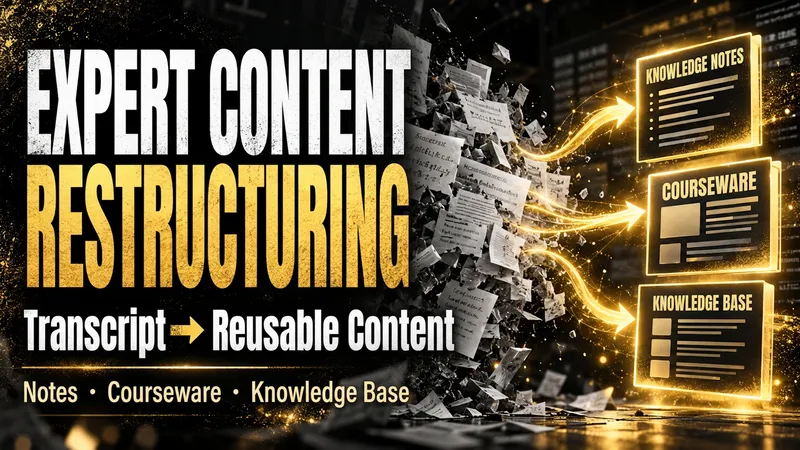
Content Reconstruction Expert
After an expert course, training session, interview, or meeting, what remains is often a long, messy transcript that is difficult to use again. The Expert Content Reconstructor fully restructures existing text into genuinely usable content deliverables. It does not produce a summary that keeps only the conclusions; it preserves definitions, explanations, examples, conditions, figures, limitations, steps, and conclusions, then reorganizes them into a clear knowledge hierarchy. You can use it to: - Turn transcripts of expert courses into reusable knowledge notes; - Turn training materials or speeches into course outlines, course content, and PPT page copy; - Turn interviews, articles, or meeting notes into structured articles, knowledge base entries, or team documents; - Organize multiple materials into searchable, traceable knowledge packages. You only need to provide the existing text and explain who will read it, how deeply it should be organized, and what output format you prefer. You will receive: - Complete knowledge notes, articles, course outlines, course content, or PPT page copy; - Clear heading levels, paragraphs, lists, and necessary terminology explanations; - Teaching notes that students can study directly, without retaining paraphrasing such as “the speaker says” or “the course will cover”; - Structured content that can be delivered directly to clients, teams, or a knowledge base; - Source logs, content ledgers, glossaries, quality reports, and retrieval chunks as needed; - No compression of useful content simply for brevity, and no added viewpoints, examples, or conclusions that are not present in the source material. Suitable for organizing existing written materials; Does not handle audio recognition or generate transcripts from audio.
 Write
WriteAIGC Reduction & Rewrite v7.0
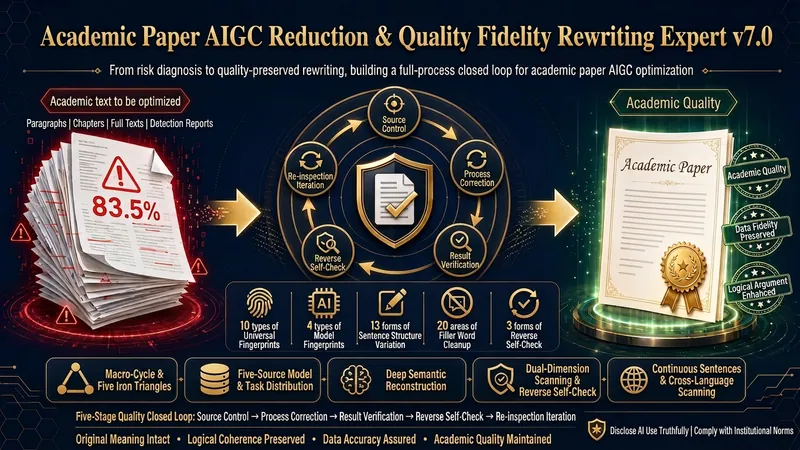
📚 Academic Paper AIGC Reduction and Quality-Preserving Rewriting Expert v7.0 Designed for graduate students, researchers, and paper authors, this academic text optimization skill operates on a core closed loop of 'source control → process correction → result verification → reverse self-check → iterative re-check'. It systematically diagnoses and optimizes issues such as templated expressions, mechanical logic, vague content, inaccurate terminology, and style inconsistencies while preserving original meaning, technical terms, data, and core conclusions. 🔍📝 🌟 Core Capabilities 🔬 Multi-layer Risk Diagnosis Covers 10 types of universal text fingerprints and assists in identifying common expression patterns of models such as ChatGPT, Claude, DeepSeek, and Wenxin Yiyan. 🧠 Deep Semantic Restructuring Goes beyond synonym replacement to rebuild more natural and in-depth academic reasoning by adjusting proposition expression, information order, argument approach, and evidence organization. ✍️ Quality-Preserving Rewriting Comprehensively applies 13 sentence transformation strategies and 20 methods for cleaning high-frequency templated expressions, improving mechanical sentence structures, repetitive connectors, and overly rigid formatting. 📊 Full-text Structure Diagnosis Through macro-cycle and five key triangles, checks whether research problems, theory, literature review, methods, results, conclusions, and innovation form a complete closed loop. 🧩 Fine-grained Section Adaptation Develops differentiated diagnostic and rewriting strategies for abstract, introduction, literature review, research methods, results, discussion, and conclusion respectively. 🌐 Cross-language Risk Scanning Assists in identifying translationese, passive voice stacking, long sentence nesting, and mixed Chinese-English formatting abnormalities to make Chinese academic expression more natural and accurate. 🔄 Reverse Self-check Loop After rewriting, re-verifies from three aspects: technique distribution, new text fingerprints, and information integrity, to avoid 'becoming more templated' or losing key content. 🛡️ Academic Integrity Protection Does not fabricate literature, data, cases, or policy evidence; separately marks information requiring author verification and reminds users to honestly disclose AI usage. 🎯 Use Cases ✅ Single paragraph or partial section optimization ✅ Targeted modification of marked paragraphs from inspection reports ✅ Polishing of abstract, introduction, literature review, discussion, and conclusion ✅ Full-text AIGC risk feature diagnosis ✅ Language and structure adaptation for target journals ✅ Pre-submission quality review and consistency check 📦 Final Deliverables 📄 Quality-preserving rewritten text 🔎 Risk and issue diagnosis report 🛠️ Rewriting strategy and technique description ✅ Reverse self-check and information integrity report 💡 Items requiring author verification and subsequent revision suggestions 🎓 Original meaning preserved · Logic intact · No fabricated data · Academic quality maintained ⚠️ This skill aims to improve academic expression quality and reduce text risk features. It does not guarantee passage through any specific detection platform or achieving a particular detection score.
Copy Editing & Dual Rewrite
Use this skill to sharpen your observation and writing.\n\nIt turns loose, overdecorated, and logically uneven articles and copy into finished drafts with a clear structure and forceful language. Whether you’re working with short sentences, paragraphs, or expressed ideas, it carefully diagnoses issues such as typos, overuse of filler words, disconnected syntax, stacked modifiers, and confusion in time or space, then points out the specific problems and how to revise them.\n\nWhile preserving the original meaning, it produces two rewritten versions: the plain version removes excess and strengthens information density and sentence structure; the austere version compresses abstract judgments further, shifting toward more concrete actions, objects, and scenes. The result is less self-conscious performance and more solid, resonant prose. It’s suitable for novel excerpts, essays, commentary, social media copy, and personal writing that needs refinement.\n\nYou’ll receive a direct diagnosis of the writing issues, along with two rewrite options for easy comparison and further polishing. This helps identify habitual clichés, vague concepts, and the writer’s unconscious posturing, so every sentence becomes more precise and concise.
Information
- Version
- v2
- Last updated
- Runtime credits
- Usage-based
- Models
- Auto