选题脑暴 · 从方向到蓝图
Description
没有仿写对象时使用。输入一个选题方向 + 你的内容人格档案,AI 先帮你发散出多个切入角度,你选定后再深度解构,最终输出一份可以直接动笔的"内容蓝图"。
Related Skills
View all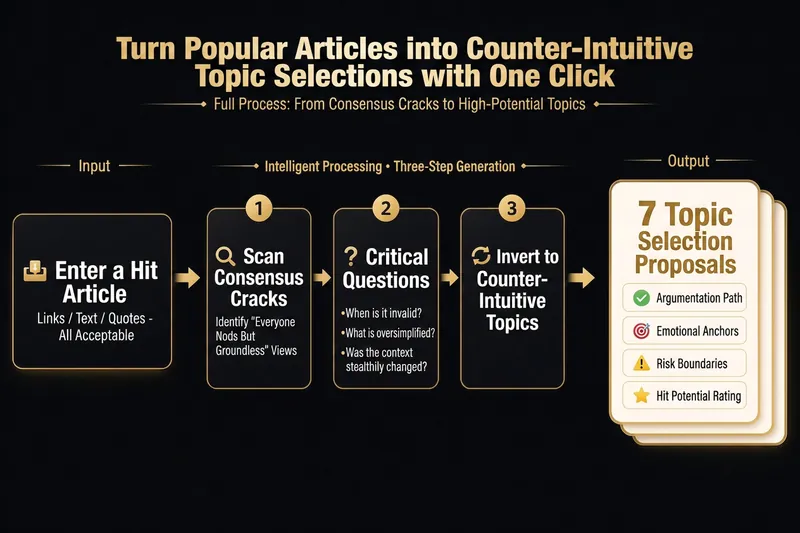 Write
1 Post->3-7 Unexpected Topics
😤 Do you feel this too— You scroll through viral articles for an hour, save seven or eight, and feel like you've "learned." But when you sit down to come up with topics—your mind goes blank. Hundreds of articles in your bookmarks, and not one of them turns into your own content. You're not lacking material; you're lacking a method to "extract your own topics from others' viral posts." 🔍 Where's the problem— Inside every 100,000+ viral article, there are a few viewpoints that "most people nod along with, but actually don't hold up." Most people scroll past them. A few people pick these views out, think in reverse—and a new topic is born. The gap is in this one "deconstruction" action. 🛠️ How it helps you— 📥 Drop in a viral article link 🔬 Automatically scans the full text, picks out common consensus that "sounds right, but the conditions for truth are quietly stripped away" ❓ Dives into three key questions for each: ① Under what circumstances is it false? ② What does it oversimplify? ③ Which context did it sneak in from? 🔄 Reverses into 3–7 counterintuitive topic ideas 📊 Each comes with a complete output: ✅ Logical path — why this topic holds up ✅ Emotional hook audience — who it's for, what hits them ✅ Risk boundary — where you might go wrong ✅ 5‑dimensional viral score — how hard this topic can hit It doesn't give you a bunch of directions to think about; it gives you topics you can start writing on right away. ✍️ 🚀 Give it a try— Search for "1 Post->3-7 Unexpected Topics" in YouMind. Open it and drop a link to a viral article you've seen recently, and it will walk you through deconstructing it into topics. 🗂️ Supports deep dives on single articles + batch filtering 📎 Opinion pieces, experience sharing, tutorials, lists—works with any article type
Research Topic Decider (2.0)
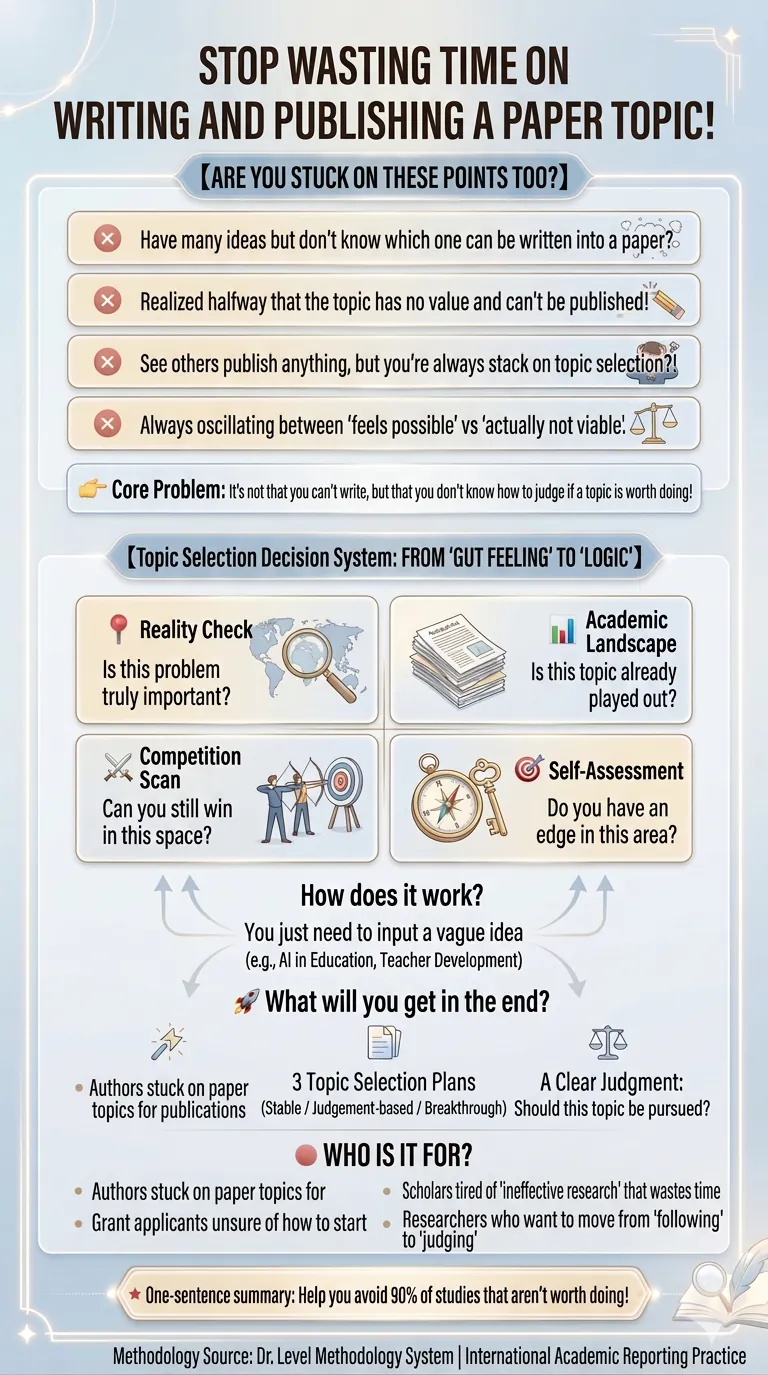
Do you also face these problems? 1. You have many ideas but don't know which can become a paper. 2. Halfway through, you realize the topic has no value and can't be published. 3. Others can publish anything, yet you're always stuck on topic selection?! 4. You're always torn between 'feels right' and 'actually not good'... 👉 The real issue isn't that you can't write, but that you can't judge whether a topic is worth doing!!! 🧠 What does this system solve for you? 1. Help you filter out truly worthwhile topics from a pile of 'seemingly okay' ideas. 2. Help you avoid overcrowded red-ocean research. 3. Help you find directions that are easier to publish and can form a research thread. 4. Help you turn 'topic selection by gut feeling' into 'logical judgment'. ⚙️ How does it work? Just input a vague idea, like 'AI applications / Teacher development / Classroom management' The system will do four things for you: 📍 Reality check: Is this issue really important? 📊 Academic check: Has it been overdone? ⚔️ Competition check: Do you still have a chance to win? 🎯 Self check: Do you have an advantage in this direction? 🚀 What will you get in the end? A 'research sweet spot' (the essence of a truly worthwhile research problem) 3 topic options (safe / publishable / breakthrough) A clear judgment: Should you do this topic or not? 🧠 Who is this for? People who want to publish papers but are stuck on topic selection. People who want to apply for research projects but don't know where to start. People who no longer want to waste time on 'ineffective research'. Researchers who want to go from 'following' to 'judging'. 📌 One-sentence summary It's not about thinking of more topics, but about reducing 90% of research that isn't worth doing! 🧠 Methodology Source This system is built on a methodology system distilled by PhD-level researchers, continuously optimized through national and international academic presentation practices and provincial/ministerial-level research project experience.
 Write
End-First Humanities Proposals
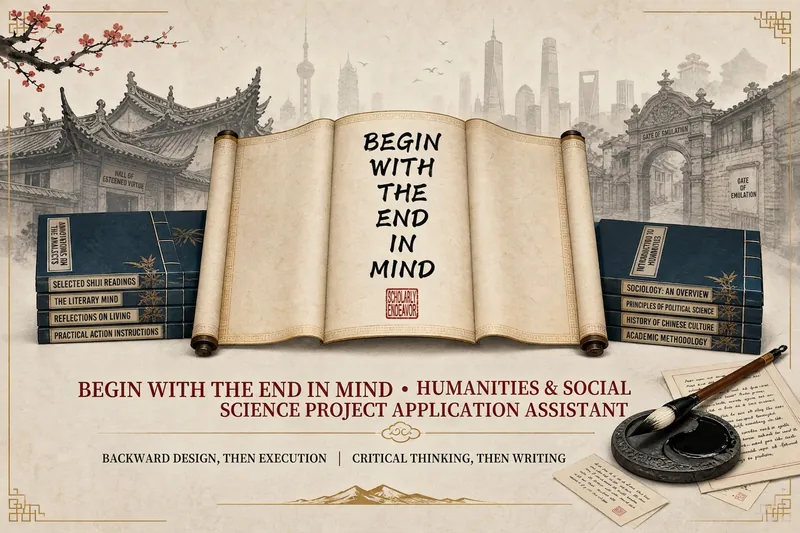
The biggest risk in a proposal isn’t writing slowly—it’s heading in the wrong direction. Most methods have you “write from start to finish, following the research process.” This Skill takes the opposite approach—backward first, then forward: it pushes you to clarify “what exactly is the innovation,” then work backward from the reviewers’ perspective to determine “what needs to be shown and why they should believe you.” Only after that does it have you write in a logical reading order. It sets three hard gates: you can’t lock in a topic until you’ve searched the literature thoroughly, you can’t start writing until the innovation is clear, and the final draft can’t be completed without your confirmation. It also uses XYZ multi-axis searches to verify that a “research gap” truly exists—never treating “I didn’t find it” as “no one has studied it.” Other AI helps you write faster. This Skill has you start later, so you get it right the first time.
选题脑暴 · 从方向到蓝图
Description
没有仿写对象时使用。输入一个选题方向 + 你的内容人格档案,AI 先帮你发散出多个切入角度,你选定后再深度解构,最终输出一份可以直接动笔的"内容蓝图"。
Related Skills
View allWrite1 Post->3-7 Unexpected Topics
😤 Do you feel this too— You scroll through viral articles for an hour, save seven or eight, and feel like you've "learned." But when you sit down to come up with topics—your mind goes blank. Hundreds of articles in your bookmarks, and not one of them turns into your own content. You're not lacking material; you're lacking a method to "extract your own topics from others' viral posts." 🔍 Where's the problem— Inside every 100,000+ viral article, there are a few viewpoints that "most people nod along with, but actually don't hold up." Most people scroll past them. A few people pick these views out, think in reverse—and a new topic is born. The gap is in this one "deconstruction" action. 🛠️ How it helps you— 📥 Drop in a viral article link 🔬 Automatically scans the full text, picks out common consensus that "sounds right, but the conditions for truth are quietly stripped away" ❓ Dives into three key questions for each: ① Under what circumstances is it false? ② What does it oversimplify? ③ Which context did it sneak in from? 🔄 Reverses into 3–7 counterintuitive topic ideas 📊 Each comes with a complete output: ✅ Logical path — why this topic holds up ✅ Emotional hook audience — who it's for, what hits them ✅ Risk boundary — where you might go wrong ✅ 5‑dimensional viral score — how hard this topic can hit It doesn't give you a bunch of directions to think about; it gives you topics you can start writing on right away. ✍️ 🚀 Give it a try— Search for "1 Post->3-7 Unexpected Topics" in YouMind. Open it and drop a link to a viral article you've seen recently, and it will walk you through deconstructing it into topics. 🗂️ Supports deep dives on single articles + batch filtering 📎 Opinion pieces, experience sharing, tutorials, lists—works with any article type
Research Topic Decider (2.0)
Do you also face these problems? 1. You have many ideas but don't know which can become a paper. 2. Halfway through, you realize the topic has no value and can't be published. 3. Others can publish anything, yet you're always stuck on topic selection?! 4. You're always torn between 'feels right' and 'actually not good'... 👉 The real issue isn't that you can't write, but that you can't judge whether a topic is worth doing!!! 🧠 What does this system solve for you? 1. Help you filter out truly worthwhile topics from a pile of 'seemingly okay' ideas. 2. Help you avoid overcrowded red-ocean research. 3. Help you find directions that are easier to publish and can form a research thread. 4. Help you turn 'topic selection by gut feeling' into 'logical judgment'. ⚙️ How does it work? Just input a vague idea, like 'AI applications / Teacher development / Classroom management' The system will do four things for you: 📍 Reality check: Is this issue really important? 📊 Academic check: Has it been overdone? ⚔️ Competition check: Do you still have a chance to win? 🎯 Self check: Do you have an advantage in this direction? 🚀 What will you get in the end? A 'research sweet spot' (the essence of a truly worthwhile research problem) 3 topic options (safe / publishable / breakthrough) A clear judgment: Should you do this topic or not? 🧠 Who is this for? People who want to publish papers but are stuck on topic selection. People who want to apply for research projects but don't know where to start. People who no longer want to waste time on 'ineffective research'. Researchers who want to go from 'following' to 'judging'. 📌 One-sentence summary It's not about thinking of more topics, but about reducing 90% of research that isn't worth doing! 🧠 Methodology Source This system is built on a methodology system distilled by PhD-level researchers, continuously optimized through national and international academic presentation practices and provincial/ministerial-level research project experience.
WriteEnd-First Humanities Proposals
The biggest risk in a proposal isn’t writing slowly—it’s heading in the wrong direction. Most methods have you “write from start to finish, following the research process.” This Skill takes the opposite approach—backward first, then forward: it pushes you to clarify “what exactly is the innovation,” then work backward from the reviewers’ perspective to determine “what needs to be shown and why they should believe you.” Only after that does it have you write in a logical reading order. It sets three hard gates: you can’t lock in a topic until you’ve searched the literature thoroughly, you can’t start writing until the innovation is clear, and the final draft can’t be completed without your confirmation. It also uses XYZ multi-axis searches to verify that a “research gap” truly exists—never treating “I didn’t find it” as “no one has studied it.” Other AI helps you write faster. This Skill has you start later, so you get it right the first time.
Find your next favorite skill
Explore more curated AI skills for research, creation, and everyday work.