Paper Format Expert
Submission-ready in 1 sec. Escape Word hell.
Paper Format Expert
Submission-ready in 1 sec. Escape Word hell.
Showcase
Description
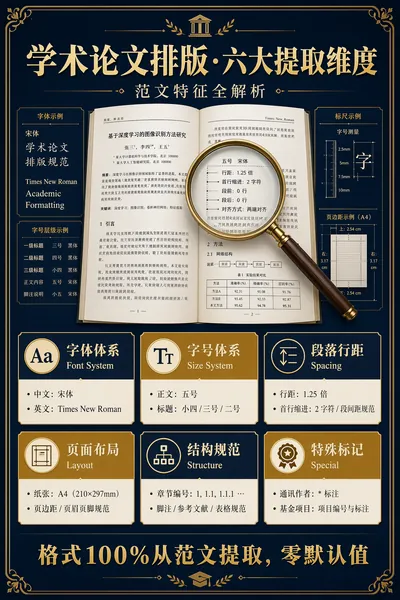
Upload a sample document and your draft; the Skill automatically extracts all formatting features (font, size, spacing, margins, structure, citation style) from the sample and outputs your draft in the same format. Supports PDF/DOCX/TXT/MD input and HTML(Word)/Markdown output, with 8 citation styles. "No need to learn formatting or write instructions. Give it a sample, and it returns a perfectly formatted paper. The 'Academic Formatting Expert' Skill makes paper formatting as easy as copy-paste." 🗣️ User Testimonials "I used to waste a whole day adjusting formats when submitting to a different journal. Now with this Skill, I upload the new journal's sample and my paper is reformatted in 30 seconds. So convenient!" — A young university professor "The thesis template from my school was dozens of pages long and drove me crazy. I used this Skill with my advisor's excellent thesis as the sample. One-click formatting and the result was identical — amazing!" — A second-year master's student Say goodbye to formatting struggles and return to the beauty of academia. It's time to end the war with formatting. Leave this tedious, repetitive yet precise work to AI, and give your precious time and energy back to real research and thinking. Let your paper meet its deserved evaluation in the most professional and compliant way. Try the "Academic Formatting Expert" Skill now and turn your next paper into your next masterpiece.
Related Skills
View all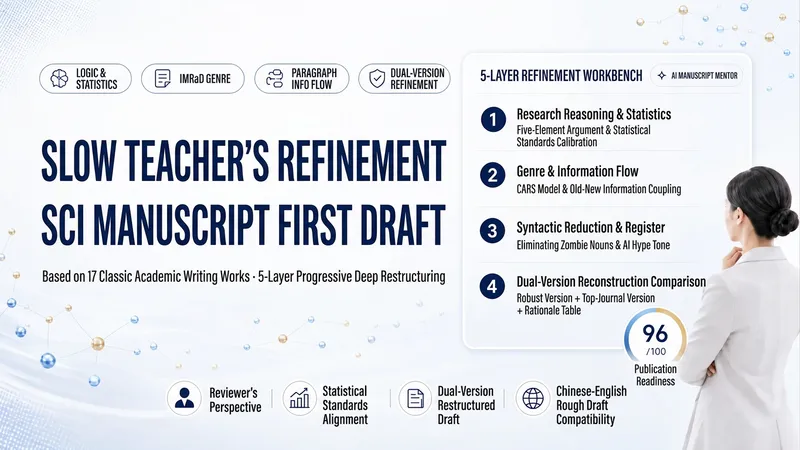 Write
SCI Paper Revision
This goes beyond basic vocabulary polishing. It acts like an experienced mentor with peer-review expertise, helping you refine your early SCI draft toward top-journal standards. It places the [Original ❌] and the [Polished Version ✅] side by side, explaining in plain language why each change was made. [Paste Any Draft Directly] Whether it is a bilingual draft, a single section (Abstract, Introduction, Methods, Results & Discussion, Conclusion, figure captions), a full manuscript, a Cover Letter, or a Response to Reviewers, you can send it directly. [How to Use This Skill (Three-Step Reading Method)] Step 1 (Read the full paragraph preview for rhythm): After you submit your draft, each version (Robust Version A / Advanced Version B) begins with an underlined full-paragraph preview without Chinese explanations. Spend 15 seconds reading it from start to finish to sense the flow and rhythm. Step 2 (Review sentence-by-sentence comparisons and reasoning): Next, review the sentence-by-sentence breakdown. The [❌ Original (with strikethrough)] and [✅ Polished (bold and underlined)] are aligned right next to each other. Each sentence includes [💡 Writing Tip] explaining the awkwardness of the original, the rationale for the change, and underlying English writing principles. Step 3 (Select a version for a clean, copy-ready text): Reply with your choice of A or B (or request minor adjustments), and it will remove all underlines and notes to provide a clean, copy-ready English draft for your Word document. [3 Core Safeguards] 1. Preempts reviewer critiques by closing logical and statistical loopholes (such as treating P > 0.05 as proof of no effect, mismatched comparisons, or missing control experiment premises); 2. Avoids overly long, breathless sentences, keeping standard sentences within the 15–25 word golden range with a natural mix of sentence lengths; 3. 100% zero fabrication of data and literature, clearly marking missing values or error bar definitions for you to verify.
Reference Matching Expert
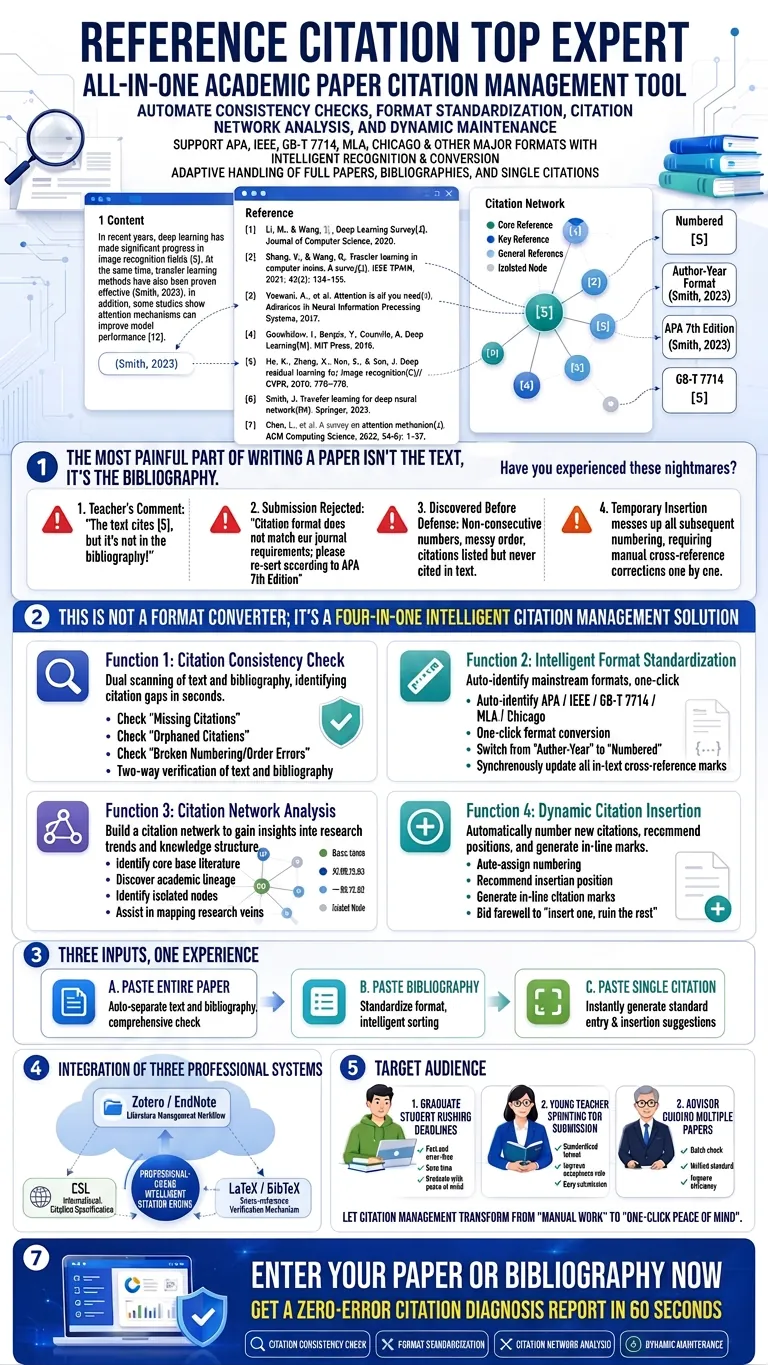
A comprehensive academic paper cross-reference management tool that automates citation consistency checks, format standardization, citation relationship analysis, and dynamic citation maintenance. Supports intelligent recognition and conversion of mainstream citation formats including APA/IEEE/GB-T 7714/MLA/Chicago. Adaptively handles three input forms: full paper, reference list, and single citation. Integrates Zotero/EndNote reference management workflows, Citation Style Language international standards, and LaTeX/BibTeX cross-reference verification mechanisms. "The most painful part of writing a paper isn't the text—it's the references." Have you experienced these nightmares? Advisor's comment: "You cited [5] in the text, but it's not in the reference list!" Rejection: "Citation format does not meet journal requirements. Please reformat according to APA 7th edition." Discovery before the defense: Reference numbers are non-sequential, order is chaotic, and some references are never cited but still in the list. Inserting a new reference mid-paper messes up all subsequent numbers, requiring manual correction of every cross-reference. 【Reference Citation Expert】—— Your academic writing 'citation immune system'. This is not a format converter; it's a four-in-one intelligent citation management solution: 🔍 Feature 1: Citation Consistency Check — Bidirectional scan of text and reference list, instantly locating missing citations, orphan references, and broken numbering. No citation gap can hide. 📐 Feature 2: Smart Formatting — Automatically identifies APA/IEEE/GB-T 7714/MLA/Chicago formats, converts with one click, and updates all cross-reference markers simultaneously. Switch from author-year to numeric style without manual effort. 🕸️ Feature 3: Citation Relationship Analysis — Builds a citation network by connecting to online resources, identifying core foundational papers, academic lineage, and isolated nodes, helping you map research connections. ➕ Feature 4: Dynamic Citation Insertion — New references are automatically numbered, insertion points recommended, and inline citation markers generated. No more 'one insertion wreaks havoc on the whole document.' Three inputs, one experience: Paste entire paper → automatically separate text and reference list, full check Paste reference list → unify format, smart sorting Paste single citation → instantly generate standardized entry and insertion suggestions Integrating three major professional systems: Zotero/EndNote workflows × CSL international citation standards × LaTeX/BibTeX cross-reference verification. Whether you're a graduate student racing a deadline, a young faculty member rushing to submit, or a supervisor guiding multiple papers— Turn citation management from 'manual labor' to 'one-click peace of mind.' Now input your paper or reference list and get a zero-error citation diagnostic report in 60 seconds.
 Research
Academic Paper Writing v4.1
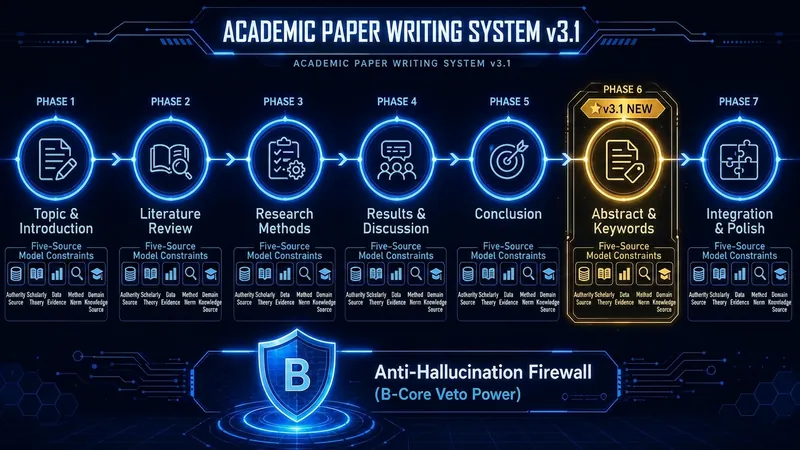
A full-process academic paper writing system that combines the Five Sources model with the AFP 3.1 three-layer architecture. Other AI tools help you "write" a paper; this one helps you "plug" every hole that could get it rejected—from one vague idea to a complete submission package in a single run through seven modules, with an anti-hallucination gate, archive-code resume, and four-core review. [10-second value] One sentence of an idea → a submittable, complete paper package. Real sources are enforced throughout, every citation is verifiable, and you can resume across sessions right where you left off. [Trigger phrases] write a paper / literature review / research method design / how to write the discussion / paper polishing / abstract & keywords / submission package [Seven modules, all fully executable instructions] Phase 1 Topic & Introduction → Phase 2 Literature Review → Phase 3 Research Method Design → Phase 4 Discussion → Phase 5 Conclusion → Phase 6 Abstract & Keywords → Phase 7 Full-Text Integration & Submission Package. Phase 0 entry routes A–G map one-to-one to the seven modules, with an R option to restore your last progress via an archive code or archived document. [v4.1 upgrades] 1. Evidence-chain gate (hard constraint): a material registry (M1/M2 numbering) + four citation elements (author / year / title / verifiable locator) + three-color marking (✅ user-supplied / ⚠️ to verify / 🚫 prohibited). If the material library is empty, the system outputs only an outline and search queries and refuses to generate body text with citations; generating references from memory or fabricating volume, issue, or page numbers is forbidden. 2. Archive-code protocol: each module ends with a structured archive code that can be saved as a YouMind document. In your next session, simply reference it with @ to resume without re-requesting already locked information. 3. Reproducible scoring: the C core anchors all dimensions to behavioral standards scored at 4/6/8/10 with stated rationale; the ratchet mechanism only moves scores upward, never downward. 4. Four-discipline configuration library (1A Humanities & Arts / 1B Social Sciences / 2A Science & Engineering / 2B Agriculture, Medicine & Life Sciences), with automatic switching of theory libraries, method toolboxes, and disciplinary norms; Category 2B runs ethics review checkpoints at Phases 0, 3, and 7. 5. Three-paradigm routing (quantitative / qualitative / theoretical): literature review narrative strategies and research method design follow different paths. 6. Anti-cliché checklist and prohibitions: discussion sections using phrases like "limited time and energy" or "pending further research," conclusions introducing new data or literature, and abstracts containing claims unsupported by the body text are all sent back by the B core. 7. Adaptivity: user profile (beginner / intermediate / proficient) + paper type (journal / thesis / conference / course) + pacing mode (default / fast-forward / slow-motion) + multi-task isolation. 8. Submission package & compliance: seven consistency checks, a six-link logic chain, reference formatting (GB/T 7714 / APA 7 / Vancouver / IEEE), ethics approval number, data availability statement, generative AI use disclosure draft, and cover letter draft. [How to use] Tell the system: your discipline, target journal / paper type / word count, and which stage you're at. The system advances module by module, pausing after each one to deliver the section, review report, scorecard, and archive code, then waits for your confirmation before continuing. [Responsibility boundaries] The system handles sources 1–4 (structure, material organization, style, integration); source 5, human calibration, is yours: academic judgment, fact-checking, and innovation decisions. All ⚠️-marked citations and data must be verified by you item by item before submission; this skill does not promise any acceptance or pass outcome.
Information
- Version
- v7
- Last updated
- Runtime credits
- Usage-based
- Models
- Auto
