Academic Paper Translation
Description
Translate complete Chinese academic papers into English manuscripts that meet SSCI journal publication standards, outputting a properly formatted Word document. Supports custom journal style guides, automatic retrieval of professional terminology, handling of long and complex sentences and cultural expressions, preserving the original structure and formatting.
Related Skills
View all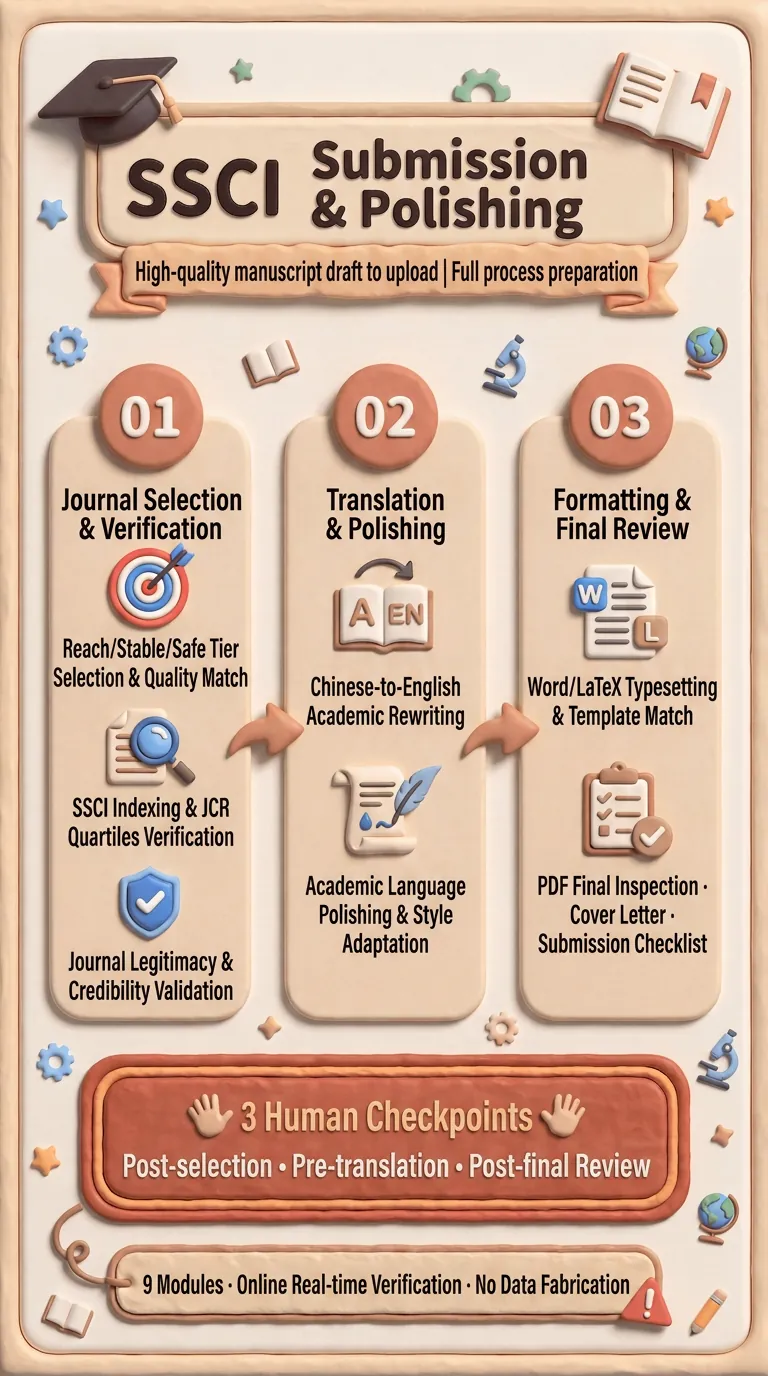
SSCI Submission & Polish
Overview: A full-process Skill for pre-submission preparation of SSCI papers, supporting journal recommendations, native language translation, English editing, target journal adaptation, format checking, reference verification, Cover Letter and submission material organization. Core Capabilities: SSCI journal recommendation and legitimacy verification, aggressive/stable/safe submission strategy, target journal Author Guidelines analysis, sample literature style anchoring, Chinese-to-English academic paper conversion, English editing, Word/LaTeX/journal template format checking, reference and DOI verification, PDF submission file final check, Cover Letter drafting, plagiarism report interpretation, and submission material checklist organization. Keywords: SSCI, academic paper, submission, journal selection, English editing, academic translation, Cover Letter, Author Guidelines, references, Zotero, DOI, Word formatting, LaTeX, PDF final check, plagiarism check and reduction Notes: This Skill does not design research from scratch, rewrite theoretical frameworks, reanalyze data, or fabricate data/literature/reviewers. Its focus is to help users prepare their existing manuscripts into a state more suitable for submission.
 Write
WriteAcademic Paper Editor
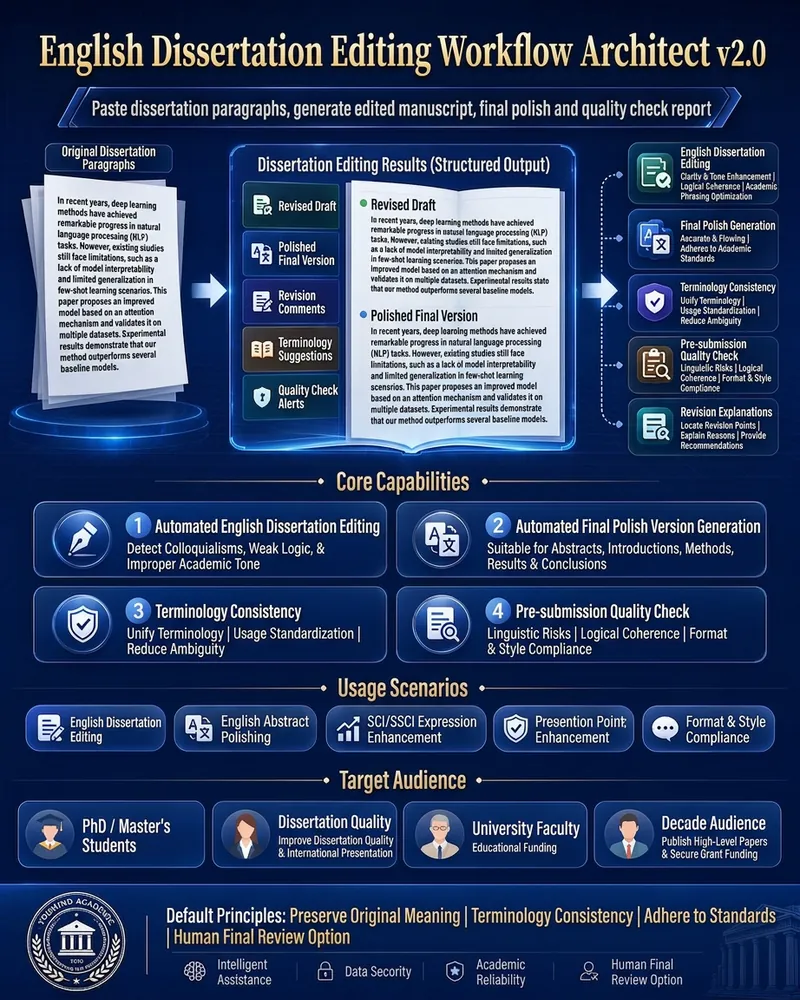
Paste a paper paragraph to generate a polished version, an English translation, and a quality-check report. It can help you: 1. Automatically polish Chinese academic papers Identify conversational wording, loose expression, logical jumps, and insufficiently academic tone, then produce more standardized and clearer academic Chinese. 2. Automatically generate an English translation Translate Chinese paper paragraphs into English that follows academic writing conventions while preserving terminology, logical relationships, and the tone of the research. 3. Automatically perform bilingual quality checks Check terminology consistency, logical flow, semantic deviations, grammar issues, long-sentence risks, and whether the academic phrasing is sound. 4. Automatically explain revisions In addition to providing the results, explain what was changed and why, making it easier to continue revising the full paper. Suitable for: PhD students, master's students, university instructors, researchers, paper submission authors, research group members, and writers of English abstracts and SCI/SSCI papers. How to use: Paste a paper paragraph and say what you want to do: “Please polish this Chinese academic paragraph.” “Please translate it into English.” “Please polish the Chinese first, then translate it into English.” “Please check whether this English paragraph fits academic writing conventions.” If you do not specify a mode, I will default to “Chinese polishing + English translation + quality-check report.”
 Write
WriteAIGC Reduction & Rewrite v7.0
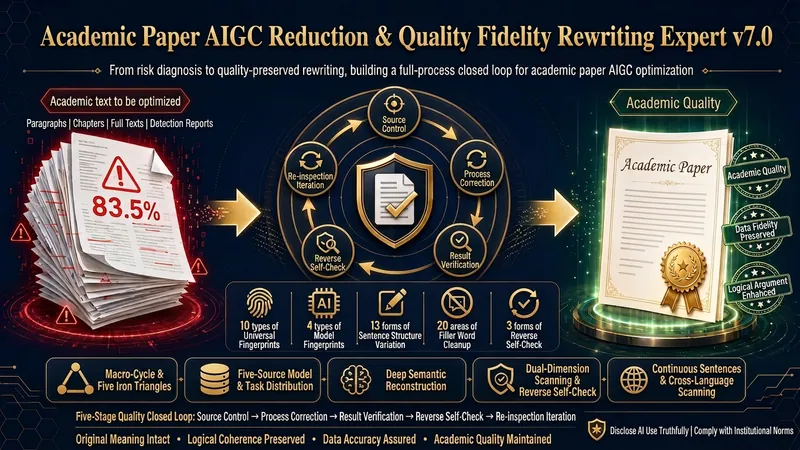
📚 Academic Paper AIGC Reduction and Quality-Preserving Rewriting Expert v7.0 Designed for graduate students, researchers, and paper authors, this academic text optimization skill operates on a core closed loop of 'source control → process correction → result verification → reverse self-check → iterative re-check'. It systematically diagnoses and optimizes issues such as templated expressions, mechanical logic, vague content, inaccurate terminology, and style inconsistencies while preserving original meaning, technical terms, data, and core conclusions. 🔍📝 🌟 Core Capabilities 🔬 Multi-layer Risk Diagnosis Covers 10 types of universal text fingerprints and assists in identifying common expression patterns of models such as ChatGPT, Claude, DeepSeek, and Wenxin Yiyan. 🧠 Deep Semantic Restructuring Goes beyond synonym replacement to rebuild more natural and in-depth academic reasoning by adjusting proposition expression, information order, argument approach, and evidence organization. ✍️ Quality-Preserving Rewriting Comprehensively applies 13 sentence transformation strategies and 20 methods for cleaning high-frequency templated expressions, improving mechanical sentence structures, repetitive connectors, and overly rigid formatting. 📊 Full-text Structure Diagnosis Through macro-cycle and five key triangles, checks whether research problems, theory, literature review, methods, results, conclusions, and innovation form a complete closed loop. 🧩 Fine-grained Section Adaptation Develops differentiated diagnostic and rewriting strategies for abstract, introduction, literature review, research methods, results, discussion, and conclusion respectively. 🌐 Cross-language Risk Scanning Assists in identifying translationese, passive voice stacking, long sentence nesting, and mixed Chinese-English formatting abnormalities to make Chinese academic expression more natural and accurate. 🔄 Reverse Self-check Loop After rewriting, re-verifies from three aspects: technique distribution, new text fingerprints, and information integrity, to avoid 'becoming more templated' or losing key content. 🛡️ Academic Integrity Protection Does not fabricate literature, data, cases, or policy evidence; separately marks information requiring author verification and reminds users to honestly disclose AI usage. 🎯 Use Cases ✅ Single paragraph or partial section optimization ✅ Targeted modification of marked paragraphs from inspection reports ✅ Polishing of abstract, introduction, literature review, discussion, and conclusion ✅ Full-text AIGC risk feature diagnosis ✅ Language and structure adaptation for target journals ✅ Pre-submission quality review and consistency check 📦 Final Deliverables 📄 Quality-preserving rewritten text 🔎 Risk and issue diagnosis report 🛠️ Rewriting strategy and technique description ✅ Reverse self-check and information integrity report 💡 Items requiring author verification and subsequent revision suggestions 🎓 Original meaning preserved · Logic intact · No fabricated data · Academic quality maintained ⚠️ This skill aims to improve academic expression quality and reduce text risk features. It does not guarantee passage through any specific detection platform or achieving a particular detection score.
Academic Paper Translation
Description
Translate complete Chinese academic papers into English manuscripts that meet SSCI journal publication standards, outputting a properly formatted Word document. Supports custom journal style guides, automatic retrieval of professional terminology, handling of long and complex sentences and cultural expressions, preserving the original structure and formatting.
Related Skills
View allSSCI Submission & Polish
Overview: A full-process Skill for pre-submission preparation of SSCI papers, supporting journal recommendations, native language translation, English editing, target journal adaptation, format checking, reference verification, Cover Letter and submission material organization. Core Capabilities: SSCI journal recommendation and legitimacy verification, aggressive/stable/safe submission strategy, target journal Author Guidelines analysis, sample literature style anchoring, Chinese-to-English academic paper conversion, English editing, Word/LaTeX/journal template format checking, reference and DOI verification, PDF submission file final check, Cover Letter drafting, plagiarism report interpretation, and submission material checklist organization. Keywords: SSCI, academic paper, submission, journal selection, English editing, academic translation, Cover Letter, Author Guidelines, references, Zotero, DOI, Word formatting, LaTeX, PDF final check, plagiarism check and reduction Notes: This Skill does not design research from scratch, rewrite theoretical frameworks, reanalyze data, or fabricate data/literature/reviewers. Its focus is to help users prepare their existing manuscripts into a state more suitable for submission.
WriteAcademic Paper Editor
Paste a paper paragraph to generate a polished version, an English translation, and a quality-check report. It can help you: 1. Automatically polish Chinese academic papers Identify conversational wording, loose expression, logical jumps, and insufficiently academic tone, then produce more standardized and clearer academic Chinese. 2. Automatically generate an English translation Translate Chinese paper paragraphs into English that follows academic writing conventions while preserving terminology, logical relationships, and the tone of the research. 3. Automatically perform bilingual quality checks Check terminology consistency, logical flow, semantic deviations, grammar issues, long-sentence risks, and whether the academic phrasing is sound. 4. Automatically explain revisions In addition to providing the results, explain what was changed and why, making it easier to continue revising the full paper. Suitable for: PhD students, master's students, university instructors, researchers, paper submission authors, research group members, and writers of English abstracts and SCI/SSCI papers. How to use: Paste a paper paragraph and say what you want to do: “Please polish this Chinese academic paragraph.” “Please translate it into English.” “Please polish the Chinese first, then translate it into English.” “Please check whether this English paragraph fits academic writing conventions.” If you do not specify a mode, I will default to “Chinese polishing + English translation + quality-check report.”
WriteAIGC Reduction & Rewrite v7.0
📚 Academic Paper AIGC Reduction and Quality-Preserving Rewriting Expert v7.0 Designed for graduate students, researchers, and paper authors, this academic text optimization skill operates on a core closed loop of 'source control → process correction → result verification → reverse self-check → iterative re-check'. It systematically diagnoses and optimizes issues such as templated expressions, mechanical logic, vague content, inaccurate terminology, and style inconsistencies while preserving original meaning, technical terms, data, and core conclusions. 🔍📝 🌟 Core Capabilities 🔬 Multi-layer Risk Diagnosis Covers 10 types of universal text fingerprints and assists in identifying common expression patterns of models such as ChatGPT, Claude, DeepSeek, and Wenxin Yiyan. 🧠 Deep Semantic Restructuring Goes beyond synonym replacement to rebuild more natural and in-depth academic reasoning by adjusting proposition expression, information order, argument approach, and evidence organization. ✍️ Quality-Preserving Rewriting Comprehensively applies 13 sentence transformation strategies and 20 methods for cleaning high-frequency templated expressions, improving mechanical sentence structures, repetitive connectors, and overly rigid formatting. 📊 Full-text Structure Diagnosis Through macro-cycle and five key triangles, checks whether research problems, theory, literature review, methods, results, conclusions, and innovation form a complete closed loop. 🧩 Fine-grained Section Adaptation Develops differentiated diagnostic and rewriting strategies for abstract, introduction, literature review, research methods, results, discussion, and conclusion respectively. 🌐 Cross-language Risk Scanning Assists in identifying translationese, passive voice stacking, long sentence nesting, and mixed Chinese-English formatting abnormalities to make Chinese academic expression more natural and accurate. 🔄 Reverse Self-check Loop After rewriting, re-verifies from three aspects: technique distribution, new text fingerprints, and information integrity, to avoid 'becoming more templated' or losing key content. 🛡️ Academic Integrity Protection Does not fabricate literature, data, cases, or policy evidence; separately marks information requiring author verification and reminds users to honestly disclose AI usage. 🎯 Use Cases ✅ Single paragraph or partial section optimization ✅ Targeted modification of marked paragraphs from inspection reports ✅ Polishing of abstract, introduction, literature review, discussion, and conclusion ✅ Full-text AIGC risk feature diagnosis ✅ Language and structure adaptation for target journals ✅ Pre-submission quality review and consistency check 📦 Final Deliverables 📄 Quality-preserving rewritten text 🔎 Risk and issue diagnosis report 🛠️ Rewriting strategy and technique description ✅ Reverse self-check and information integrity report 💡 Items requiring author verification and subsequent revision suggestions 🎓 Original meaning preserved · Logic intact · No fabricated data · Academic quality maintained ⚠️ This skill aims to improve academic expression quality and reduce text risk features. It does not guarantee passage through any specific detection platform or achieving a particular detection score.
Find your next favorite skill
Explore more curated AI skills for research, creation, and everyday work.