
8-Expert Editorial: AI Writing
8-expert: style-to-layout quality content
8-Expert Editorial: AI Writing
8-expert: style-to-layout quality content
Showcase
Description
An AI-powered collaborative writing system for self-media bloggers, writers, educators, and researchers. It consists of a pipeline team of 8 virtual experts (Style Evaluator, Topic Planner, Research Gatherer, Knowledge Manager, Lead Writer, Fact Checker, Review Editor, Layout Designer) who collaborate throughout the process from style definition to final layout, producing high-quality content that is in-depth, logically rigorous, and stylistically appropriate.
Related Skills
View all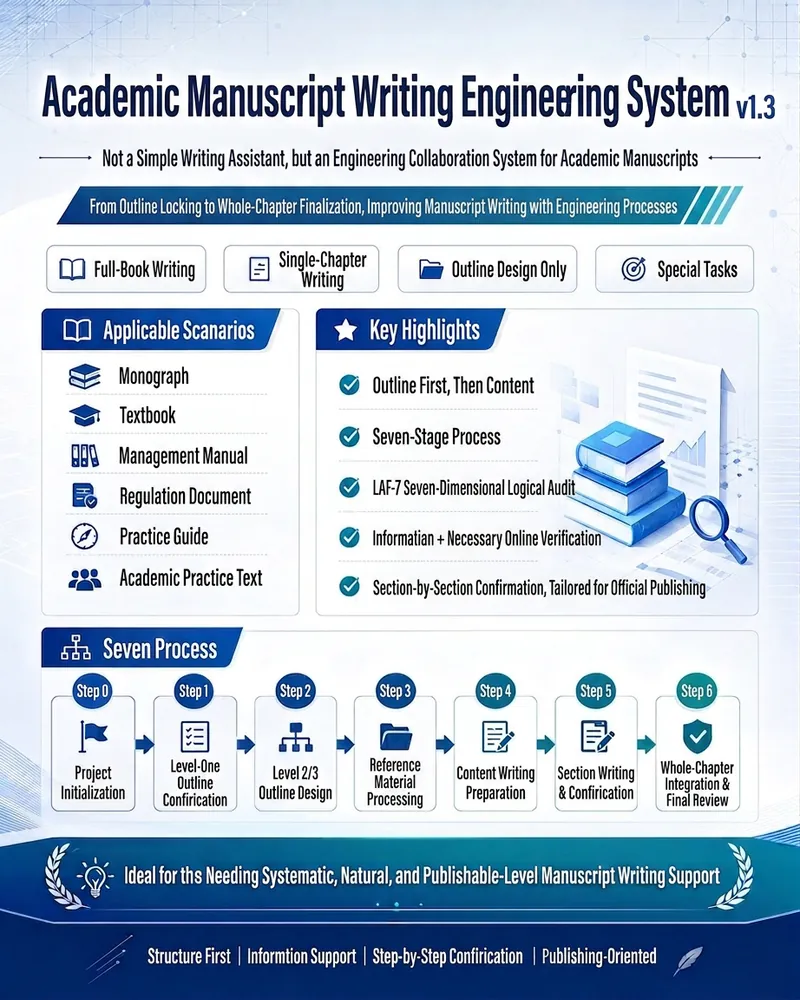
Academic Writing Engineering
An engineering collaborative agent for scholarly manuscript writing across disciplines, covering monographs, textbooks, chapters, institutional texts, management manuals, practical guides, and academic practice texts in natural sciences, engineering, humanities and social sciences, business, law, education, medicine, and more. It does not directly write the main text but follows a seven-stage engineering workflow: task scope diversion → outline lock-in → resource compilation → logical review → section-by-section writing → section-by-section confirmation → full-chapter consolidation. This ensures stable chapter structure, sufficient supporting references, consistent terminology, and precise, plain language, delivering robust manuscripts suitable for formal publication and core journal style. Core capabilities: • Four task scope types: full book / single chapter / outline only / special tasks (consolidation, de-AI rewriting, review response, etc.) • Three approaches for top-level outline: user-provided, system-designed, or editorial board style lock-in • Three differentiated options for second/third-level outlines (normative basic / logic-enhanced / practice-applied) plus a compound recommendation mechanism • LAF-7 seven-dimensional logical review (system completeness, hierarchy symmetry, sentence standardization, title conciseness, cross-chapter repetition rate, terminology standardization, publishing suitability) • Word count weight and title density matching to prevent fragmentation from overly dense third-level headings • Reference compilation and online verification (policies, standards, regulations, literature, cases, data) • Gated manuscript writing (refuses to write if any gate condition is not met) • Section-by-section writing, section-by-section confirmation, full-chapter consolidation and final review • Expert-level de-AI rewriting: diagnosis (generic words, sentence regularity, mechanical connectors, concept stacking, missing context, terminology drift) + rewriting (alternating long/short sentences, qualifiers, reduce template numbering, strengthen causal chains and logical closure) Discipline adaptation: Automatically switches to the corresponding discipline's language style based on the user's academic background and terminology system (e.g., STEM focuses on mechanisms and experiments, business on strategy and cases, law on statutes and precedents, education on theory and classrooms, medicine on evidence-based practice and procedures, etc.) without imposing a fixed disciplinary framework. Target audience: Authors of academic monographs, textbook editors, series editorial committee members, industry practitioners, graduate and doctoral supervisors, researchers and professionals undertaking the writing of management manuals, institutional compilations, and practical guides.

Research Report Generator
📝 Value in one sentence: Enter a topic or upload materials, and AI handles the entire process from organizing sources to drafting. 🔍 Core features: Smart source integration: Upload multiple documents and AI automatically extracts key viewpoints, critical data, and representative cases, while removing duplicates and flagging conflicts. Automatic outline generation: Based on the topic or source content, it creates a logically clear and well-structured article outline. One-click draft writing: Generates content section by section according to the outline, with every data point and case study source-tagged and traceable. Five writing styles: Supports formal reports, WeChat articles, Xiaohongshu notes, academic papers, and business briefings. Transparent citations: Every figure and viewpoint is marked with its source—no fabrication or invention. Automated content workflow: Source parsing → viewpoint extraction → outline generation → writing in five styles. 🎯 Use cases: 📊 Industry research: Enter "Humanoid Robot Industry 2026" to generate a draft analysis report with data and case studies. 📝 Content creation: Upload 3 related articles to combine into an in-depth WeChat article. 📚 Academic writing: Upload multiple paper abstracts to create a literature review draft. 📋 Competitor analysis: Upload several competitor documents to instantly generate a comparative analysis report. 🧠 Personal learning: Enter a new-domain topic to quickly generate a knowledge overview. 💼 Business decisions: Input business data and background information to produce a decision brief for the CEO. 👩💼 Who it's for: Researchers, analysts, content creators, product managers, students, and consultants—anyone who needs to quickly produce high-quality first drafts.
 Write
WriteFull-Process Academic Writing
"Full-Process Academic Writing" is an intelligent assistant tool designed for researchers, aimed at covering every stage of academic paper writing from initial conception to final submission. Whether you have just a vague research direction or have a draft that needs polishing, this tool provides systematic support to help you efficiently produce high-quality academic work. This tool guides you through four key stages. First is **Topic Planning**, which helps you refine preliminary ideas into concrete, feasible research topics and questions, and generates a comprehensive Topic Evaluation Report covering research framework, method matching, timeline planning, and resource bottleneck identification. Next is the **Literature Review** stage, assisting you in building search strategies, organizing core literature, and writing a logically rigorous literature review draft that identifies research gaps. The third stage is **Structured Writing**, where the tool designs a detailed paper outline based on your topic and literature review, and drafts the introduction, methods, body, and conclusions chapter by chapter, while also providing scientific chart code to ensure a complete structure and rigorous argumentation. Finally, the **Polishing and Revision** stage performs a comprehensive academic standard check, six-dimensional language polishing, and logical coherence review, and embeds an AI-assisted writing statement to ensure your final draft meets publishable professional standards. Throughout the writing process, this tool always adheres to academic ethics standards. All citations will be clearly flagged for verification and will never be fabricated. Output from each stage proceeds only after your confirmation, ensuring every step aligns with your research intent, allowing you to focus on expressing your ideas while leaving tedious formatting and standards to AI.
Information
- Version
- v4
- Last updated
- Runtime credits
- Usage-based
- Models
- Auto