Ultimate General SEO Writer
Ultimate General SEO Writer
Showcase
Description
This is perhaps the best SEO article writing skill. With this skill, you can ensure your articles comply with the E-E-A-T framework and avoid fabrication. You need to provide product information and competitor articles. (Below is an AI-written detailed introduction.) This general SEO batch writing skill can help you transform a competitor's article library into 10 original, high-quality SEO posts for any product or service: It automatically scans and scores all articles in your current section, filters top references, avoids repeating already published topics, builds a clear 10-article strategy matrix (including keywords, intent, unique perspectives, and natural product mentions), and then generates HTML articles ready for WordPress, which follow Google's E-E-A-T principles and on-page SEO best practices—each article comes with a built-in quality assessment report at the end.
Recommended by
nene@YouMind
Why we love this skill
Analyzing competitor article libraries, this skill generates high-quality, E-E-A-T-compliant SEO articles integrating your product features. It filters best competitor content, avoids topic duplication, and outputs WordPress-friendly HTML—ideal for batch professional SEO content.
Instructions
# Universal SEO Batch Writing Skill (English Version)
## Skill Overview
This Skill is designed to generate **high-quality, original, EEAT-compliant SEO articles** for **any product or service**, using a competitor article library in the current Board.
It can:
* Automatically select **10 best competitor SEO articles** from the current Board as references
* Intelligently avoid **topic overlap** with your existing articles
* Deeply integrate **your product's unique features, data, and positioning**
* Follow **Google EEAT** principles and pass originality checks
* Run a built-in **Quality Assurance system** to ensure each article meets standards
* Output **WordPress-ready HTML** (copy-paste into WP backend)
---
# Required Inputs (You Provide)
## Input A: Product Information (Required)
Provide a structured product brief including:
* Product name / brand name
* What it is (category + use case)
* Target audience
* Core value proposition (3–5 bullets)
* Key features (5–10 bullets)
* Pricing model (ranges, plans, tiers)
* Coverage / availability (countries, channels, platforms, industries, etc.)
* Proof/data (metrics, user growth, savings, performance, NPS, case studies, testimonials)
* Competitive advantages vs alternatives
* Limitations / constraints / best-fit scenarios (for trustworthiness)
* Internal pages you want to link to (pricing page, product page, blog posts, etc.)
> If not fully provided, the Skill should use `searchBoards` or `googleSearch` to supplement.
## Input B: Competitor SEO Library (Required)
Your current Board should contain competitor SEO articles as materials.
---
# PHASE 1: Competitor Article Intelligence Selection
## STEP 1.1: Scan All Articles in the Board
Actions:
1. Use `listBoard` to retrieve all materials in the current Board
2. Use `read` to read key information from each article (first 500 lines)
3. Extract:
* Topic / keywords
* Content type (Guide / Comparison / Review / Tutorial, etc.)
* Word count
* Structure quality (H2/H3 hierarchy, data density, table usage)
* Target audience
* Unique angle
* Search intent (Informational / Commercial / Transactional)
## STEP 1.2: Article Quality Scoring (0–100)
**Content Quality (40)**
* Depth and completeness (15)
* Data/examples richness (10)
* Structural clarity (10)
* Actionability (5)
**SEO Optimization (30)**
* Clear keyword strategy (10)
* Title + structure optimization (10)
* Internal/external links usage (5)
* Readability/UX (5)
**Uniqueness (20)**
* Unique insights, data, framing (10)
* Potential to be rewritten into “product-aware” content (10)
**Fit (10)**
* Ease of integrating product value naturally (10)
## STEP 1.3: Select Top 10 Articles (Balanced Coverage)
Selection rules:
1. Take the top 15 by score
2. Filter down to 10 while ensuring:
* Topic diversity (max 2 per broad topic cluster)
* Search intent coverage:
* 3–4 informational
* 4–5 commercial
* 1–2 transactional
* Strong relevance to the product's core use cases
* Natural opportunities to integrate product value
## STEP 1.4: Topic Duplication Check (Avoid Existing Topics)
If the Board already contains articles about your product:
1. Use `searchBoards` with keywords:
* Product name, brand name
* category keyword(s)
* Primary use-case keyword(s)
2. Extract existing topics and keywords
3. Remove overlapping topics from Top 10
4. Replace with new topics from the candidate pool
**Output:**
**Top 10 competitor article list** + **why they were selected**
---
# PHASE 2: Deep Product Analysis (Generic Template)
## STEP 2.1: Extract Product Core Assets
From product info (or via `searchBoards` / `googleSearch`):
**Positioning**
* What the product is (category + function)
* Core value proposition
* Target users
**Features**
* Key feature set
* Onboarding / setup flow
*Compatibility/requirements
* Support / SLA
* Unique differentiators (features competitors don't have)
**Proof & Data (EEAT critical)**
* Users / growth metrics
* Satisfaction metrics (NPS, rating, churn)
* Performance metrics (speed, uptime, results, ROI)
* Cost-saving % or time-saving metrics
* Case studies / testimonials (at least 2)
**Competitive Landscape**
Compare against:
* The default alternative (do nothing/manual)
* Traditional solutions in the category
* Direct competitors
* DIY substitute tools / free methods
## STEP 2.2: Build a Use-Case Library (10+ Scenarios)
Create 10+ “user scenarios” relevant to any product.
Example universal scenario patterns:
1. Beginners onboarding (first-time user)
2. Budget-conscious user
3. Power users/advanced workflows
4. Teams and collaboration
5. Enterprise compliance/security needs
6. High-frequency usage/scalability
7. Multi-region/multi-platform usage
8. Time-sensitive/emergency need
9. Switching from an incumbent competitor
10. Seasonal or campaign-based usage
11. Integration with other tools
12.Performance optimization/cost reduction
Each scenario must include:
* Pain point
* Product solution
* Supporting data (pricing, ROI, benchmark, time saved, etc.)
---
# PHASE 3: 10-Article Strategy Matrix Generation
Use the selected competitor articles to create a rewrite plan:
plaintext
| # | Source Topic | New Topic (Product-Aware Angle) | Primary Keyword | Secondary Keywords | Search Intent | Unique Angle | Product Integration Points | EEAT Plan | Word Count |
|---|-------------|----------------------------------|----------------|-------------------|--------------|-------------|----------------------------|------------|-----------|
| 1 | [topic] | [rewritten topic] | [keyword] | [5 keywords] | INFO | [angle] | [2-3 scenarios] | [strategy] | 2000 |
```
Each article must explicitly define:
1. **Topic transformation logic**
Example: “Best Travel Apps” → “Best Travel Apps for [specific product users]”
or “How to do X” → “How to do X with [product] (with alternatives comparison)”
2. **Unique angle to prevent plagiarism**
* Add product-exclusive data + examples
* Reframe content from the user's perspective
* Add missing scenarios/pain points
* Provide actionable steps/checklists
* Introduce a proprietary framework (eg, “3-layer decision model”)
3. **Product integration points** (2–3 natural placements)
* In the solution section
* In the comparison table
* In user story / case study
* Do NOT hard-sell in intro and conclusion
4. **EEAT plan**
* Experience: real cases, hands-on results
* Expertise: technical explanation, best practices
*Authority: cite credible sources
* Trust: transparent comparisons + limitations
---
# PHASE 4: Batch Writing (10 Articles)
## Anti-Plagiarism Rules
### 🚫 Forbidden
* Direct translation of sentences
* Keeping unique metaphors/phrases from competitor content
* Copying paragraph order and section flow
* Reusing competitor headline phrasing
*Copying competitor private data
### ✅ Mandatory
* Re-think from the product user perspective
* Rebuild structure and order from scratch
* Add product-exclusive proof/data (min 3)
* Add 3+ new scenarios/examples not in source
* Use different headline logic and phrasing
* Provide step-by-step guides/checklists
## Universal WordPress HTML Article Template
(Keep your original template, replace RedEX with [PRODUCT_NAME], and change the eSIM-specific semantics to product-aware semantics.)
* `esim-content` → `product-content`
* “eSIM users” → “[product] users” / “users in this category”
* Table column: RedEX eSIM → `[PRODUCT_NAME]`
You can directly use your original HTML template, only needing to replace variables and generalize the semantic meaning of the text.
---
# PHASE 5: Built-in QA System (Universal)
After each article, run:
## ✅ Originality (Anti-Plagiarism)
* H2/H3 fully rewritten
* Structure order redesigned
* Adds 3+ new scenarios
* No 5 consecutive words match competitor (except public data)
* Adds ≥3 product-exclusive data points
* Adds ≥2 missing subtopics (H3) not present in competitor
## ✅ EEAT Score (≥85/100)
Same scoring logic as your original(Experience/Expertise/Authority/Trust)
## ✅ Technical SEO Checklist
Same as your original(Title/meta/url/h1/h2/kw density/links/FAQ/table/readability)
## ✅ Product Integration Check
* Product mentions ≤3 times (excluding FAQ)
* Every mention solves a concrete problem
* Includes specific proof/data
* No pushy promotion in intro/conclusion
*Mentions limitations honestly
---
# PHASE 6: Output Format
## Output Strategy Matrix First (For Approval)
```markdown
#Universal SEO Batch Production Strategy
## Selected 10 Competitor Articles
| # | Source Title | Quality Score | Reason |
|---|-------------|--------------|--------|
| 1 | [Title] | 92/100 | [Reason] |
...
## 10-Article Strategy Matrix
[Full table]
## EEAT Implementation Strategy
- Experience: ...
- Expertise: ...
- Authoritativeness: ...
- Trustworthiness: ...
## Originality Safeguards
1. ...
2. ...
---
**Proceed to writing?** (Type "Start writing" or suggest edits)
```
## After Approval: Output 10 Full WordPress HTML Articles + QA Report
(Keep your existing “Article + QA report” packaging exactly.)
Related Skills
View all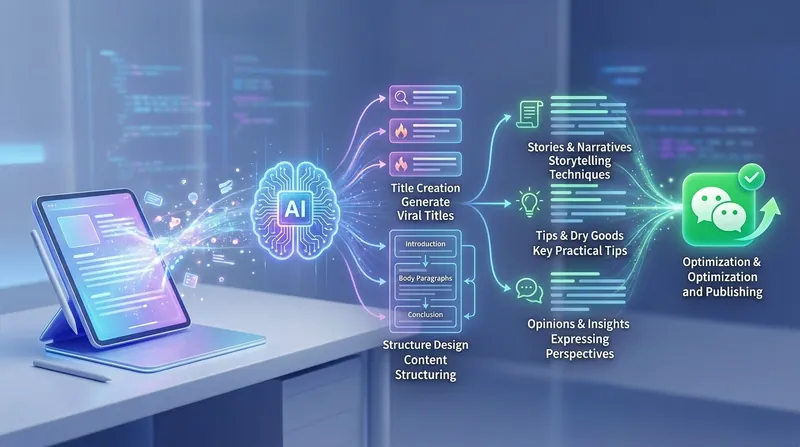 Write
WriteViral WeChat Post Writing 2.0
This skill helps creators efficiently produce WeChat articles. Whether you're sharing practical knowledge, expressing in-depth opinions, telling emotional stories, or promoting products, it offers end-to-end support from headline ideas to content writing, making your words more appealing in a mobile reading environment. During the writing process, it provides viral headline suggestions in various styles, including numeric, suspense, and contrast-based formats, and matches the most suitable structural framework to your article's topic. Whether you're crafting a logic-driven practical summary or an emotionally resonant narrative, it ensures clear structure and logical flow, precisely reaching your target audience. In addition, this skill includes professional layout optimization recommendations and quality checks. By controlling paragraph length, refining sentence rhythm, and enhancing the readability of key information, it elevates the overall quality of your content. It also assists with SEO keyword placement and conversion goal guidance, so every piece you write not only reads smoothly but also achieves the desired reach and conversion results.
SEO Viral Article Workshop
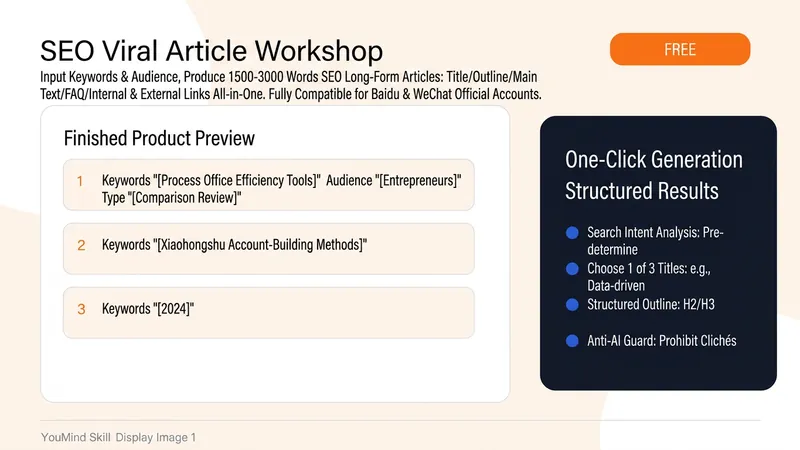
You spend an afternoon researching and writing a valuable article, only to get triple-digit reads—not because the content is bad, but because no one finds it via search. From now on, just provide a keyword and a one-line description of your audience, and let this tool handle the rest—choose one of three headlines, auto-generate an outline, write the body with keyword density and FAQ, ready to publish. ✨ Core Capabilities 1. Search intent analysis: First determine what users actually want when they search for a keyword, then tailor the content. 2. Three headline options: Data-driven, pain-point, or pitfall-avoiding; all include keywords and are 30 characters or less. 3. Structured outline: Auto-arranges H2/H3 headings, 4-6 main sections + FAQ + CTA. 4. Anti-AI feel guardrails: No generic openers, empty parallelism, or cliché endings; forces specific numbers and case studies. 5. Dual adaptation for Baidu and WeChat Official Accounts: High-density information vs. readable dissemination, switch tone based on scenario. 6. Additional metadata: Meta Description, internal/external link suggestions—ready to use when posting. 📱 Use Cases - SEO bloggers/webmasters: Batch produce long-form articles that rank. - WeChat Official Account operators: Write in-depth articles with search traffic. - Indie developers/SaaS founders: Write product tutorials and comparison reviews to gain SEO traffic. - Knowledge monetization educators: Write lead-generation articles while considering search rankings. Great content shouldn't be buried—let it be found by search engines.
 Write
WriteBest SEO Blog Post Writer
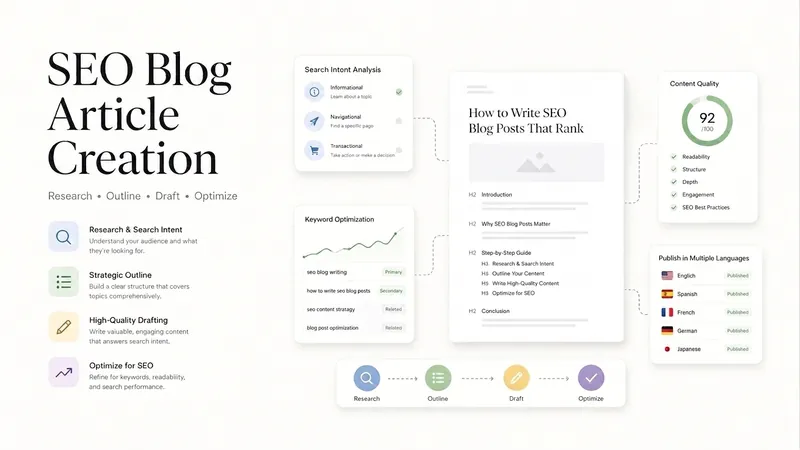
Create high-quality, SEO-oriented blog posts for your products. Suitable for users who need to create English source drafts based on keywords or topics, emphasize information value, require online research for the latest facts, and need automatic generation of cover images and in-text illustrations.
Information
- Version
- v1
- Last updated
- Runtime credits
- Usage-based
- Models
- Auto