Book2Skill — Distill Any Book
Stop taking notes — turn books into callable skills.
Book2Skill — Distill Any Book
Stop taking notes — turn books into callable skills.
Showcase
Description
Stop taking notes — turn books into callable skills. Turn any book into a set of skills you can actually call inside YouMind. An eight-stage pipeline reads the whole book, extracts its methods, stress-tests them, and registers each as a one-click skill — every one carrying its source, triggers, and boundaries. Distill, never fabricate. Stop collecting reading notes; put the book to work.
Related Skills
View all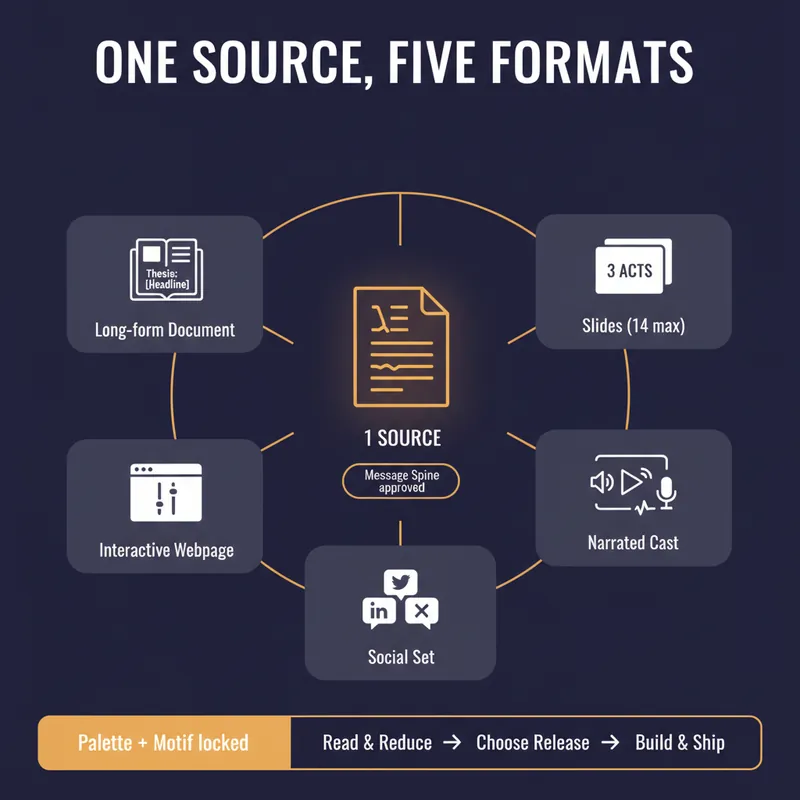 Write
WriteOne Source, Five Formats
YouMind can produce a document, a slide deck, a narrated video, an interactive webpage and a set of social posts. Most people use one of them, because doing all five by hand means writing the same argument five times and watching it drift a little further each time. This skill stops the drift by refusing to start until you have a spine. Before anything is generated it writes a Message Spine: one thesis under 25 words, three load-bearing points, the single strongest piece of evidence, the one image a reader should still have tomorrow, the change you want in them, and who this is explicitly not for. You approve it. Every format is then built from the spine, never from the previous format, so nothing compounds an earlier compromise. Then it tells you which formats are actually worth making. A short reflective essay makes bad slides. A dense data teardown makes bad audio. It will recommend two formats and explain why the other three would weaken the work, which is the opposite of what a content-multiplier is supposed to say. Each format gets built to its own rules, one at a time, with your confirmation. Slides get one idea per slide and speaker notes that carry the argument. The cast script is written for the ear, with numbers rounded and given a comparison and a deliberate pause before the strongest evidence. The webpage gets exactly one interactive move the flat text could not do. The social set opens each post on a different point so it does not read as three copies of itself, and every post gives away something real instead of begging for a click. One palette, one type treatment, one recurring motif, decided in writing before the first image is generated. You finish with a ship sheet: what goes where, in what order, how many days apart, with what call to action, and the one signal to watch. Plus a consistency check that quotes the thesis sentence from every format and confirms they still agree. It estimates credits before it spends them and never renders a full cast or image set without an explicit yes.
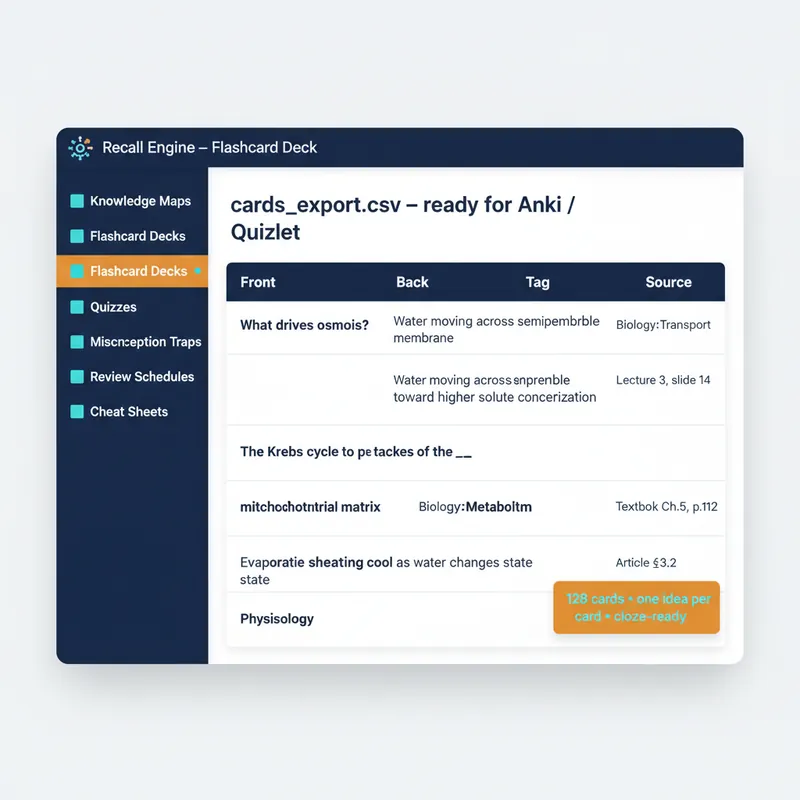
Recall Engine: Study Kit from Sources
You read it. You highlighted it. A week later it is gone. YouMind is very good at helping you collect and create. Recall Engine handles the part in between: actually keeping what you read. Point it at a board, an article, a PDF, a lecture or a podcast transcript and it builds a complete study system out of that specific material — not a generic summary. What you get: • A testable knowledge map that separates the 8-15 things you must know from the detail and the context, each tied to its source • A ready-to-import flashcard deck as CSV — paste straight into Anki, Quizlet or a spreadsheet — written to real card-design rules: one idea per card, cloze for definitions, question form for causes, nothing with a four-item answer • A three-tier quiz that moves from recall to application to transfer, each question with its answer, its source, and the wrong answer you were most likely to pick • Five misconception traps drawn from the actual material, in the form "most people think X, actually Y, and here is why the confusion happens" • A dated review schedule on expanding intervals that fits your real deadline and your real minutes per day • A one-page cheat sheet, plus the three questions your source never answers It calibrates first: exam, interview, teaching it, or long-term fluency all produce different decks. It refuses to invent a fact to make a neat card — where a source is ambiguous, the card asks about the ambiguity. Contested claims are tagged, with the counter-view on the back. Built for students, researchers, people preparing for interviews or certifications, and anyone whose reading list is longer than their memory.
 Research
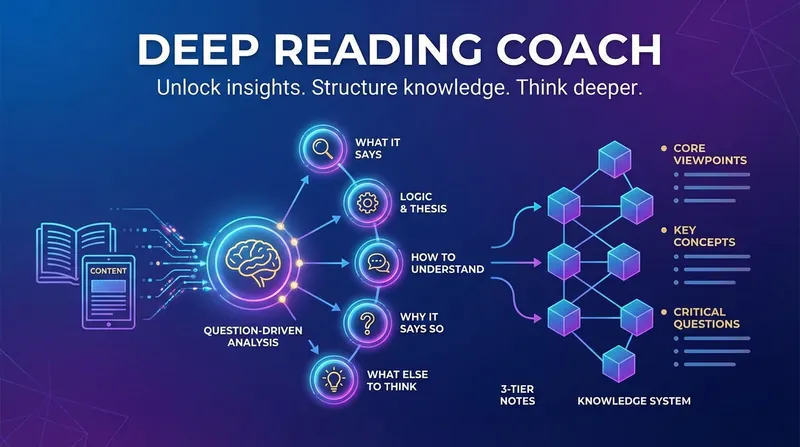
Deep Reading Coach
Transform fragmented content into structured insights using the "Question-Driven 5-Step Method" and "3-Tier Notes". Supports articles, papers, videos, podcasts, books, and more. Decode complex ideas with clarity and critical thinking.
Information
- Version
- v3
- Last updated
- Runtime credits
- Usage-based
- Models
- Auto