
Selected Works of Mao
Analyze complex decisions and dilemmas
Selected Works of Mao
Analyze complex decisions and dilemmas
Showcase
Description
When facing business decisions, startup strategies, workplace competition, organizational management, project bottlenecks, major personal choices, or industry issues, this turns complex dilemmas into manageable, actionable problems. It uses principles from the Selected Works of Mao such as seeking truth from facts, interest analysis, principal contradictions, unity of opposites, protracted war, mass line, and practice to strip away emotions, slogans, and surface conflicts, pointing directly to the interest structures and critical contradictions that determine success or failure. Whether you provide a brief description or full background, you will receive a distinct and in-depth analysis: clarifying known facts and information blind spots, identifying allies, opponents, and forces that can be won over, determining whether to defend, build strength, or concentrate for a breakthrough under current conditions, and deducing feasible paths for different scenarios. The analysis does not dodge problems or replace judgment with ambiguous balance. The final output is a complete breakthrough analysis and action plan covering emergency damage control, near-term breakthroughs, and long-term mechanism building, complete with low-cost validation actions and feedback standards to help you quickly correct your judgment in real-world practice. Ideal for managers, entrepreneurs, and individual users who need strategic clarity, complex decision analysis, and executable solutions.
Recommended by
Dancang
Why we love this skill
Transforms the six-step thinking framework into a modern decision-making breakthrough tool, stripping away emotions and appearances to lock onto the primary contradiction, dissect interest structures, and provide verifiable, phased action plans within 72 hours.
Best for
Best for managers, entrepreneurs, and individuals who need to untangle complex situations, make strategic judgments, and build actionable plans.
How to use this Skill
Provide your input
Enter a business decision, startup strategy, workplace dilemma, project bottleneck, major personal choice, or industry issue, along with background, known facts, and constraints.
Run the Skill
After you submit your problem, the system organizes the facts, interests, and key contradictions, assesses the strategic stage, and deduces viable paths.
Review your result
Receive a structured breakthrough analysis and action plan, including emergency damage control, short-term breakthroughs, long-term mechanisms, and low-cost validation standards.
Related Skills
View all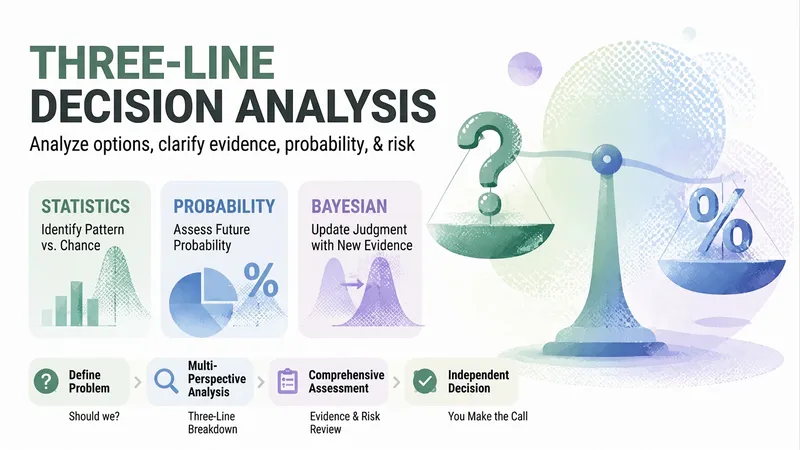
Should I Do It? Analysis
Turn the vague uncertainty of “Should I do X?” into a clearly bounded decision analysis that can be checked and updated over time. Whether you’re considering leaving your job to start a business, investing in a project, buying an asset, or making a career or life choice, you can provide text, tables, documents, or screenshots to organize your options, time horizon, major costs, how much risk you’re willing to accept, and how much confidence you need before acting. The analysis examines the question through statistics, probability theory, and Bayesian reasoning: checking whether samples are reliable and whether an observed pattern is more likely a real trend or a coincidence; breaking down possible future scenarios and comparing probabilities, expected returns, and tail risks; then combining prior beliefs with new evidence to determine which information is truly discriminating and how your judgment should be updated. User-provided facts, public information, and analytical assumptions are clearly separated. When reliable data is lacking, uncertainty is not concealed behind false precision. You’ll receive a replayable decision framework that includes new information worth verifying, actionable next steps, triggers for reassessment, and key evidence still needed. It won’t make the decision for you or present assumptions as facts. Instead, it helps you see the evidence, probabilities, costs, and risks clearly, leaving the decision in your hands.
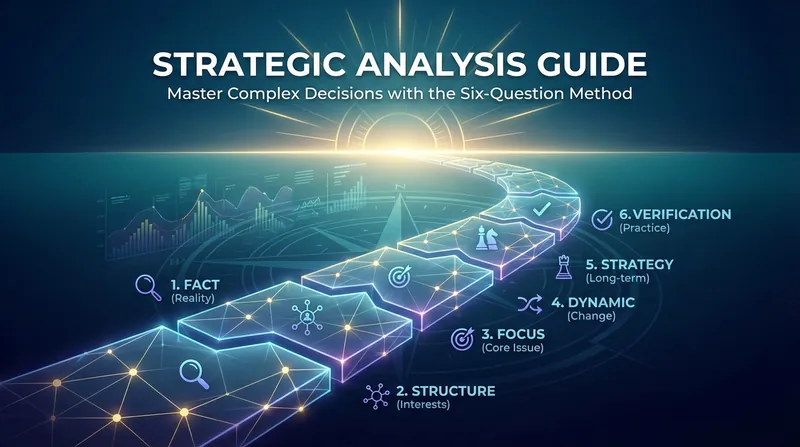
Mao's Strategic Six Questions
A strategic analysis framework based on Mao Zedong Thought, analyzing complex problems through six progressive questions: facts, interests, contradictions, dynamics, strategies, and verification. Supports two modes: quickly generate a complete analysis report, or engage in guided interactive deep thinking. Suitable for industry analysis, business decision-making, strategic planning, and other scenarios.
Multi-Framework Analysis
Turn complex problems into structured, multi-perspective analyses that can be reviewed, verified, and used to support next steps. Whether you are evaluating career choices, business and product decisions, social phenomena, controversial issues, trending topics, innovations, or abstract concepts, this Skill first clarifies the subject, goals, constraints, known information, and key unknowns. It then selects complementary cognitive frameworks based on the task, avoiding a pileup of concepts or repeated versions of the same conclusion. The analysis clearly distinguishes between information provided by the user, verified facts, general principles, assumptions, inferences, and content that still needs validation. It places evidence, mechanisms, counterevidence, alternative explanations, and uncertainty within a clear chain of reasoning. For time-sensitive, controversial, specialized, or high-risk facts, it can use targeted web searches and verify original sources. When sources conflict, it preserves the differences rather than filling gaps with unverified data or overly certain claims. The final output typically includes a problem profile; the framework selection and analysis of each framework; areas of agreement and disagreement across perspectives; sensitive variables; blind spots and failure conditions; and conditional conclusions with confidence levels. It does not replace professional medical, legal, investment, tax, or other advice. Instead, it helps you identify the factors that truly affect judgment and design minimal validation steps, information-gathering plans, decision gates, or reversible next steps. Simple questions can be condensed into a brief assessment, while complex or multi-subject tasks can be developed into a complete analytical report.
Information
- Version
- v6
- Last updated
- Runtime credits
- Usage-based
- Models
- Auto
- Use cases
- Research & analysisBusiness & strategyPersonal growth
- What you get
- ReportDocumentPlan
