
Critical Writing · IBAC
Build the logic first, then write with a complete argument
Critical Writing · IBAC
Build the logic first, then write with a complete argument
Showcase
Description
Many articles lack depth not because of the writing, but because the author has not fully clarified what question they are answering or why their conclusion follows. This skill uses Tian Hongyun’s critical writing structure, IBAC— I: Issue, B: major premise (hidden assumptions and beliefs), A: minor premise (facts and evidence), and C: Conclusion—to first narrow a topic into an arguable question, then create an IBAC argument map and pause for your confirmation. Once confirmed, it turns the framework into a complete argumentative essay, along with a hand-drawn marker-style structure diagram and an IBAC self-checklist that identifies, point by point, where premises remain weak and where evidence is missing. It does not embellish or fabricate: wherever evidence is insufficient, it writes “evidence needed” rather than glossing over the gap with rhetoric. Suitable for academic writing, science communication, workplace writing, and independent media, with flexible use across contexts.
Recommended by
Shuting@YouMind
Why we love this skill
IBAC clarifies the question, assumptions, evidence, and conclusion before drafting, visualizing, and checking each step for clear, verifiable reasoning.
Best for
Students, researchers, and content creators who need to organize complex ideas, strengthen their reasoning, and write argumentative essays.
How to use this Skill
Provide your input
Provide a writing prompt, claim to examine, or background material. You can also include style requirements and any evidence you already have.
Run the Skill
The skill organizes the question, premises, evidence, and conclusion, then builds an argument structure for you to review. After confirmation, it completes the article and checks for evidence gaps.
Review your result
Receive a clear argumentative essay, a hand-drawn-style argument diagram, and a self-checklist marking weak points.
Related Skills
View all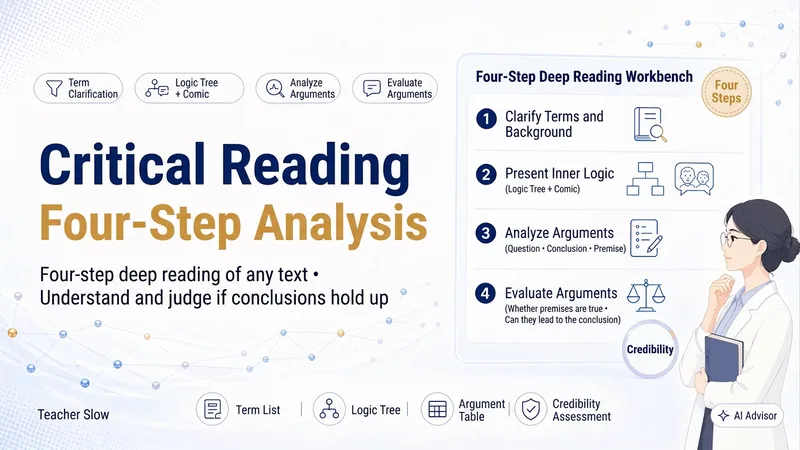 Research
Four-Step Critical Reading
When reading a book, paper, or report, the hardest part is often not understanding the words, but explaining what the author is really saying—and why they believe it. Based on Tian Hongyun’s *Critical Thinking in Plain English: From Beginner to Master*, this skill uses a four-step critical reading method to break down a passage: ① Clear up terminology and background obstacles; ② Use a text logic tree and a hand-drawn cartoon to map its underlying logic; ③ Create an analytical argument table identifying the issues, conclusion, premises, and unstated premises; ④ Create a commentary argument table to assess whether the premises are true and whether they support the conclusion. It then provides a credibility assessment of the conclusion and a list of knowledge that still needs to be added. It knows when not to overdo it: only texts that genuinely express a viewpoint go through all four steps, while purely explanatory or narrative texts go through the first two steps only. Suitable for papers, commentary, reports, policy texts, book passages, and any other material that calls for close reading, helping you move from “opening a book and counting it as reading” to genuine deep reading.
 Write
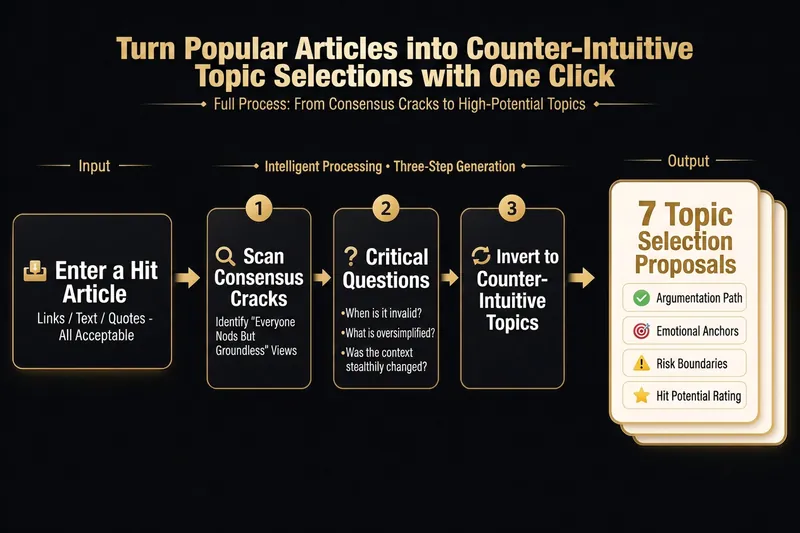
Write1 Post->3-7 Unexpected Topics
😤 Do you feel this too— You scroll through viral articles for an hour, save seven or eight, and feel like you've "learned." But when you sit down to come up with topics—your mind goes blank. Hundreds of articles in your bookmarks, and not one of them turns into your own content. You're not lacking material; you're lacking a method to "extract your own topics from others' viral posts." 🔍 Where's the problem— Inside every 100,000+ viral article, there are a few viewpoints that "most people nod along with, but actually don't hold up." Most people scroll past them. A few people pick these views out, think in reverse—and a new topic is born. The gap is in this one "deconstruction" action. 🛠️ How it helps you— 📥 Drop in a viral article link 🔬 Automatically scans the full text, picks out common consensus that "sounds right, but the conditions for truth are quietly stripped away" ❓ Dives into three key questions for each: ① Under what circumstances is it false? ② What does it oversimplify? ③ Which context did it sneak in from? 🔄 Reverses into 3–7 counterintuitive topic ideas 📊 Each comes with a complete output: ✅ Logical path — why this topic holds up ✅ Emotional hook audience — who it's for, what hits them ✅ Risk boundary — where you might go wrong ✅ 5‑dimensional viral score — how hard this topic can hit It doesn't give you a bunch of directions to think about; it gives you topics you can start writing on right away. ✍️ 🚀 Give it a try— Search for "1 Post->3-7 Unexpected Topics" in YouMind. Open it and drop a link to a viral article you've seen recently, and it will walk you through deconstructing it into topics. 🗂️ Supports deep dives on single articles + batch filtering 📎 Opinion pieces, experience sharing, tutorials, lists—works with any article type
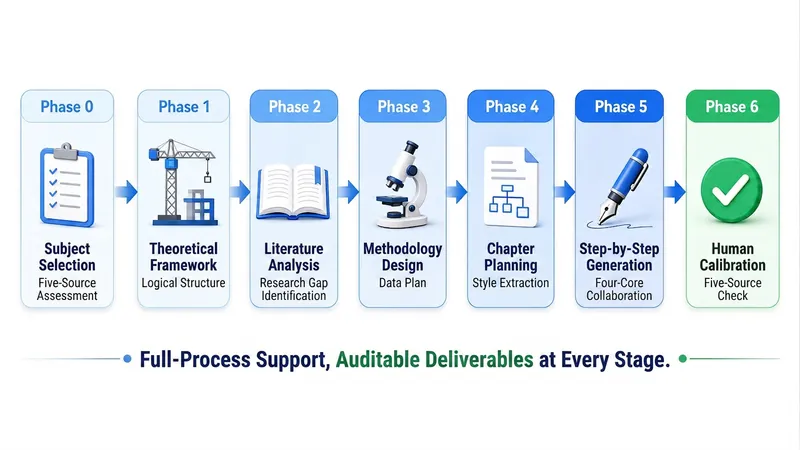
Proposal Readiness Checker
Before you spend dozens of hours writing your thesis, take ten minutes to run a structured checkup. This skill does only one thing: It diagnoses, not writes. It tells you whether your topic can hold up, whether your materials are sufficient, what's missing, where to fill the gaps, and in what order. Then it gives you an actionable missing-material checklist and search queries. It will not write your introduction, literature review, methods, or discussion. Four steps: 1. Discipline diagnosis: Classify your work into 1A Humanities/Arts, 1B Social Sciences, 2A Science/Engineering, or 2B Agriculture/Medicine/Life Sciences, and load the corresponding regulatory red lines; 2B triggers a mandatory ethics review block. 2. Topic checkup: Examine the topic from three dimensions—momentum, shape, and wording—to judge whether the research unit can be operationalized, whether the research question can be answered, and whether the topic has been done to death. 3. Material checkup: Register your existing literature into an M1/M2… material library, verify each entry against the four elements (author/year/title/verifiable locator), and compute the true coverage rate. 4. Gap list and search queries: Specify how many papers of what type are missing and which piece of evidence is lacking, and provide search queries ready to paste into databases (including Boolean keyword combinations, time ranges, and screening criteria). When to use it (trigger phrases): "Help me check my proposal" "Can this topic work?" "Do I have enough literature?" "My proposal was sent back" "I want to confirm before starting to write" — for graduate students who have just set a direction but haven't started writing; for those whose proposal was rejected but don't know why; for those with a pile of literature but unsure if it's enough to begin; for those wanting to confirm whether the topic is worth the investment before committing fully. Deliverables: A Proposal Checkup Report document + a Five-Source Readiness Scorecard (each level has behavioral criteria, not vague scoring) + a prioritized list of missing materials + search queries + an archive code. The archive code is compatible with the Academic Paper Full-Process Writing System v4.0; after the checkup, paste it there to continue writing without re-stating your discipline, topic, or journal. What this skill explicitly does not do: It does not write the main text, generate reference lists, or fabricate authors, years, volumes, issues, pages, or DOIs. Any literature found via online search is flagged with ⚠️ "needs verification" and must be verified by you before use. This skill does not promise any acceptance or passing outcome.
Information
- Version
- v4
- Last updated
- Runtime credits
- Usage-based
- Models
- Auto
- Use cases
- Writing & contentResearch & analysisLearning & education
- What you get
- ArticleReportImage
- Visual styles
- Hand-drawn