
Four-Step Critical Reading
Read closely and test whether the argument holds
Four-Step Critical Reading
Read closely and test whether the argument holds
Showcase
Description
When reading a book, paper, or report, the hardest part is often not understanding the words, but explaining what the author is really saying—and why they believe it. Based on Tian Hongyun’s *Critical Thinking in Plain English: From Beginner to Master*, this skill uses a four-step critical reading method to break down a passage: ① Clear up terminology and background obstacles; ② Use a text logic tree and a hand-drawn cartoon to map its underlying logic; ③ Create an analytical argument table identifying the issues, conclusion, premises, and unstated premises; ④ Create a commentary argument table to assess whether the premises are true and whether they support the conclusion. It then provides a credibility assessment of the conclusion and a list of knowledge that still needs to be added. It knows when not to overdo it: only texts that genuinely express a viewpoint go through all four steps, while purely explanatory or narrative texts go through the first two steps only. Suitable for papers, commentary, reports, policy texts, book passages, and any other material that calls for close reading, helping you move from “opening a book and counting it as reading” to genuine deep reading.
Recommended by
淡苍
Why we love this skill
Moves close reading beyond understanding to testing whether an argument holds, while clearly separating facts from value judgments and honestly flagging what cannot be confirmed.
Related Skills
View all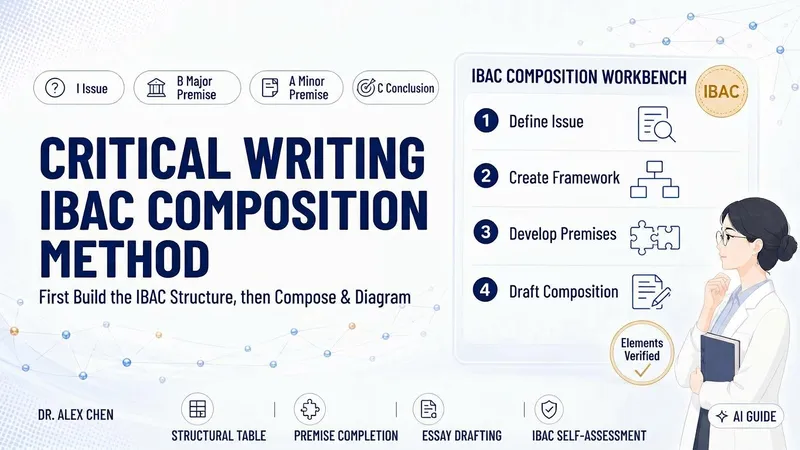 Write
WriteCritical Writing · IBAC
Many articles lack depth not because of the writing, but because the author has not fully clarified what question they are answering or why their conclusion follows. This skill uses Tian Hongyun’s critical writing structure, IBAC— I: Issue, B: major premise (hidden assumptions and beliefs), A: minor premise (facts and evidence), and C: Conclusion—to first narrow a topic into an arguable question, then create an IBAC argument map and pause for your confirmation. Once confirmed, it turns the framework into a complete argumentative essay, along with a hand-drawn marker-style structure diagram and an IBAC self-checklist that identifies, point by point, where premises remain weak and where evidence is missing. It does not embellish or fabricate: wherever evidence is insufficient, it writes “evidence needed” rather than glossing over the gap with rhetoric. Suitable for academic writing, science communication, workplace writing, and independent media, with flexible use across contexts.
Slow Teacher · Think Clearly
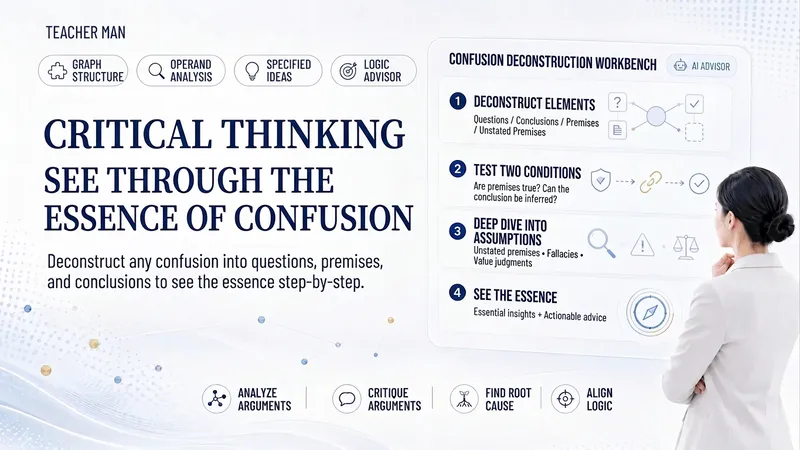
Share any confusion—about work, study, life, relationships, emotions, decisions, or anything else. Using the framework from Tian Hongyun's “General Course in Critical Thinking: Methods for Thinking Correctly,” the Skill breaks it down into “question—premise—conclusion—unstated premise,” then tests it with two questions: “Is the premise true?” and “Can the premise support the conclusion?” It identifies unstated premises and common fallacies, distinguishes factual judgments from value judgments, and ultimately helps you see the essence of the situation and define a practical next step. The tone is equal, gentle, and conversational, with hand-drawn marker-style illustrations added automatically for key steps.
 Research
Wittgensteinian Inquiry
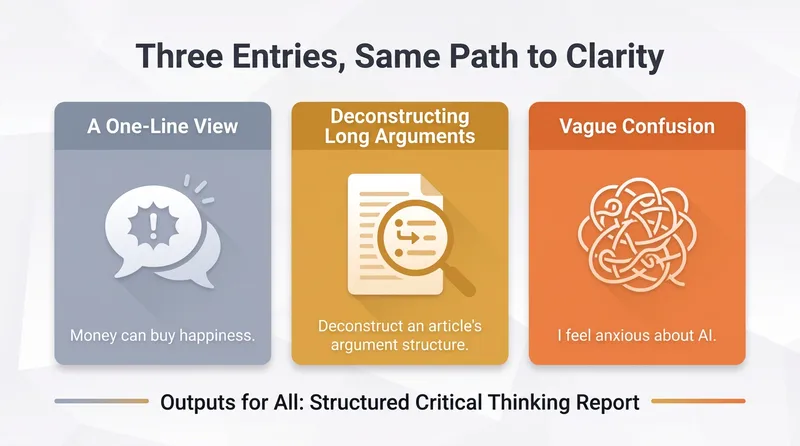
We “think” every day, but much of what we call thinking is really just going in circles. What holds us back is often not a lack of thought, but unclear wording, leaps in reasoning, or asking the wrong question—problems we cannot see for ourselves, while others may hesitate to point them out. • 📝 You have a one-sentence viewpoint but cannot explain what it really means. “Money can buy happiness”—what does “happiness” mean? And what does “buy” mean here? Does the meaning change in another context? • 🤔 You are arguing with someone and feel that something “kind of makes sense, but you cannot say what is wrong.” Logical leaps hide between “so” and “therefore,” making them difficult to spot. • 🌀 You finish an article feeling that “something is off,” but cannot identify it. Some sentences sound profound until you question how they are being used—and then they lose their meaning. • 😵 You have a vague anxiety but do not know how to sort it out. “I am anxious about AI”—are you worried about unemployment, losing control, or something else? • 🎭 Many statements like “you absolutely have to…” are really commands quietly disguised as facts. Mixing two different language games can create an “objective necessity” that does not actually exist. This skill was made to address these problems. It is not a consultant that “gives you answers,” but a language therapist: it does not decide what is right or wrong for you. Instead, like Wittgenstein himself, it uses persistent questioning to push your thinking toward clarity—bringing ambiguity into view and revealing false questions for what they are. Inquiry is not about teaching you to win. It is about helping you see. It does not provide standard answers or motivational platitudes. It believes that often, we are not failing to think hard enough; our wording is unclear, our reasoning jumps, or we are asking the wrong question. When an ambiguous question is broken down into a series of clear, smaller questions, the answer often emerges on its own—and what we truly need is the honesty to “say exactly what we mean.” > Whatever can be said can be said clearly; and whatever cannot be said should be passed over in silence. (This is a paraphrase of the final sentence of Wittgenstein’s *Tractatus Logico-Philosophicus*, not a word-for-word quotation.)
Information
- Version
- v4
- Last updated
- Runtime credits
- Usage-based
- Models
- Auto