Deep Web Research Kit
Cross-source research and Chinese data packs
Deep Web Research Kit
Cross-source research and Chinese data packs
Showcase
Description
When you need to investigate a topic, gather background information, or conduct research, this tool searches across multiple sources, verifies information, and organizes it into a traceable Chinese data package. It supports quick, standard, and deep-dive modes.
Best for
Ideal for users who need to systematically verify materials, organize evidence, and create ready-to-use research documents.
How to use this Skill
Provide your input
Provide a research topic or question, and optionally include links, files, regions, time ranges, target readers, and research modes.
Run the Skill
The system searches and verifies materials across multiple sources, categorizing source types, credibility, dates, and data metrics while organizing cross-references, discrepancies, and information gaps.
Review your result
Receive a traceable Chinese reference package containing an executive summary, dimension-based material list, key citations and data, glossary, and follow-up research recommendations.
Related Skills
View all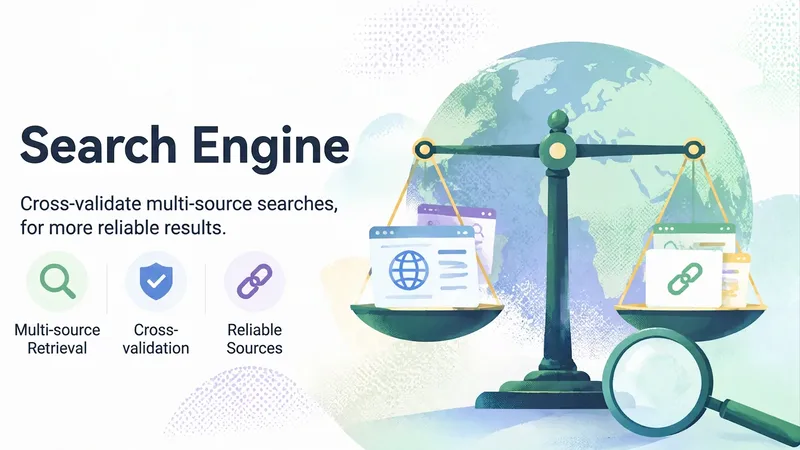
Search Engine
Turn natural-language questions into traceable public web search results for research, fact-checking, finding public-account articles, troubleshooting program errors, and searching for papers, technical documentation, and open-source projects. For topics requiring current information or evidence from multiple sources, it combines Chinese and international search results across different types of public sources, helping reduce omissions and bias from relying on a single search engine. In addition to summarizing relevant pages, it organizes titles, sources, links, and available publication dates, merges duplicate results, and distinguishes independent evidence from different organizations or websites. For key claims, the results present supporting and opposing information, disagreements between sources, and a credibility assessment based on the amount and quality of the evidence. This helps you see which points are supported by cross-checking and which remain isolated claims or cannot be confirmed. You can enter search terms or a claim to verify directly, and add a field, time range, region, language preference, or specific websites. The final output includes a structured search summary, source list, cross-checking results, and items requiring verification. Content that cannot be accessed, requires login, or has scraping restrictions is clearly marked; speculation is never used in place of real sources.
 Research
Company Background Checker
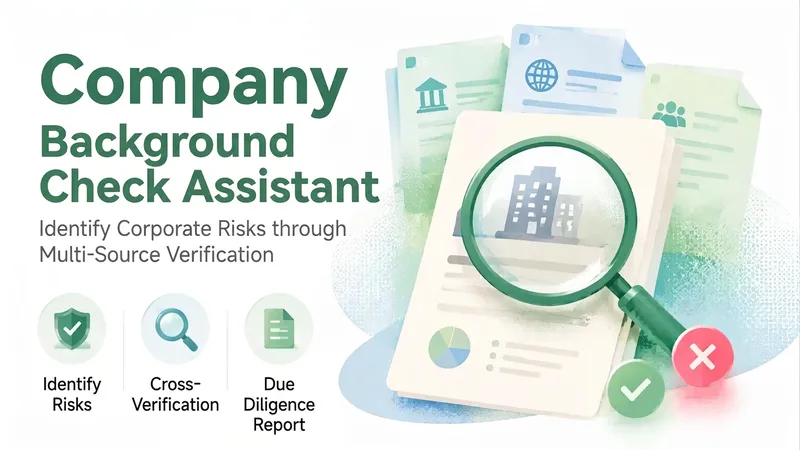
The Company Background Checker uses a tiered evidence verification method to check the authenticity of partners, suppliers, bidders, and internship providers. It identifies risks such as qualification grafting, data inflation, time anomalies, entity mismatches, metric mixing, performance misattribution, disguised dispatching, and omitted negative facts, producing due diligence conclusions that can be directly reported to leadership and written into contracts. Each conclusion is tagged across two dimensions: evidence nature (A-G: statutory registration, official lists, judicial supervision, annual reports, commercial databases, public web, inference) and source status (original official, official reference, commercially processed, self-reported), strictly distinguishing between disproven, unverified, and lacking evidence. It includes a built-in data source accessibility table and integration tiers. For listed or bond-issuing entities, it first reads disclosures from Cninfo and stock exchanges; for unlisted micro-enterprises, it provides alternative pathways for login walls and an industry metrics exception table. It enforces strict group-to-legal-entity attribution and includes 13 omission checks. Version 2.4 adds a bidding and supplier admission module: distinguishing bidding from winning, verifying performance entity attribution, grading licenses and certifications across four levels, checking three discredited lists according to regulatory standards with one-vote veto, and delivering a one-page conclusion card, evidence request letter, and contract risk clause package, complete with 18 regression self-checks. Version 2.5 adds an educational scenario module for reviewing school-enterprise partners, internship providers, and employment agencies, incorporating admission criteria and red lines based on vocational school internship regulations, using five criteria to identify disguised dispatching, prohibiting intermediary involvement and proxy fee collection, mandating tripartite agreements and internship liability insurance, and noting that these regulations serve as references for general undergraduate institutions. Version 2.5.1 introduces a final delivery gate with six-item skip-step consistency checks, an evidence chain self-verification table, a single-screen five-piece delivery set, anti-patterns, and a channel fact cold-start table. It disables commercial database inferred fields like enterprise scale or ratings. It supports four modes: basic risk overview from company name alone, targeted verification with company name and claims, page-level verification of uploaded materials, and integration consulting. It triggers when users mention background checks, due diligence, partner or supplier reviews, bidding qualifications, internship provider checks, school-enterprise reliability, cross-validation, or requests to verify specific companies. It is not suitable for legally binding due diligence requiring a law firm or classified military qualification reviews.
 Research
Verbal Idea to In-Depth Report
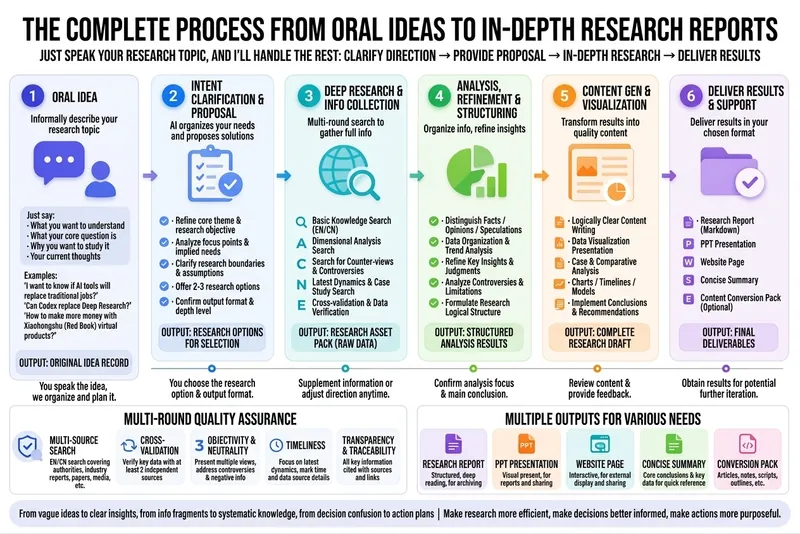
This skill is designed to transform your vague research ideas into clear, actionable plans, providing in-depth analysis and ultimately delivering customized research results. Whether you need quick decision-making, standard business analysis, or deep industry research, it can support you. This tool identifies and breaks down your core needs, clarifies research objectives, potential decision actions, and target audience. Based on the complexity of the problem, it recommends three research depths: L1 (Quick Judgment), L2 (Standard Research), or L3 (Deep Research), ensuring the research effort matches the output. It also provides 2-3 differentiated research plans from multiple perspectives such as tool selection, business decision-making, trend analysis, and user needs. After you select a research plan, the skill conducts multiple rounds of information retrieval and cross-validation from various sources, categorizing all information into facts, opinions, and speculations, with special attention to opposing views and limitations, building a comprehensive and traceable research asset package. Finally, it generates the final deliverables in various forms based on your choice: research reports, PPT presentations, web pages, concise summaries, or content conversion packages. Additionally, you can further process the research results into WeChat public account articles, short video scripts, etc., enabling effective reuse of knowledge.
Information
- Version
- v2
- Last updated
- Runtime credits
- Usage-based
- Models
- Auto
- Use cases
- Writing & contentResearch & analysis
- What you get
- ReportDocumentData
