
AFP Policy & CSSCI Topics
Deep policy analysis and 3–5 CSSCI topics
AFP Policy & CSSCI Topics
Deep policy analysis and 3–5 CSSCI topics
Showcase
Description
AFP prompt system—deep policy analysis (three-level identification of sources, hot-topic implications, and academic mapping) and CSSCI topic generation (3–5 topics, each with policy basis, theoretical foundation, theoretical and practical significance, and publication-potential assessment). Supports three entry points: A1 panoramic analysis, A2 targeted analysis, and B reverse matching of ideas. Auto-Flow operation: strict step-by-step progression, silent background checks, a heartbeat HUD, and hard stops at each stage.
Related Skills
View all
H&SS Topic Selection AFP
Humanities and Social Sciences Topic Selection Engineering System 🎯 Adaptive Coverage System: | Topic Type | System Fit | Difficulty Level | |------------|------------|------------------| | National Social Science Fund | ✅ Core Application | ★★★★★ | | Ministry of Education Humanities and Social Sciences Project | ✅ Fully Compatible | ★★★★☆ | | National Education Science Planning Key Projects | ✅ Fully Compatible | ★★★★☆ | | Provincial Social Science Planning | ✅ Fully Compatible | ★★★☆☆ | | Vocational Education/Teaching Reform Projects | ✅ Fully Compatible | ★★★☆☆ | 📊 Six-Stage Delivery Process (P0-P5 Mandatory Steps): | Stage | Phase | Core Output | Key Action | |-------|-------|-------------|------------| | P0 | Anchor Your Base | Personal Resources & Position Assessment | Take stock of your academic accumulation, existing achievements, and team resources | | P1 | Policy Decoding & Real Problem Extraction | Policy Analysis Table + Problem List | Scan the latest policy documents to uncover issues that truly matter to the review committee | | P2 | Atomic-Level Object Decomposition | Minimum Granularity Object Table | Break down grand propositions into core research objects | | P3 | Nine-Grid Topic Explosion | 9 Topic Direction Matrix | One object, 9 angles, select the optimal direction | | P4 | Critical Review & Finalization | Revision Suggestions + Risk Checklist | Two-role confrontation: applicant vs. blind reviewer, iterative refinement | | P5 | Asset Packaging | Topic Core Asset Memorandum | Final topic + reasoning logic + ready for proposal writing | 🔧 Built-in Standard Tool Library: ✓ Two-Role Confrontation System — Topic Planner ↔ Blind Review Expert (self vs. self PK) ✓ Naming Red Line Check — No colons/dashes/subtitles allowed, must end with "research" ✓ Trinity Rule — Qualifier + Object + Problem (invisible scoring sheet) ✓ Real-Time Policy Update — Synchronized with latest guidelines from NSSF, MOE, and Education Science Planning ✓ Nine-Grid Topic Matrix — Systematically spread 9 angles, visualize innovation comparison ✓ Blind Review Risk Assessment — Predict topic weaknesses in review 📈 Expected Results: 📌 Grant Approval Rate — From average 20-30% to 60-70%+ (depending on prior accumulation) ⏱️ Topic Selection Cycle — From 3-6 months of polishing to 2-3 weeks of systematic finalization 🎯 Hit Accuracy — From "broadcasting" to precisely targeting the review logic of the target committee 📦 Continuity — The Topic Memorandum can directly interface with "Grant Proposal Writing AFP" for a complete closed loop
 Write
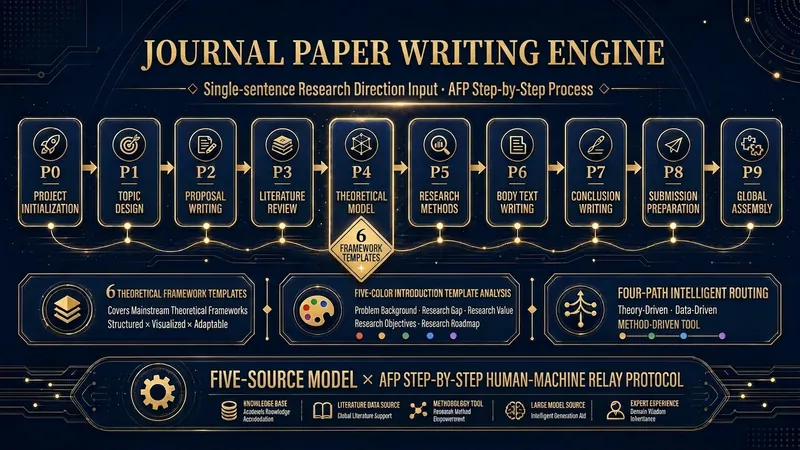
WriteJournal Paper Writing Engine
Input your research direction in one sentence, and the AFP step-by-step engine guides you through the entire process. P1 Topic Design — Davis Interesting Theory + Problematization’s Five-Level Topic Selection Method, extracting real problems from phenomena. P2 Introduction Writing — Five-Color Template Analysis Method, breaking down top journal model papers section by section: emotional appeal → knowledge gap → literature positioning → research space → value declaration, with embedded full deconstruction prompts. P3 Literature Review — Structured organization, distinguishing research threads and dialogue objects. P4 Theoretical Framework — Six theory integration templates embedded throughout (complementary, contrast, bridging, hierarchical, evolutionary, general), each containing six paragraphs: introduction → justification → sorting → premise → analysis → conclusion; plus a five-level deep-drill sentence skeleton for single-theory depth. P5 Research Methods — Automatically adapts strategies based on four paths: empirical quantitative, qualitative, speculative, and mixed. P6 Body Writing — 9-3-1 pyramid structure. P7 Conclusion Writing — Three-level conclusion processing (findings → dialogue → extension). P8 Submission Preparation — Eight methods to reduce AI detection rate. P9 Global Assembly — Compiles independent documents from each stage into a complete draft, supports cross-chapter bidirectional backfill, and allows interruption and iterative backtracking at any time. 🎯 Suitable for: Graduate students (master's and PhD) and early-career researchers aiming to submit to Chinese C-journals, core journals, or SSCI, especially those stuck on theoretical framework and introduction writing. ⚙️ Underlying Architecture: Five-Source Model × AFP Step-by-Step Human-Machine Relay Protocol, with heartbeat signals, mandatory stop points, and dual-core auditing.
 Research
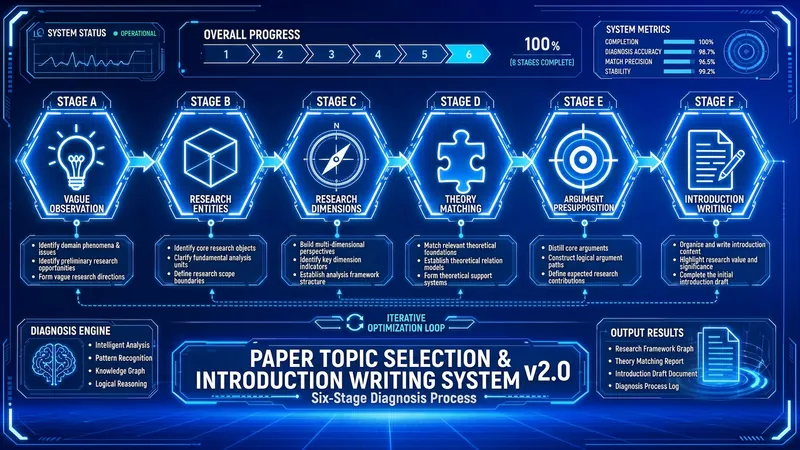
Thesis Topic & Intro v3.2
Read in 10 seconds: turn a vague observation into a defensible topic, then into an introduction that can pass review. Throughout, it uses only the real materials you provide — no fabricated references. Trigger words: thesis topic, topic selection, introduction, research gap, academic writing, thesis proposal, topic selection before literature review. Applies to: journal papers / dissertations / conference papers / course papers, across all disciplines — humanities and social sciences, STEM, agriculture, medicine, and life sciences. Up and running in 3 minutes: lock in your discipline and starting point → shape the topic layer by layer → strict evidence-chain gate → module-by-module introduction → ratchet finalization. [Division of labor with other skills] The health check comes first, writing comes after, and polishing comes last. This skill handles the middle stretch: topic shaping + introduction draft. It does not write the full paper (that's the Academic Paper Full-Process Writing System v4.x), and it does not polish language sentence by sentence (that's the Academic Paper Three-Track Polishing System v8.x). [Six gates] 1. Discipline placement: classify into one of four categories — 1A humanities/arts, 1B social sciences, 2A STEM, 2B agriculture/medicine/life sciences — and load the corresponding red-line norms; for category 2B, ethics review status is always checked. 2. Stage positioning: are you at a vague observation, have a unit but no angle, have an object but no theory, lack a method, lack a viewpoint, or only lack an introduction? Start from the corresponding gate instead of starting over from scratch. 3. Topic shaping: research unit → dimension compass → theoretical perspective → research method → research viewpoint, locked layer by layer; before locking each layer, first judge whether the previous layer holds. 4. Strict evidence-chain gate: before the introduction, your references are registered into an M1/M2… material library, each entry verified on four elements — author/year/title/locator; if fewer than 3 references are registered in the conversation, the system refuses to generate the research-gap statement — not a downgrade, a refusal. 5. Module-by-module generation: the introduction is produced in five inverted-pyramid modules, and each module must be annotated with citation numbers [Mn]; no source, no sentence. 6. Ratchet finalization: only versions that have passed receive credit; qualifying modules are locked and no longer changed; scores only go up, never down. [Deliverables] A '[Topic Keyword] · Topic & Introduction' document + a sentence-level traceable citation mapping table + a ⚠️ to-verify checklist + an AFP archive code. The archive code works across four systems — the proposal health-checker, the v4.x full-process system, and the three-track polishing system — so switching skills doesn't require re-stating your discipline, topic, journal, or material library. [Explicitly not done] It does not fabricate authors, years, volumes, issues, page numbers, or DOIs; any bibliographic records retrieved online are marked ⚠️ to-verify and can only be written into the reference list after you verify them; it makes no promises of acceptance or passing review. Authorship and responsibility are yours — please verify every citation and data point.
Information
- Version
- v4
- Last updated
- Runtime credits
- Usage-based
- Models
- Auto