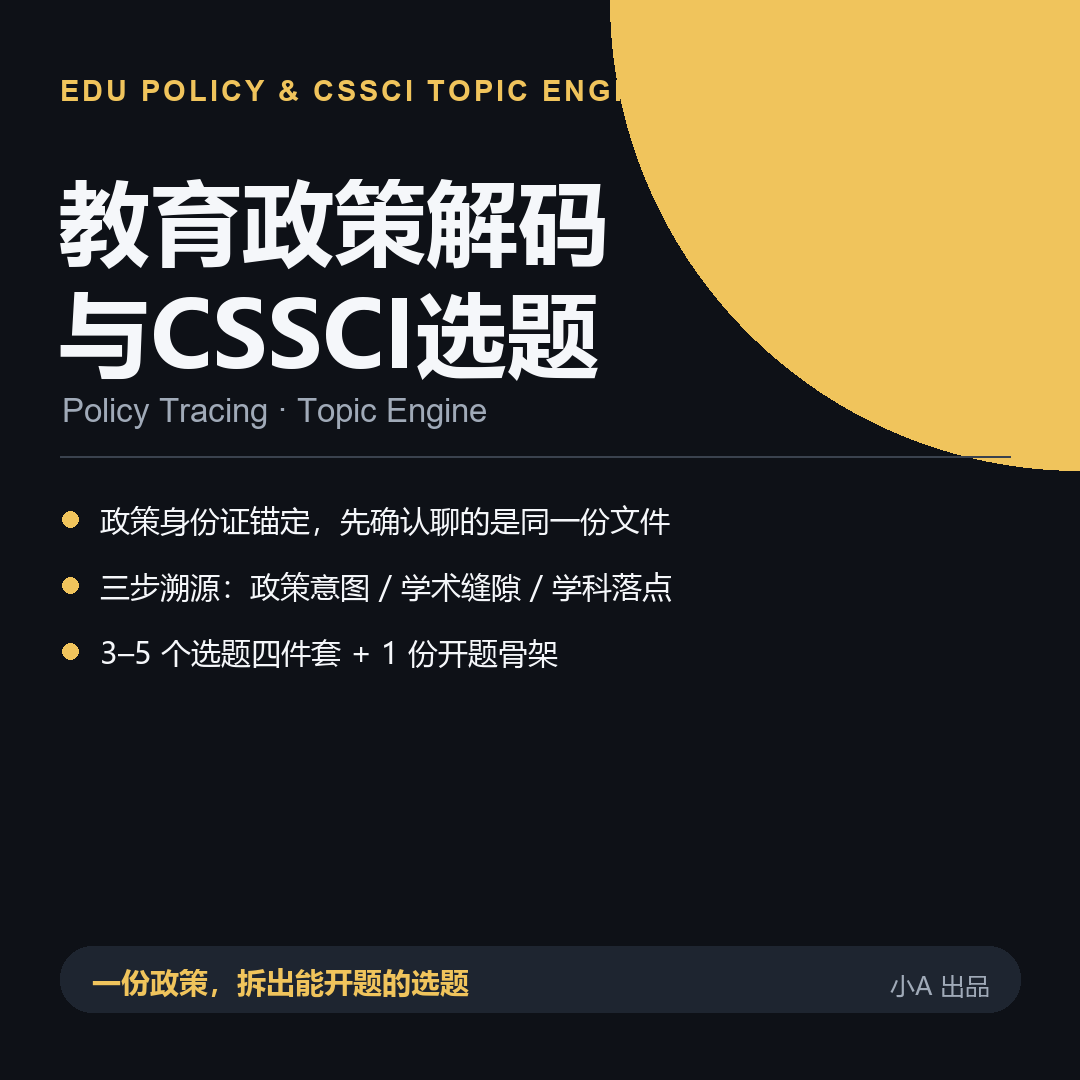
Education Policy Decoder
Extract paper topics and proposal frameworks from policies
Education Policy Decoder
Extract paper topics and proposal frameworks from policies
Showcase
Description
Activated when users send an educational policy document or name, or request help turning educational policies into paper topics, writing CSSCI or core journal articles, interpreting policies like Double Reduction, New Curriculum Standards, or Education Strong Nation Guidelines for publication, or finding National Social Science Fund or Ministry of Education project directions. It uses a policy-tracing method to deliver traceable interpretations, 3 to 5 high-potential topics, and 1 proposal skeleton without fabricating policy clauses while highlighting research gaps. ## Summary Transforms a national education policy into traceable interpretations, 3 to 5 high-potential topics, and 1 proposal skeleton ready for your report. Covers high-frequency pain points such as turning education policies into research topics, writing CSSCI and core journal papers, publishing based on major guidelines, and finding project directions. Designed specifically for education researchers and graduate students. ## What You Will Get 1. Policy ID: Issuing authority, release date, legal hierarchy, core proposition. 2. Three-Step Tracing Breakdown: Policy intent, academic gaps, and disciplinary landing points. 3. 3–5 Topics, Each with Four Elements: Policy basis, theoretical foundation, theoretical and practical significance, and publication potential rating. 4. 1 Proposal Skeleton: Research questions, literature review framework, analytical approach, and potential innovations. 5. Traceability Verification: Any clause absent from the original text is marked as unverified; no forced fabrication. 6. Case Library: Complete breakdown demonstrations of policies like Double Reduction, New Curriculum Standards, and Education Strong Nation Guidelines. ## Who It Is For Education graduate students facing proposal blocks, young university teachers and researchers aiming for CSSCI or core journals and national or ministry projects, and education faculty research secretaries and mentor groups. Note: Since primary and secondary school teachers no longer primarily rely on papers for professional titles, this Skill is not tailored for that group.
Recommended by
Dancang
Why we love this skill
Deconstructs education policies into traceable CSSCI topics and proposal frameworks with high fidelity, rigorous gap analysis, and zero fabrication.
Related Skills
View all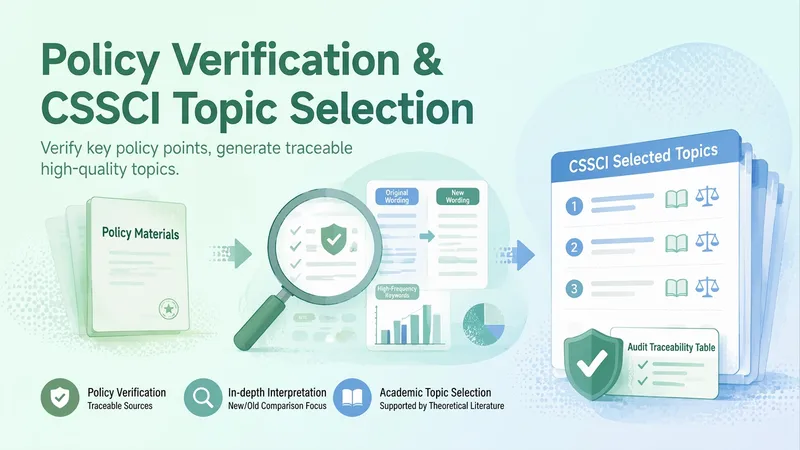
Policy Tracing & CSSCI Topics
Turn national policy materials into verifiable, traceable CSSCI research topics. Suitable inputs include full policy texts, older and newer versions of documents, policy keywords, policy lists, or document numbers. Whether the materials are complete or not, build a source record covering the policy origin, issuing body, document number, date, level, and validity status. Check each item against authoritative source texts, noting the citation location, source link, and verification status—“consistent,” “uncertain,” or “needs verification”—to avoid mistaking summaries for original policy language. Building on this verification, identify additions, strengthened measures, and phased-out content in newer and older policies. Extract high-frequency terms, policy context, and timing windows, then connect policy trends to real-world problems supported by evidence. Next, develop research questions at the levels of phenomena, mechanisms, and theory; match them with perspectives such as institutional theory, principal–agent theory, and policy diffusion; and identify research gaps through recent, traceable literature. The result is a pool of candidate topics with theoretical support, literature evidence, and proposed data and methods. Finally, select 3–5 CSSCI topics and assess each one’s policy timeliness, theoretical and practical value, and publication feasibility. Provide the policy basis, real-world problem, theoretical perspective, literature gap, data sources, and methodological approach. Confirmed results can be compiled into a structured research report that preserves complete source details, verification status, and audit-trail information—suitable for topic development in policy research, public administration, economics and management, and related social sciences.
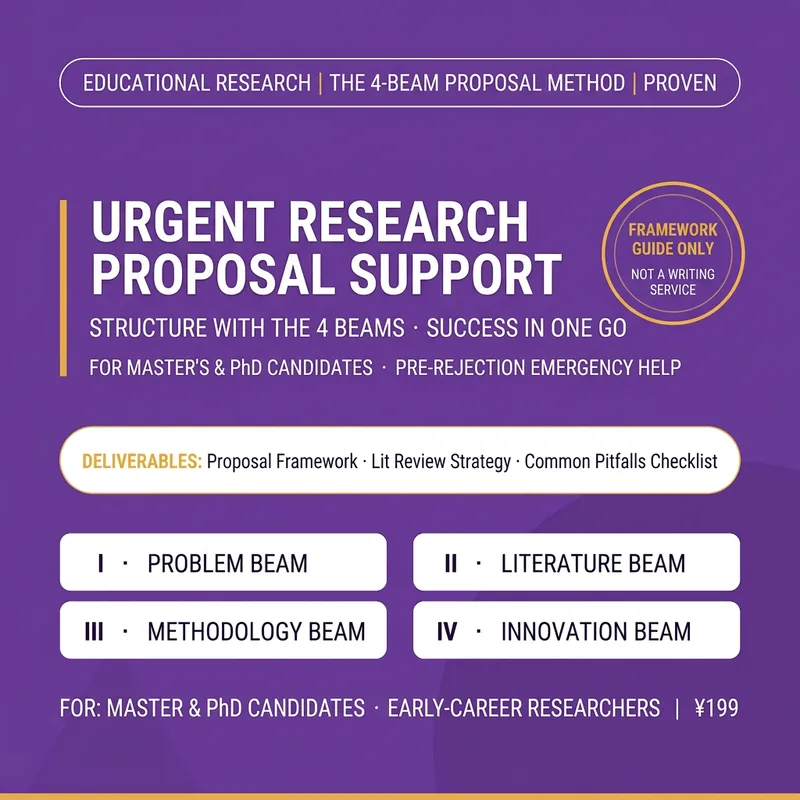
Education Proposal Four-Pillar Framework
An emergency proposal assistance skill for education graduate students and young researchers, using the vertical Four-Pillar Proposal Method. Triggers when users ask how to write an education thesis proposal, how to design education research, what to do if a proposal is rejected, how to structure a literature review, how to formulate research questions, or how to handle advisor misalignment. Uses the Four-Pillar Method (Problem Pillar / Literature Pillar / Methodology Pillar / Innovation Pillar) to generate a proposal skeleton, a literature search strategy table, and a rejection risk checklist. Version 1.0.0. * **One-Sentence Positioning** Your personal proposal skeleton generator: turns loose directions, piled-up literature, mismatched methods, and empty innovation points into four solid pillars—problem, literature, methodology, and innovation—plus advisor alignment checks, making your proposal robust rather than a word count exercise. **How to Use - The Four-Pillar Method** 1. Problem Pillar: Three cuts to narrow the direction (lock the target / set the perspective / draw boundaries), with main and sub-questions ready to use. 2. Literature Pillar: Avoid piling up; build a map by context, school of thought, debate, or gap to pinpoint your research gap. 3. Methodology Pillar: Match quantitative, qualitative, or mixed methods by disciplinary paradigm, including red flags like IRB prerequisites. 4. Innovation Pillar: Choose one from theory, perspective, method, or target, grounding it in how it differs from existing work. 5. Closing: Advisor alignment check to connect your lens back to your advisor's framework, preventing rejections due to drifting off course. **What You Receive** A proposal skeleton (four pillars filled out cell by cell), a literature search strategy table (databases + keywords + tracing), and a rejection risk checklist (top 8 reasons + avoidance tips), ready to be expanded into a full proposal. **Compliance Disclaimer** This skill does not ghostwrite complete proposals or papers; it only generates frameworks and checklists. It does not fabricate literature or data, clearly labels AI generation, requires original literature verification, does not guarantee approval, prioritizes offline confirmation for ethics reviews and advisor conflicts, and defers to institutional formats and advisor opinions.

HE Document Write&Review v3.0
🎯 Got your application rejected? Can't find the highlight for your proposal? Don't know where to start with review comments? Three real scenarios: 🔸 Scenario 1: Application season anxiety—Reviewer feedback: "Insufficient theoretical support, vague policy basis." Unsure which documents to cite or which theoretical framework to use. 🔸 Scenario 2: Proposal writing dilemma—In charge of course construction plan: objectives, tasks, pathways, evaluation… each part needs writing, but you feel the logic is not rigorous enough and worry about being questioned on "feasibility" during review. 🔸 Scenario 3: Review dilemma—Need to write peer review comments: must point out issues while maintaining professionalism, be well-founded but not too harsh. How to strike the balance? 💡 What can this system do for you? Not just give advice—it writes, revises, and reviews for you directly. 📝 Writing Mode: From topic to final document Enter your topic and existing materials. The system automatically identifies the document type (application/proposal/report/review). Automatically matches authoritative policy documents and theoretical support. Generates content chapter by chapter, each with evidence, logic, and facts. Key promise: Never fabricates data; clearly tells you what's missing. 🔍 Review Mode: Expert-level diagnosis Upload your text. Professional scoring across 7 dimensions (value, alignment, completeness, innovation, feasibility, support, expression quality). Precisely identifies problem areas. Provides specific revision suggestions + example rewrites. Not general advice, but paragraph-level specific guidance. ✏️ Revision Optimization Mode: Precision enhancement Strengthens arguments based on existing text. Optimizes expression, eliminates empty talk and clichés. Standardizes terminology and logic. Improves overall competitiveness. ⚡ Three Core Mechanisms (Unique) 🛡️ Firewall Mechanism Built-in "fact boundary": User-provided real data is never fabricated; policy basis must have sources; theoretical support cannot be misapplied. Every sentence you see can be traced back to its source. 🔄 Multi-core Adversarial Engine One core writes, another specifically checks for errors. Like having a strict auditor watching, ensuring no "unsubstantiated facts," "logic gaps," or "policy mismatches" occur. 📊 Stepwise Guidance Doesn't ask you 20 questions at once—identifies the most critical gaps and asks only the 3–5 most necessary questions. After each stage, clearly tells you "what's done," "what's missing," and "what to do next." 🎯 Scope of Application (All Higher Education Scenarios) ✅ Teaching achievement award applications (institutional/provincial/national) ✅ Quality engineering project applications (top courses/teaching teams/textbooks, etc.) ✅ Course construction plans, major construction plans ✅ Major self-assessment reports, course acceptance reports ✅ Expert review comments, peer reviews ✅ Education reform project applications, closing reports 🚀 User Experience Writing an application from scratch: Provide the topic and basic materials → System identifies document type, takes inventory, matches policies and theories → Generates outline → Writes chapter by chapter → Consolidates → Get a draft in 1 hour. Reviewing existing text: Upload document → System automatically scores → Lists main issues → Provides revision suggestions and example rewrites → Get review report in 20 minutes. Optimizing existing plan: Provide existing text and optimization direction → System diagnoses weaknesses → Strengthens arguments, optimizes expression → Get optimized version in 30 minutes. 👉 Try it now—make higher education document writing no longer a burden. This is not just a writing assistant; it's an intelligent engine that understands higher education rules, review standards, and professional expression.
Information
- Version
- v3
- Last updated
- Runtime credits
- Usage-based
- Models
- Auto
- Use cases
- Writing & contentResearch & analysisLearning & education
- What you get
- ReportBriefPlan
