English Document Deep Dive
Description
Intelligent adaptive translation and in-depth analysis for highly specialized English documents. Automatically identifies the document type and level of specialization, then selects an efficient basic mode or an advanced deep-analysis mode. Covers complete translation, authoritative web-based fact-checking, structured extraction, professional interpretation, and multiple rounds of final review and proofreading—aiming to stay 100% faithful to the original meaning, maintain consistent terminology, minimize errors and omissions, and meet professional standards. **Risk notice:** This tool uses AI for automated information processing and generation. Although it is governed by strict rules and review procedures, the risks of model misjudgment, missing information, and “hallucinations” cannot be completely eliminated. All outputs are provided for reference only. For high-risk decisions involving legal matters, compliance, investment and financing, medicine, or similar areas, always verify the output against the original text and have a qualified professional conduct the final review and confirmation.
Related Skills
View all Write
WriteFull-Process Academic Writing
"Full-Process Academic Writing" is an intelligent assistant tool designed for researchers, aimed at covering every stage of academic paper writing from initial conception to final submission. Whether you have just a vague research direction or have a draft that needs polishing, this tool provides systematic support to help you efficiently produce high-quality academic work. This tool guides you through four key stages. First is **Topic Planning**, which helps you refine preliminary ideas into concrete, feasible research topics and questions, and generates a comprehensive Topic Evaluation Report covering research framework, method matching, timeline planning, and resource bottleneck identification. Next is the **Literature Review** stage, assisting you in building search strategies, organizing core literature, and writing a logically rigorous literature review draft that identifies research gaps. The third stage is **Structured Writing**, where the tool designs a detailed paper outline based on your topic and literature review, and drafts the introduction, methods, body, and conclusions chapter by chapter, while also providing scientific chart code to ensure a complete structure and rigorous argumentation. Finally, the **Polishing and Revision** stage performs a comprehensive academic standard check, six-dimensional language polishing, and logical coherence review, and embeds an AI-assisted writing statement to ensure your final draft meets publishable professional standards. Throughout the writing process, this tool always adheres to academic ethics standards. All citations will be clearly flagged for verification and will never be fabricated. Output from each stage proceeds only after your confirmation, ensuring every step aligns with your research intent, allowing you to focus on expressing your ideas while leaving tedious formatting and standards to AI.
 Write
WriteAIGC Reduction & Rewrite v7.0
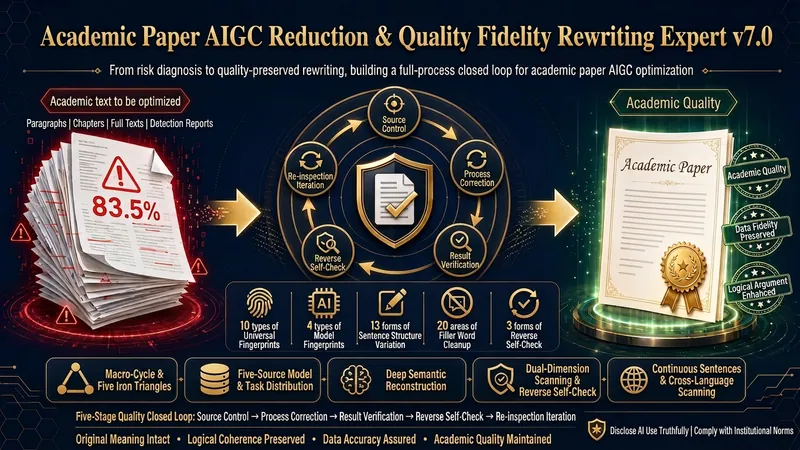
📚 Academic Paper AIGC Reduction and Quality-Preserving Rewriting Expert v7.0 Designed for graduate students, researchers, and paper authors, this academic text optimization skill operates on a core closed loop of 'source control → process correction → result verification → reverse self-check → iterative re-check'. It systematically diagnoses and optimizes issues such as templated expressions, mechanical logic, vague content, inaccurate terminology, and style inconsistencies while preserving original meaning, technical terms, data, and core conclusions. 🔍📝 🌟 Core Capabilities 🔬 Multi-layer Risk Diagnosis Covers 10 types of universal text fingerprints and assists in identifying common expression patterns of models such as ChatGPT, Claude, DeepSeek, and Wenxin Yiyan. 🧠 Deep Semantic Restructuring Goes beyond synonym replacement to rebuild more natural and in-depth academic reasoning by adjusting proposition expression, information order, argument approach, and evidence organization. ✍️ Quality-Preserving Rewriting Comprehensively applies 13 sentence transformation strategies and 20 methods for cleaning high-frequency templated expressions, improving mechanical sentence structures, repetitive connectors, and overly rigid formatting. 📊 Full-text Structure Diagnosis Through macro-cycle and five key triangles, checks whether research problems, theory, literature review, methods, results, conclusions, and innovation form a complete closed loop. 🧩 Fine-grained Section Adaptation Develops differentiated diagnostic and rewriting strategies for abstract, introduction, literature review, research methods, results, discussion, and conclusion respectively. 🌐 Cross-language Risk Scanning Assists in identifying translationese, passive voice stacking, long sentence nesting, and mixed Chinese-English formatting abnormalities to make Chinese academic expression more natural and accurate. 🔄 Reverse Self-check Loop After rewriting, re-verifies from three aspects: technique distribution, new text fingerprints, and information integrity, to avoid 'becoming more templated' or losing key content. 🛡️ Academic Integrity Protection Does not fabricate literature, data, cases, or policy evidence; separately marks information requiring author verification and reminds users to honestly disclose AI usage. 🎯 Use Cases ✅ Single paragraph or partial section optimization ✅ Targeted modification of marked paragraphs from inspection reports ✅ Polishing of abstract, introduction, literature review, discussion, and conclusion ✅ Full-text AIGC risk feature diagnosis ✅ Language and structure adaptation for target journals ✅ Pre-submission quality review and consistency check 📦 Final Deliverables 📄 Quality-preserving rewritten text 🔎 Risk and issue diagnosis report 🛠️ Rewriting strategy and technique description ✅ Reverse self-check and information integrity report 💡 Items requiring author verification and subsequent revision suggestions 🎓 Original meaning preserved · Logic intact · No fabricated data · Academic quality maintained ⚠️ This skill aims to improve academic expression quality and reduce text risk features. It does not guarantee passage through any specific detection platform or achieving a particular detection score.
 Write
WriteAccident Root Cause & Actions
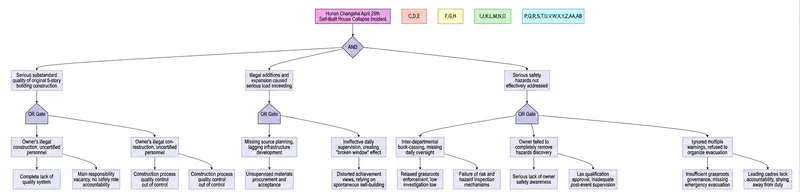
Do you find yourself repeatedly asking these questions in safety management? An accident analysis report runs dozens of pages, yet its conclusions still stop at “employee violated procedures” or “weak safety awareness,” leaving the real cause undiscovered? You issue a long list of corrective actions, but they amount to vague statements like “strengthen training” and “improve systems”—with no clear path to implementation, while similar accidents continue to happen? The accident investigation report contains extensive details, but you do not know how to organize them into a clear chain of causation that lets management see the root problem at a glance? When facing a regulatory or group review, you need a rigorous, layered analysis, but the tools available are either too superficial or too theoretical to reflect real-world conditions? You want to use external accident cases for internal safety awareness, but worry that exposing company names could create unnecessary public-opinion risks? Effective safety management is not about assigning “blame” after an incident; it is about identifying causes in advance. Only by uncovering the problems embedded deep within the organization can corrective actions truly take hold. This Skill is an intelligent assistant that provides in-depth analysis and improvement recommendations like an experienced safety expert. What is it? A professional tool that analyzes the root causes of an accident and generates actionable recommendations based on the original accident investigation report. It avoids generalities and stays faithful to the source material you provide, accurately extracting key information, reconstructing what happened, and tracing the causes layer by layer like a detective until it reaches the underlying systemic defects. How does it work? Reach the root cause in three steps Provide the accident investigation report — Upload or paste the complete investigation report, internal notice, or detailed description of the accident; Automatic in-depth analysis — The tool intelligently extracts key information from the report, including the timeline, actions of involved personnel, equipment status, and descriptions of management systems. It objectively reconstructs the accident in detail and ensures that every analysis remains faithful to the source material without subjective assumptions; Get layered diagnoses and improvement prescriptions — You will receive a clearly structured analysis report that can be put into practice directly. Why can its framework “peel back the layers”? Unlike traditional accident analysis, this tool clearly divides causes into three levels, making problems easier to see, address, and fix: Level 1: Direct causes — Identifies the specific actions or conditions that led to the accident, such as “an employee failed to close a valve according to procedure” or “a safety interlock on a piece of equipment failed.” These are the immediate triggers of the accident and the easiest facts to observe. Level 2: Contributing causes — Reveals systemic problems in company management, such as gaps in procedures, insufficient training, inadequate supervision, or incomplete maintenance. For example: “The operating procedure for this position did not specify the emergency shutdown process” or “The equipment had not received a periodic inspection in the past year.” These are the conditions that allowed the direct causes to arise. Level 3: Root causes — Further uncovers deep defects in the company’s safety management system or safety culture, such as “Long-term underinvestment in safety left aging equipment without timely replacement,” “Management prioritized production over safety, with assessment metrics disconnected from safety performance,” or “Safety responsibilities weakened at each level, leaving frontline employees afraid to report hazards.” These are the areas that truly require fundamental corrective action. All analysis remains strictly focused on the company’s internal situation, and company names are anonymized to ensure safe, objective discussion suitable for internal analysis and external communication. Why are the improvement recommendations actionable? For every identified cause, the tool generates specific, executable measures that can be implemented—not empty phrases like “strengthen management.” For example: Identified cause Corresponding improvement recommendation (example) Direct cause: The valve was not closed as required Revise the operating procedure for the position to add a step requiring two-person confirmation and signatures after the valve is closed; install a position sensor on the valve and connect it to the central control system for alarm notifications Contributing cause: No equipment inspection was conducted in the past year Create an annual inspection plan for this type of equipment, specifying the inspection cycle and responsible person; include inspection results in the equipment records, with automatic reminders for overdue inspections Root cause: Insufficient safety investment and aging equipment Create a dedicated budget for safety equipment upgrades in the annual budget; include equipment safety status in the workshop director’s monthly performance evaluation, with a weighting of no less than 15% Every recommendation specifies “who will do what, how, and by when,” avoiding vague language and helping companies effectively prevent similar accidents while continuously improving workplace safety. Broad, practical use cases Accident reviews and internal analysis meetings — Provide objective, in-depth analysis materials and guide discussions from “assigning blame” toward “improvement”; Corrective action planning — Generate a corrective-action task list directly from the analysis conclusions, with clear ownership and specific measures; Submitting accident analysis reports to regulators or group headquarters — Provide a rigorous, clearly structured professional report; Developing safety training materials — Turn your company’s or industry peers’ accident cases into real and persuasive teaching materials; Safety management system reviews and upgrades — Extract systemic issues from individual accidents and drive broader improvements to the management system. More than an analysis report Ultimately, you will receive a complete, ready-to-use deliverables package, including: Accident reconstruction summary: An objective timeline based on the source material; Three-level cause analysis table: A clear side-by-side view of direct, contributing, and root causes; Targeted improvement action list: Every measure corresponds to a specific cause and defines the implementation direction and acceptance criteria; Analysis explanation document: An explanation of the analytical logic and reasoning process, making it easier to explain and advance the findings with your team. All content anonymizes company names to ensure safety and practical use. So, the next time you face an accident report and are no longer satisfied with shallow, incident-by-incident conclusions, do not rely on intuition or generic templates. Give it a real report, and it will return a deep, actionable plan for systematic improvement. Uncover the root cause to truly prevent further loss—and give every “why” an answer.
English Document Deep Dive
Description
Intelligent adaptive translation and in-depth analysis for highly specialized English documents. Automatically identifies the document type and level of specialization, then selects an efficient basic mode or an advanced deep-analysis mode. Covers complete translation, authoritative web-based fact-checking, structured extraction, professional interpretation, and multiple rounds of final review and proofreading—aiming to stay 100% faithful to the original meaning, maintain consistent terminology, minimize errors and omissions, and meet professional standards. **Risk notice:** This tool uses AI for automated information processing and generation. Although it is governed by strict rules and review procedures, the risks of model misjudgment, missing information, and “hallucinations” cannot be completely eliminated. All outputs are provided for reference only. For high-risk decisions involving legal matters, compliance, investment and financing, medicine, or similar areas, always verify the output against the original text and have a qualified professional conduct the final review and confirmation.
Related Skills
View allWriteFull-Process Academic Writing
"Full-Process Academic Writing" is an intelligent assistant tool designed for researchers, aimed at covering every stage of academic paper writing from initial conception to final submission. Whether you have just a vague research direction or have a draft that needs polishing, this tool provides systematic support to help you efficiently produce high-quality academic work. This tool guides you through four key stages. First is **Topic Planning**, which helps you refine preliminary ideas into concrete, feasible research topics and questions, and generates a comprehensive Topic Evaluation Report covering research framework, method matching, timeline planning, and resource bottleneck identification. Next is the **Literature Review** stage, assisting you in building search strategies, organizing core literature, and writing a logically rigorous literature review draft that identifies research gaps. The third stage is **Structured Writing**, where the tool designs a detailed paper outline based on your topic and literature review, and drafts the introduction, methods, body, and conclusions chapter by chapter, while also providing scientific chart code to ensure a complete structure and rigorous argumentation. Finally, the **Polishing and Revision** stage performs a comprehensive academic standard check, six-dimensional language polishing, and logical coherence review, and embeds an AI-assisted writing statement to ensure your final draft meets publishable professional standards. Throughout the writing process, this tool always adheres to academic ethics standards. All citations will be clearly flagged for verification and will never be fabricated. Output from each stage proceeds only after your confirmation, ensuring every step aligns with your research intent, allowing you to focus on expressing your ideas while leaving tedious formatting and standards to AI.
WriteAIGC Reduction & Rewrite v7.0
📚 Academic Paper AIGC Reduction and Quality-Preserving Rewriting Expert v7.0 Designed for graduate students, researchers, and paper authors, this academic text optimization skill operates on a core closed loop of 'source control → process correction → result verification → reverse self-check → iterative re-check'. It systematically diagnoses and optimizes issues such as templated expressions, mechanical logic, vague content, inaccurate terminology, and style inconsistencies while preserving original meaning, technical terms, data, and core conclusions. 🔍📝 🌟 Core Capabilities 🔬 Multi-layer Risk Diagnosis Covers 10 types of universal text fingerprints and assists in identifying common expression patterns of models such as ChatGPT, Claude, DeepSeek, and Wenxin Yiyan. 🧠 Deep Semantic Restructuring Goes beyond synonym replacement to rebuild more natural and in-depth academic reasoning by adjusting proposition expression, information order, argument approach, and evidence organization. ✍️ Quality-Preserving Rewriting Comprehensively applies 13 sentence transformation strategies and 20 methods for cleaning high-frequency templated expressions, improving mechanical sentence structures, repetitive connectors, and overly rigid formatting. 📊 Full-text Structure Diagnosis Through macro-cycle and five key triangles, checks whether research problems, theory, literature review, methods, results, conclusions, and innovation form a complete closed loop. 🧩 Fine-grained Section Adaptation Develops differentiated diagnostic and rewriting strategies for abstract, introduction, literature review, research methods, results, discussion, and conclusion respectively. 🌐 Cross-language Risk Scanning Assists in identifying translationese, passive voice stacking, long sentence nesting, and mixed Chinese-English formatting abnormalities to make Chinese academic expression more natural and accurate. 🔄 Reverse Self-check Loop After rewriting, re-verifies from three aspects: technique distribution, new text fingerprints, and information integrity, to avoid 'becoming more templated' or losing key content. 🛡️ Academic Integrity Protection Does not fabricate literature, data, cases, or policy evidence; separately marks information requiring author verification and reminds users to honestly disclose AI usage. 🎯 Use Cases ✅ Single paragraph or partial section optimization ✅ Targeted modification of marked paragraphs from inspection reports ✅ Polishing of abstract, introduction, literature review, discussion, and conclusion ✅ Full-text AIGC risk feature diagnosis ✅ Language and structure adaptation for target journals ✅ Pre-submission quality review and consistency check 📦 Final Deliverables 📄 Quality-preserving rewritten text 🔎 Risk and issue diagnosis report 🛠️ Rewriting strategy and technique description ✅ Reverse self-check and information integrity report 💡 Items requiring author verification and subsequent revision suggestions 🎓 Original meaning preserved · Logic intact · No fabricated data · Academic quality maintained ⚠️ This skill aims to improve academic expression quality and reduce text risk features. It does not guarantee passage through any specific detection platform or achieving a particular detection score.
WriteAccident Root Cause & Actions
Do you find yourself repeatedly asking these questions in safety management? An accident analysis report runs dozens of pages, yet its conclusions still stop at “employee violated procedures” or “weak safety awareness,” leaving the real cause undiscovered? You issue a long list of corrective actions, but they amount to vague statements like “strengthen training” and “improve systems”—with no clear path to implementation, while similar accidents continue to happen? The accident investigation report contains extensive details, but you do not know how to organize them into a clear chain of causation that lets management see the root problem at a glance? When facing a regulatory or group review, you need a rigorous, layered analysis, but the tools available are either too superficial or too theoretical to reflect real-world conditions? You want to use external accident cases for internal safety awareness, but worry that exposing company names could create unnecessary public-opinion risks? Effective safety management is not about assigning “blame” after an incident; it is about identifying causes in advance. Only by uncovering the problems embedded deep within the organization can corrective actions truly take hold. This Skill is an intelligent assistant that provides in-depth analysis and improvement recommendations like an experienced safety expert. What is it? A professional tool that analyzes the root causes of an accident and generates actionable recommendations based on the original accident investigation report. It avoids generalities and stays faithful to the source material you provide, accurately extracting key information, reconstructing what happened, and tracing the causes layer by layer like a detective until it reaches the underlying systemic defects. How does it work? Reach the root cause in three steps Provide the accident investigation report — Upload or paste the complete investigation report, internal notice, or detailed description of the accident; Automatic in-depth analysis — The tool intelligently extracts key information from the report, including the timeline, actions of involved personnel, equipment status, and descriptions of management systems. It objectively reconstructs the accident in detail and ensures that every analysis remains faithful to the source material without subjective assumptions; Get layered diagnoses and improvement prescriptions — You will receive a clearly structured analysis report that can be put into practice directly. Why can its framework “peel back the layers”? Unlike traditional accident analysis, this tool clearly divides causes into three levels, making problems easier to see, address, and fix: Level 1: Direct causes — Identifies the specific actions or conditions that led to the accident, such as “an employee failed to close a valve according to procedure” or “a safety interlock on a piece of equipment failed.” These are the immediate triggers of the accident and the easiest facts to observe. Level 2: Contributing causes — Reveals systemic problems in company management, such as gaps in procedures, insufficient training, inadequate supervision, or incomplete maintenance. For example: “The operating procedure for this position did not specify the emergency shutdown process” or “The equipment had not received a periodic inspection in the past year.” These are the conditions that allowed the direct causes to arise. Level 3: Root causes — Further uncovers deep defects in the company’s safety management system or safety culture, such as “Long-term underinvestment in safety left aging equipment without timely replacement,” “Management prioritized production over safety, with assessment metrics disconnected from safety performance,” or “Safety responsibilities weakened at each level, leaving frontline employees afraid to report hazards.” These are the areas that truly require fundamental corrective action. All analysis remains strictly focused on the company’s internal situation, and company names are anonymized to ensure safe, objective discussion suitable for internal analysis and external communication. Why are the improvement recommendations actionable? For every identified cause, the tool generates specific, executable measures that can be implemented—not empty phrases like “strengthen management.” For example: Identified cause Corresponding improvement recommendation (example) Direct cause: The valve was not closed as required Revise the operating procedure for the position to add a step requiring two-person confirmation and signatures after the valve is closed; install a position sensor on the valve and connect it to the central control system for alarm notifications Contributing cause: No equipment inspection was conducted in the past year Create an annual inspection plan for this type of equipment, specifying the inspection cycle and responsible person; include inspection results in the equipment records, with automatic reminders for overdue inspections Root cause: Insufficient safety investment and aging equipment Create a dedicated budget for safety equipment upgrades in the annual budget; include equipment safety status in the workshop director’s monthly performance evaluation, with a weighting of no less than 15% Every recommendation specifies “who will do what, how, and by when,” avoiding vague language and helping companies effectively prevent similar accidents while continuously improving workplace safety. Broad, practical use cases Accident reviews and internal analysis meetings — Provide objective, in-depth analysis materials and guide discussions from “assigning blame” toward “improvement”; Corrective action planning — Generate a corrective-action task list directly from the analysis conclusions, with clear ownership and specific measures; Submitting accident analysis reports to regulators or group headquarters — Provide a rigorous, clearly structured professional report; Developing safety training materials — Turn your company’s or industry peers’ accident cases into real and persuasive teaching materials; Safety management system reviews and upgrades — Extract systemic issues from individual accidents and drive broader improvements to the management system. More than an analysis report Ultimately, you will receive a complete, ready-to-use deliverables package, including: Accident reconstruction summary: An objective timeline based on the source material; Three-level cause analysis table: A clear side-by-side view of direct, contributing, and root causes; Targeted improvement action list: Every measure corresponds to a specific cause and defines the implementation direction and acceptance criteria; Analysis explanation document: An explanation of the analytical logic and reasoning process, making it easier to explain and advance the findings with your team. All content anonymizes company names to ensure safety and practical use. So, the next time you face an accident report and are no longer satisfied with shallow, incident-by-incident conclusions, do not rely on intuition or generic templates. Give it a real report, and it will return a deep, actionable plan for systematic improvement. Uncover the root cause to truly prevent further loss—and give every “why” an answer.
Find your next favorite skill
Explore more curated AI skills for research, creation, and everyday work.