
First-Principles Insight
First-principles insight for problem solving
First-Principles Insight
First-principles insight for problem solving
Showcase
Description
This skill helps you see through complex surfaces and get back to the most fundamental physical facts and logical origins. Whether you're dealing with a tricky business challenge, an abstruse theoretical concept, or a disruptive innovation that must begin from scratch, it applies rigorous logical deconstruction to help you question assumptions that are taken for granted, identify the key elements that drive a system, and distill penetrating, essential insights. During analysis, it guides you through a complete thinking exercise that moves from deconstruction, to questioning, to reconstruction. By scanning across dimensions such as causality, systems, and value, it precisely distinguishes phenomena from essence, filters out distracting secondary information, and pinpoints the key leverage points of a problem. This approach not only helps uncover root causes, but also frees you from fixed mindsets and allows you to build simpler, more scientific frameworks for understanding. Building on deep essential findings, this skill also offers a systematic strategy for generating innovation. It can leverage multiple thinking modes, such as combinatorial innovation, constraint inversion, and analogy transfer, to tailor diverse solutions for you, from incremental improvements to cross-domain integration. In the end, you'll receive a structured report containing the deconstruction process, core questions, essential insights, and actionable recommendations, giving you a solid logical foundation for decisions in a complex and ever-changing environment.
Recommended by
nene@YouMind
Why we love this skill
By deconstructing basic elements and questioning core assumptions, it breaks habitual thinking and delivers disruptive, physics-based solutions to complex problems.
Related Skills
View all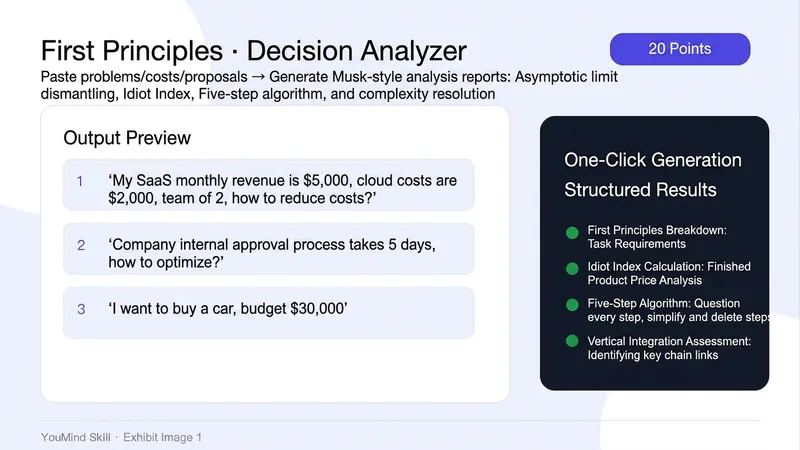
First Principles Analyzer
"This project is too expensive." "This process is too slow." "Should we do it in-house or outsource?" — Every time you're torn over such questions, your gut says something's off, but you can't pinpoint the issue or how much can be improved. Give it your problem and any data you have, and it uses Musk-style engineering thinking — not to sound like Musk, but to apply his decision framework — to break down the problem until it can't be broken further: Where is the asymptotic limit? What's the idiot index? Which steps should be removed or consolidated? One report later, you stop relying on gut feelings. ✨ Core Capabilities 1. First Principles Decomposition: Break any problem down to its fundamental elements, calculate the physical limit vs. the actual gap. 2. Idiot Index Calculation: Finished product cost / raw material cost = ? The higher the index, the more room for improvement. 3. Five-Step Algorithm: Follow the sequence of Question → Delete → Simplify → Accelerate → Automate, providing specific action recommendations. 4. Vertical Integration Assessment: Which steps have an idiot index >5? Which are worth doing in-house? 5. Physical Feasibility Check: Does the plan make sense physically? What is the hardest bottleneck? 📱 Use Cases - Startups / Small Teams: Optimize cost structure, evaluate technical solutions - Product Managers: Question requirements, cut features, accelerate iteration - Personal Decisions: Whether to learn a skill, switch tracks, calculate ROI - Any cost/efficiency issue where you feel something is off but can't articulate it It's not about chatting with Musk — it's about using his mental framework to make decisions.
 Research
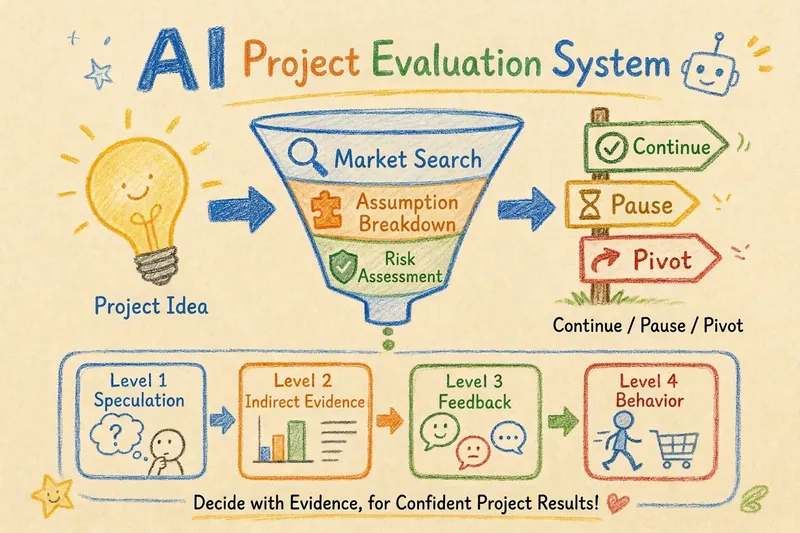
AI Project Eval & Validation
This skill is designed to provide comprehensive product or project validation analysis for entrepreneurs, product managers, and innovation teams. It helps users deeply analyze the market potential, risk points, and validation paths of new ideas, ensuring a clear understanding of core project assumptions before investing significant resources. Through multi-dimensional analysis, this skill can assess the project's current stage, identify key assumptions, and build an assumption dependency map to pinpoint the most vulnerable and dangerous parts of the project. It also analyzes the target user's role chain, the strength of current alternatives, and evaluates whether your solution has '10x improvement' potential. Additionally, it helps users identify potential 'killer questions,' conduct counterfactual failure analysis, and generate multiple positioning variants to explore more possibilities. In terms of commercialization, this skill assists users in selecting the appropriate business model, breaking down the deep reasons for user payment and purchase triggers, and proposing preliminary pricing logic. It also plans the Minimum Viable Saleable product (MVS) and devises a specific go-to-market (GTM) initial path and resource matching recommendations. Finally, it provides a tiered report containing detailed analysis, 7-day and 30-day validation plans, clear stage-gate decision suggestions, and next-step action guidelines, helping users quickly validate core assumptions at minimal cost.

First Principles Strategist
Think like Elon Musk: use first principles to deconstruct complex problems by returning to essence, questioning assumptions, extreme thinking, and logical reconstruction. Pierce through the surface to the core and reconstruct breakthrough solutions.
Information
- Version
- v4
- Last updated
- Runtime credits
- Usage-based
- Models
- Auto
