
First Principles Analyzer
Paste problem → Musk:limit,idiot index,5-step
First Principles Analyzer
Paste problem → Musk:limit,idiot index,5-step
Showcase
Description
"This project is too expensive." "This process is too slow." "Should we do it in-house or outsource?" — Every time you're torn over such questions, your gut says something's off, but you can't pinpoint the issue or how much can be improved. Give it your problem and any data you have, and it uses Musk-style engineering thinking — not to sound like Musk, but to apply his decision framework — to break down the problem until it can't be broken further: Where is the asymptotic limit? What's the idiot index? Which steps should be removed or consolidated? One report later, you stop relying on gut feelings. ✨ Core Capabilities 1. First Principles Decomposition: Break any problem down to its fundamental elements, calculate the physical limit vs. the actual gap. 2. Idiot Index Calculation: Finished product cost / raw material cost = ? The higher the index, the more room for improvement. 3. Five-Step Algorithm: Follow the sequence of Question → Delete → Simplify → Accelerate → Automate, providing specific action recommendations. 4. Vertical Integration Assessment: Which steps have an idiot index >5? Which are worth doing in-house? 5. Physical Feasibility Check: Does the plan make sense physically? What is the hardest bottleneck? 📱 Use Cases - Startups / Small Teams: Optimize cost structure, evaluate technical solutions - Product Managers: Question requirements, cut features, accelerate iteration - Personal Decisions: Whether to learn a skill, switch tracks, calculate ROI - Any cost/efficiency issue where you feel something is off but can't articulate it It's not about chatting with Musk — it's about using his mental framework to make decisions.
Related Skills
View all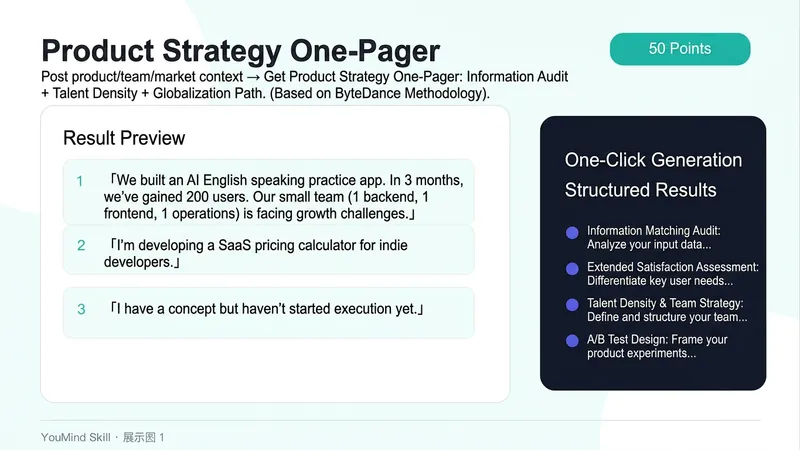
Product Strategy One-Pager
Building a product is like driving in the fog—what do users want? Is the team right? Should we go global? Which metric to optimize first? Every decision gambles the team's time and investors' money. Feed it your product info and data, and it uses ByteDance-style product methodology to help you clarify: What information and needs is your product matching? Are your current resources solving 'problems that will matter in three years' or 'urgent matters this month'? Is your team's talent density sufficient? What A/B tests can validate your core assumptions? ✨ Core Capabilities 1. Information match efficiency diagnosis: What is your product essentially matching? Where are the friction points? 2. Delayed gratification assessment: Distinguish 'important in three years' vs 'urgent this month', provide resource reallocation recommendations 3. Talent density and team strategy: Core role talent assessment + Context/Control boundary recommendations 4. A/B test design: Turn your gut assumptions into verifiable experimental plans 5. Global feasibility assessment: Language, culture, compliance, and payment four-dimensional check 📱 Use Cases - Early-stage startup teams making directional decisions - Product managers' quarterly reviews and strategy adjustments - Investors quickly evaluating a project's product logic - Developers building side projects validating ideas It doesn't give you a standard answer—it gives you a framework to ask the right questions.
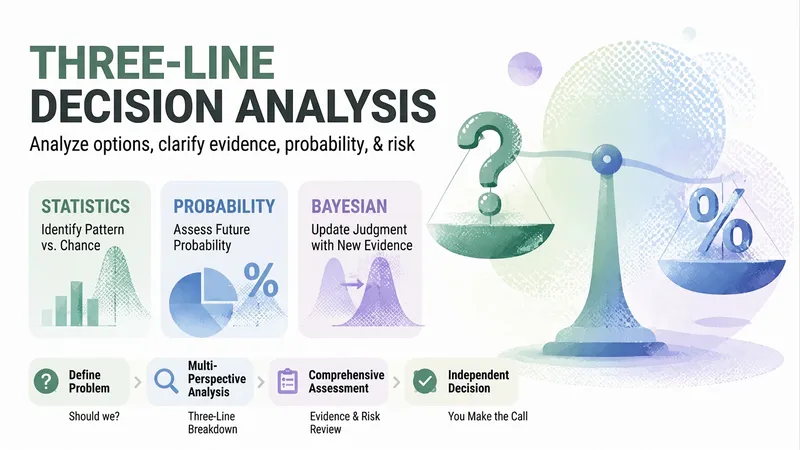
Should I Do It? Analysis
Turn the vague uncertainty of “Should I do X?” into a clearly bounded decision analysis that can be checked and updated over time. Whether you’re considering leaving your job to start a business, investing in a project, buying an asset, or making a career or life choice, you can provide text, tables, documents, or screenshots to organize your options, time horizon, major costs, how much risk you’re willing to accept, and how much confidence you need before acting. The analysis examines the question through statistics, probability theory, and Bayesian reasoning: checking whether samples are reliable and whether an observed pattern is more likely a real trend or a coincidence; breaking down possible future scenarios and comparing probabilities, expected returns, and tail risks; then combining prior beliefs with new evidence to determine which information is truly discriminating and how your judgment should be updated. User-provided facts, public information, and analytical assumptions are clearly separated. When reliable data is lacking, uncertainty is not concealed behind false precision. You’ll receive a replayable decision framework that includes new information worth verifying, actionable next steps, triggers for reassessment, and key evidence still needed. It won’t make the decision for you or present assumptions as facts. Instead, it helps you see the evidence, probabilities, costs, and risks clearly, leaving the decision in your hands.
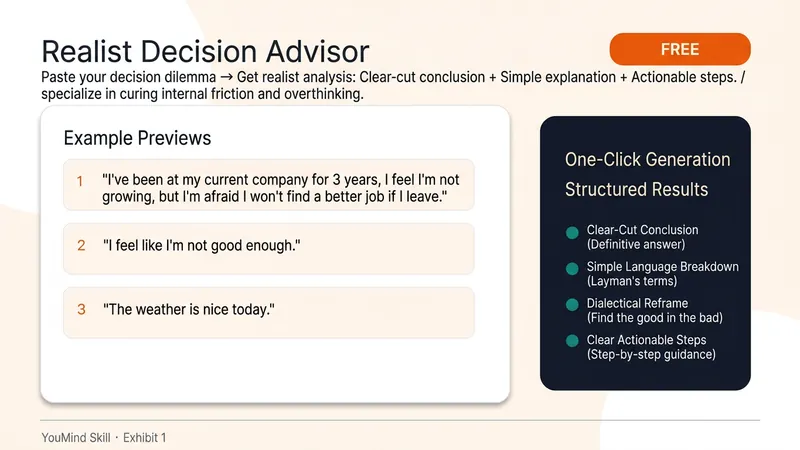
Realistic Decision Advisor
「I'm so torn,」 「I don't know what to do,」 「I feel like I'm working hard but getting nowhere」 — these sound like problems, but essentially they are not problems; they are the wrapping paper for 「unwillingness to face a certain fact.」 Throw your dilemma at it, and it gives you a plain-language conclusion. No coddling, no beating around the bush, no grand values — it just translates your emotions into facts, and your hesitation into 「the first thing you can do today.」 ✨ Core Capabilities 1. First, a conclusion: not 「pros and cons,」 but a direct verdict. 2. Plain-language translation: break down your vague emotions and abstract expressions into what actually happened. 3. Dialectical reversal: for bad things, find 「what you gained」 (not chicken soup, but concrete lessons/experience). 4. Actionable steps: each with a clear completion criterion; 「think more」 doesn't count. 5. Ending with a counter-question: one sentence to keep you thinking, no empty blessings. 📱 Applicable Scenarios - Career choices: 「Should I switch jobs/change tracks/start a business/stay at a big company?」 - Relationships: 「Should I break up/reconcile/keep distance?」 - Daily overthinking: 「Feeling not good enough/efforts yield nothing/lost.」 - Any moment when you feel 「stuck」 but can't pinpoint where. It's not a therapist; it's a friend who dares to tell you the truth.
Information
- Version
- v2
- Last updated
- Runtime credits
- Usage-based
- Models
- Auto
