Google Content Quality Checker
See what undermines trust before you publish
Google Content Quality Checker
See what undermines trust before you publish
Showcase
Description
Before you publish, check an SEO article for whether readers can truly use it, which claims don’t hold up, and what might make it seem untrustworthy. It compares the article against Google Search Central’s public content quality guidance, ranks the 3–5 highest-impact fixes, points to the exact location in the original text, and gives specific ways to improve each one. If you want, it can also rewrite the article—but it won’t invent experiences or data that aren’t in the original. Paste the full text or send a link. v2.0 update: Removed hard-coded years and algorithm update names. When specific policies are involved, it checks Google’s official documentation in real time. It no longer scores content using mechanical rules such as word count or keyword frequency. The report is now a prioritized revision checklist instead of a large eight-dimension table. During rewrites, it does not fabricate the author’s experiences, examples, or data.
Related Skills
View all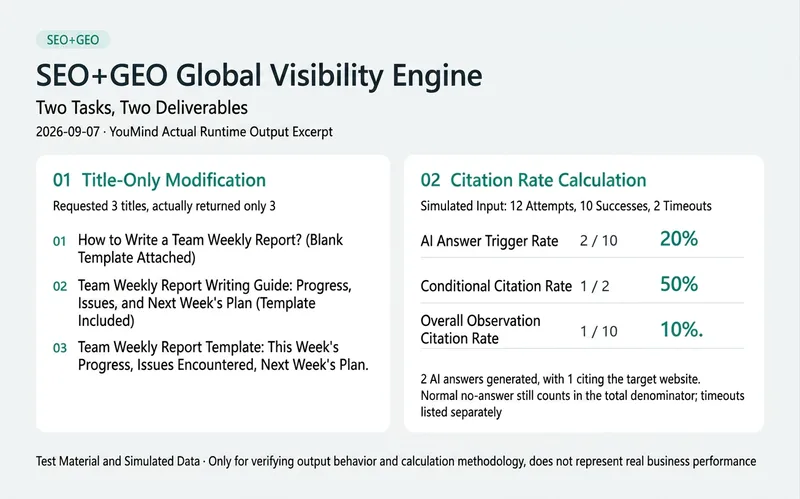
SEO+GEO Visibility Engine
Optimize the search performance and AI citation readiness of your articles, product pages, and landing pages. Quickly identify the issues most worth fixing, or get ready-to-use titles, rewrites, content briefs, technical fix lists, or performance retest plans. Four modes route tasks appropriately: send only a link or body copy for a quick diagnosis by default; request writing to get usable text first; use a full audit to break findings down by target engine and page; or use a performance retest with clearly defined data sources, numerators, denominators, and comparison conditions. Simple tasks do not require a full-length report. Supports platform-specific checks for Google AI Overviews / AI Mode, Bing / Copilot, ChatGPT Search, Perplexity, and Claude. Search, training, and user-triggered visits are assessed separately. For Chinese platforms, checks are adapted to actually available sources and direct observations rather than applying rules from other engines. v8 standardizes scoring and evidence criteria, limits the scope of local blocks, distinguishes answer trigger rate, conditional citation rate, and overall citation rate, and updates Google site-level AI control checks. Use it for your own websites, articles on third-party platforms, and unpublished drafts. Recommendations distinguish what you can change from items that require platform-side validation. Each key finding includes evidence or clearly stated limitations. Scores are provided when needed; data, authors, or citations are never fabricated, and rankings, indexing, or AI citations are not guaranteed. Actual run example (2026-09-07; test material, not business results) Title mode: Given test copy for “How to write a team weekly report” with a request to return only 3 titles, the actual output was: 1. How to Write a Team Weekly Report: Blank Template Included 2. Team Weekly Report Writing Guide: Progress, Issues, and Next Week’s Plan (Template Included) 3. Team Weekly Report Template: This Week’s Progress, Issues, and Next Week’s Plan Calculation mode: Simulated 12 attempts, with 10 successes and 2 timeouts; 2 successful runs generated AI answers, and 1 cited the target website. Actual output: AI answer trigger rate 2/10 = 20%, conditional citation rate 1/2 = 50%, and overall observed citation rate 1/10 = 10%. Normal no-answer cases remain in the overall denominator, while timeouts are listed separately. These figures validate the calculation criteria only and do not represent actual citation performance.
 Write
WriteAIGC Reduction & Rewrite v7.0
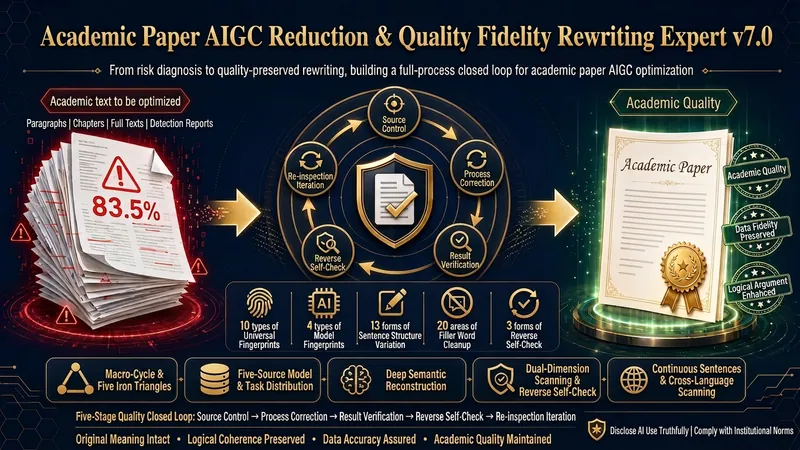
📚 Academic Paper AIGC Reduction and Quality-Preserving Rewriting Expert v7.0 Designed for graduate students, researchers, and paper authors, this academic text optimization skill operates on a core closed loop of 'source control → process correction → result verification → reverse self-check → iterative re-check'. It systematically diagnoses and optimizes issues such as templated expressions, mechanical logic, vague content, inaccurate terminology, and style inconsistencies while preserving original meaning, technical terms, data, and core conclusions. 🔍📝 🌟 Core Capabilities 🔬 Multi-layer Risk Diagnosis Covers 10 types of universal text fingerprints and assists in identifying common expression patterns of models such as ChatGPT, Claude, DeepSeek, and Wenxin Yiyan. 🧠 Deep Semantic Restructuring Goes beyond synonym replacement to rebuild more natural and in-depth academic reasoning by adjusting proposition expression, information order, argument approach, and evidence organization. ✍️ Quality-Preserving Rewriting Comprehensively applies 13 sentence transformation strategies and 20 methods for cleaning high-frequency templated expressions, improving mechanical sentence structures, repetitive connectors, and overly rigid formatting. 📊 Full-text Structure Diagnosis Through macro-cycle and five key triangles, checks whether research problems, theory, literature review, methods, results, conclusions, and innovation form a complete closed loop. 🧩 Fine-grained Section Adaptation Develops differentiated diagnostic and rewriting strategies for abstract, introduction, literature review, research methods, results, discussion, and conclusion respectively. 🌐 Cross-language Risk Scanning Assists in identifying translationese, passive voice stacking, long sentence nesting, and mixed Chinese-English formatting abnormalities to make Chinese academic expression more natural and accurate. 🔄 Reverse Self-check Loop After rewriting, re-verifies from three aspects: technique distribution, new text fingerprints, and information integrity, to avoid 'becoming more templated' or losing key content. 🛡️ Academic Integrity Protection Does not fabricate literature, data, cases, or policy evidence; separately marks information requiring author verification and reminds users to honestly disclose AI usage. 🎯 Use Cases ✅ Single paragraph or partial section optimization ✅ Targeted modification of marked paragraphs from inspection reports ✅ Polishing of abstract, introduction, literature review, discussion, and conclusion ✅ Full-text AIGC risk feature diagnosis ✅ Language and structure adaptation for target journals ✅ Pre-submission quality review and consistency check 📦 Final Deliverables 📄 Quality-preserving rewritten text 🔎 Risk and issue diagnosis report 🛠️ Rewriting strategy and technique description ✅ Reverse self-check and information integrity report 💡 Items requiring author verification and subsequent revision suggestions 🎓 Original meaning preserved · Logic intact · No fabricated data · Academic quality maintained ⚠️ This skill aims to improve academic expression quality and reduce text risk features. It does not guarantee passage through any specific detection platform or achieving a particular detection score.
Proposal Readiness Checker
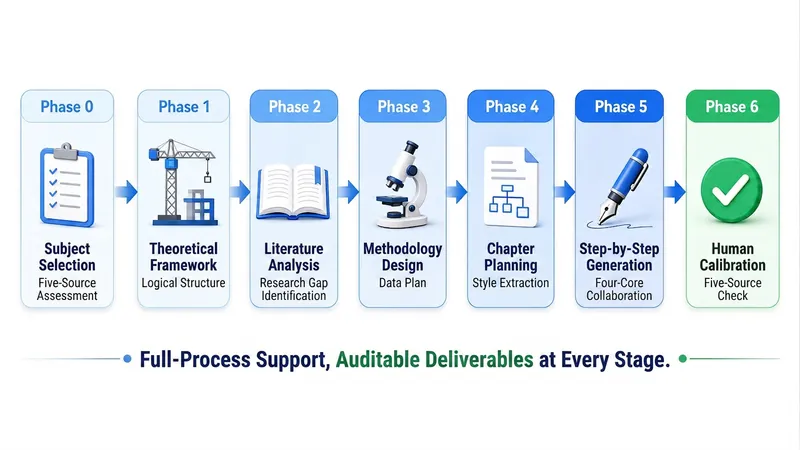
Before you spend dozens of hours writing your thesis, take ten minutes to run a structured checkup. This skill does only one thing: It diagnoses, not writes. It tells you whether your topic can hold up, whether your materials are sufficient, what's missing, where to fill the gaps, and in what order. Then it gives you an actionable missing-material checklist and search queries. It will not write your introduction, literature review, methods, or discussion. Four steps: 1. Discipline diagnosis: Classify your work into 1A Humanities/Arts, 1B Social Sciences, 2A Science/Engineering, or 2B Agriculture/Medicine/Life Sciences, and load the corresponding regulatory red lines; 2B triggers a mandatory ethics review block. 2. Topic checkup: Examine the topic from three dimensions—momentum, shape, and wording—to judge whether the research unit can be operationalized, whether the research question can be answered, and whether the topic has been done to death. 3. Material checkup: Register your existing literature into an M1/M2… material library, verify each entry against the four elements (author/year/title/verifiable locator), and compute the true coverage rate. 4. Gap list and search queries: Specify how many papers of what type are missing and which piece of evidence is lacking, and provide search queries ready to paste into databases (including Boolean keyword combinations, time ranges, and screening criteria). When to use it (trigger phrases): "Help me check my proposal" "Can this topic work?" "Do I have enough literature?" "My proposal was sent back" "I want to confirm before starting to write" — for graduate students who have just set a direction but haven't started writing; for those whose proposal was rejected but don't know why; for those with a pile of literature but unsure if it's enough to begin; for those wanting to confirm whether the topic is worth the investment before committing fully. Deliverables: A Proposal Checkup Report document + a Five-Source Readiness Scorecard (each level has behavioral criteria, not vague scoring) + a prioritized list of missing materials + search queries + an archive code. The archive code is compatible with the Academic Paper Full-Process Writing System v4.0; after the checkup, paste it there to continue writing without re-stating your discipline, topic, or journal. What this skill explicitly does not do: It does not write the main text, generate reference lists, or fabricate authors, years, volumes, issues, pages, or DOIs. Any literature found via online search is flagged with ⚠️ "needs verification" and must be verified by you before use. This skill does not promise any acceptance or passing outcome.
Information
- Version
- v2
- Last updated
- Runtime credits
- Usage-based
- Models
- Auto