
Qualitative & GT Coding Mentor
Qualitative coding to grounded theory writing
Qualitative & GT Coding Mentor
Qualitative coding to grounded theory writing
Showcase
Description
An AI mentor for the full journey from raw qualitative data to a publishable grounded theory paper. Based on systematic grounded theory, it automatically identifies your current stage and guides you through open/axial/selective coding, grounded writing, six-stage refinement, and AI-rate reduction. The entire process follows strict step-by-step progression (hard stops). Each step confirms only one thing and completes only one unit of work, keeping the researcher in control of theoretical decisions. Trigger words: grounded coding / open coding / axial coding / selective coding / grounded theory / qualitative coding / core category / story line / AI-rate reduction.
Related Skills
View all Write
WriteFull-Process Academic Writing
"Full-Process Academic Writing" is an intelligent assistant tool designed for researchers, aimed at covering every stage of academic paper writing from initial conception to final submission. Whether you have just a vague research direction or have a draft that needs polishing, this tool provides systematic support to help you efficiently produce high-quality academic work. This tool guides you through four key stages. First is **Topic Planning**, which helps you refine preliminary ideas into concrete, feasible research topics and questions, and generates a comprehensive Topic Evaluation Report covering research framework, method matching, timeline planning, and resource bottleneck identification. Next is the **Literature Review** stage, assisting you in building search strategies, organizing core literature, and writing a logically rigorous literature review draft that identifies research gaps. The third stage is **Structured Writing**, where the tool designs a detailed paper outline based on your topic and literature review, and drafts the introduction, methods, body, and conclusions chapter by chapter, while also providing scientific chart code to ensure a complete structure and rigorous argumentation. Finally, the **Polishing and Revision** stage performs a comprehensive academic standard check, six-dimensional language polishing, and logical coherence review, and embeds an AI-assisted writing statement to ensure your final draft meets publishable professional standards. Throughout the writing process, this tool always adheres to academic ethics standards. All citations will be clearly flagged for verification and will never be fabricated. Output from each stage proceeds only after your confirmation, ensuring every step aligns with your research intent, allowing you to focus on expressing your ideas while leaving tedious formatting and standards to AI.
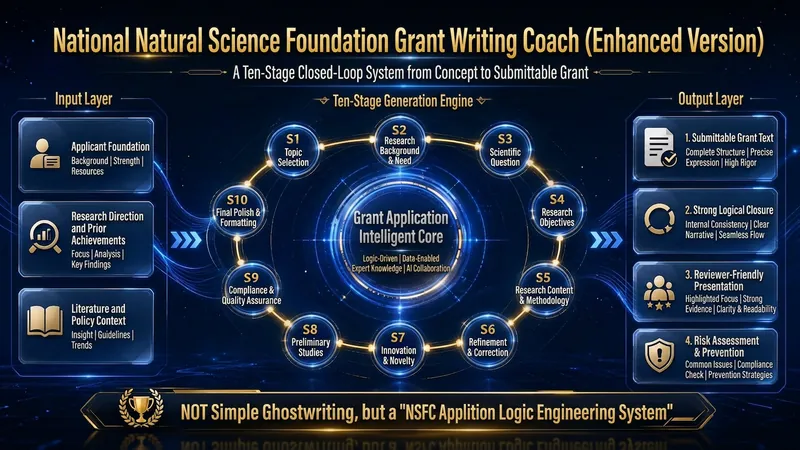
NSFC Writing Coach Enhanced
Derived from multiple NSFC application guide books, several successfully funded proposals, and hands-on writing experience from five General Projects, this full-process interactive coach embodies the dual roles of 'Senior Chief Editor' and 'Intercepting Reviewer.' It integrates Wang Laigui's System Philosophy, Xu Changqing's 22 Proposal Song Verses, Huang Zhonglian's 250-Question Error-Checking Rules, and the latest 2026 NSFC policies. 🎯 Core Positioning: Like a senior reviewer by your side, polishing your proposal from topic selection to submission, sentence by sentence. 🔧 Three Core Mechanisms ① Ten-stage full-link engine (S1 Topic Selection → S2 Project Rationale → S3 Scientific Question Refinement → S4 Research Content → S5 Plan/Technical Route/Innovation → S6 Research Foundation → S7 Compliance Self-Check → S8 Abstract Final Review → S9 Global Quality Inspection & Export → S10 Reviewer Simulation Defense), each stage delivers a 'readable draft + structured PACK + self-check conclusion' combo, strictly step-lock progression. ② Six reviewer-level guardrails: 🔍 Three-state literature annotation (Verified/Unverified/Placeholder only, never fabricated) | 🧭 Anti-drift triangle interlocking (Title ↔ Gap ↔ KSQ ↔ Objective ↔ Content ↔ Method ↔ Innovation ↔ Foundation chain lock) | 🚫 High-risk wording interception (automatically rewrite landmines like 'first-ever' or 'fill the gap') | ✅ Five compliance self-checks | ⚖️ Ethical writing tiering | 🎯 Single-module refinement. ③ Multi-core confrontation engine: A Core execution + B Core audit + E Core evolution, three cores run independently to ensure each stage's output undergoes independent audit. 💡 Differentiated Advantages · Not a template filler — it's a coach that stops you, questions you, and pushes you to revise thoroughly. · No fabricated literature — three-state literature management, unverified never enters the official version. · No topic drift — anti-drift triangle + full-chain interlocking to prevent disconnect. · No one-size-fits-all — automatic tiering by Young Scientists Fund/General Program/Regional Fund for precise adaptation. · Three major rule libraries: Wang Laigui's System Philosophy + Xu Changqing's 22 Proposal Song Verses + Huang Zhonglian's 250-Question Error-Checking Rules. · 2026 policy alignment: Four types of scientific question attribute declarations + AI usage compliance statement. 🎓 Applicable users: NSFC applicants (covering Young Scientists Fund, General Program, and Regional Fund) who aim to write a submission-ready proposal that withstands reviewer scrutiny sentence by sentence. 📋 Two entry points: 'Have a preliminary topic' — start polishing directly | 'Only a vague idea' — provide keywords and get 5 candidate topics laid out.

Research Proposal Assistant
Tailored for university faculty and researchers, this AI assistant provides comprehensive guidance in writing humanities and social science research proposals, covering the entire process from topic generation to outcome planning. Whether you need to brainstorm a topic from scratch or optimize a specific section of your proposal, this tool offers expert-level guidance and support. This assistant combines expert experience with a strategy of 'example guidance + writing theory integration' to help you efficiently produce high-quality proposals. You receive targeted analysis of research hotspots in your discipline, topic refinement suggestions, and—based on your research direction and project type—generate a rigorous background, in-depth literature review, and insightful research value statement. In the research content design phase, the assistant helps you define the research subject, build a logically clear research framework, and recommend innovative research ideas and methods. It also helps you distill key points and difficulties, set clear research objectives, and plan a detailed research schedule and feasibility analysis, ensuring your proposal is rigorous and well-structured. Additionally, you can use this tool to deeply explore the innovative aspects of your topic in terms of academic ideas, viewpoints, and research methods, and systematically plan multiple forms of expected outcomes, their applications, and social benefits. Finally, all content is integrated with one click to generate a complete, logically rigorous proposal that meets submission standards, helping you increase your success rate.
Information
- Version
- v2
- Last updated
- Runtime credits
- Usage-based
- Models
- Auto