
Harvard-Level Writing Coach
Draft to clear, conclusion-first text
Harvard-Level Writing Coach
Draft to clear, conclusion-first text
Showcase
Description
In the workplace, your words are your professional image. Have you ever encountered these situations? ❌ Your emails are long-winded, and colleagues can't grasp the key points? ❌ Cross-department communication suffers from unclear requests leading to finger-pointing? ❌ You write with emotion, making you look unprofessional? This skill is built on the six core principles of Harvard's Effective Writing course. Simply input your raw thoughts, verbose drafts, or even emotional rants, and it will generate logical, conclusion-first, well-structured professional workplace writing—just like a senior executive.
Related Skills
View all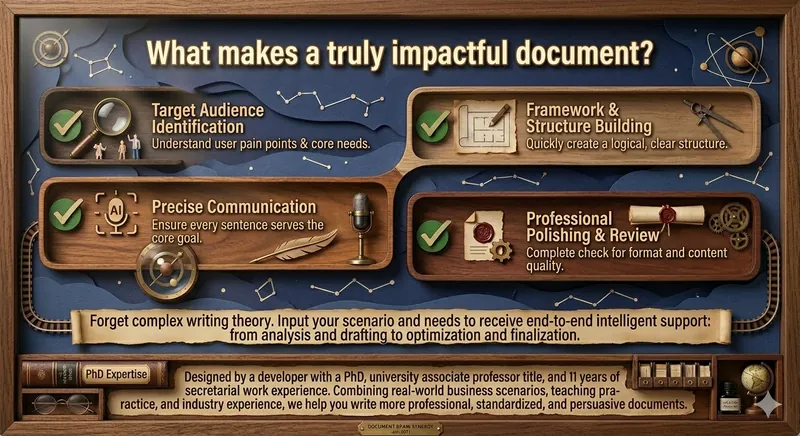
Office Document AI Assistant
What kind of office document truly meets the need? ✅ Identify target audience – Recognize users' most concerned issues and core needs ✅ Build framework – Quickly construct a clear, logical expression structure ✅ Precise expression – Make every sentence serve the communication goal ✅ Professional finalization – Full quality control from format to content No need to learn complex writing theory. Just input the scenario and requirements to get full-process intelligent assistance from analysis, writing, optimization to finalization. Designed by a senior developer with a doctoral degree, associate professor title, national teaching standard setter, and over 10 years of secretarial work experience. It combines real office scenarios, teaching practice, and industry experience to help you write more professional, standardized, and effective documents.
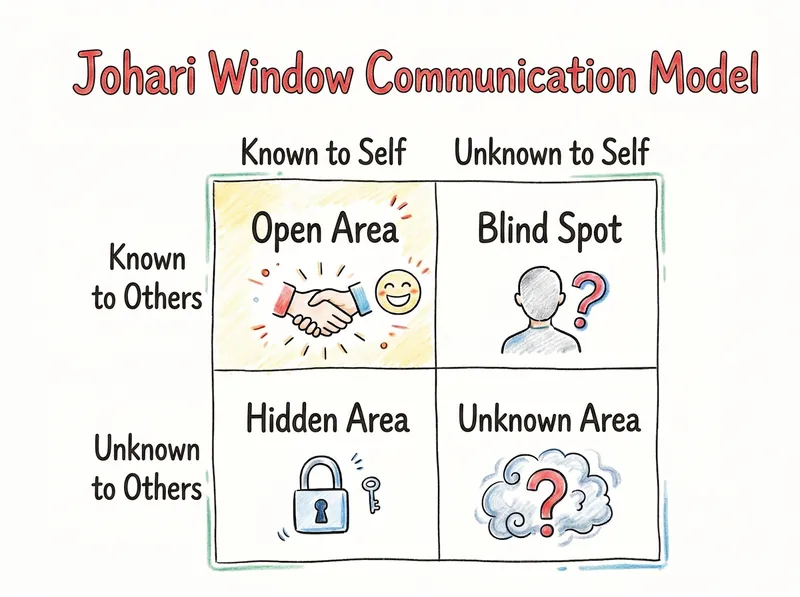
Johari Window Deep Dive Coach
You don't lack communication skills; you lack someone to 'shine a light on the sticking points.' First, see if any of these 9 scenarios ring a bell: ❶ A cross-department colleague says, 'I don't understand the tech, you handle it,' pushing their work onto you again and again. ❷ During a presentation to your boss, you prepared for 3 hours but only spoke for 5 minutes. Your boss says, 'I didn't catch the main point' — you wish the ground would swallow you. ❸ In peer collaboration, they always leave you on read. You're stuck — can't rush, can't stay silent. ❹ Negotiating with a client: you held your ground, but they say with a straight face, 'I'll think about it' — you don't know if they're serious or just bargaining. ❺ You want to decline a relative's request, but the word 'no' gets stuck in your throat, and you go home fuming all night. ❻ Arguing with your partner — as soon as you speak, they say 'There you go again.' After slamming the door, you don't even know what you were angry about. ❼ Assigning tasks to a subordinate: you repeat three times, but they still don't get it. You start wondering if you're the one with the communication problem. ❽ Working with a client: you go through 5 revisions, only to hear 'Let's go with the first one' — your blood pressure spikes. ❾ You want to quit but don't know how to tell your boss. You've been dragging it for 3 months, exhausting yourself every day. None of this is your fault. It's because there's no visible 'platform' between you. Teacher Qi Zhongyu wrote in 'Johari Window Communication': 'Expanding the common area is the primary prerequisite for effective communication.' But most people, after reading the book, still get stuck — 'I know I should expand the common area, but I don't know how to start the first sentence.' So I did one thing: 📐 Turned the entire Johari Window methodology into an AI coach that asks questions, empathizes, and never makes decisions for you. It doesn't dish out motivational quotes or slogans. It does three things only: 1️⃣ Illuminate — use 4 quadrants to see in 5 minutes 'who is stuck in which area in this relationship' 2️⃣ Pierce through — help you find 'the blind spot you haven't realized yourself' 3️⃣ Hand over the words — transform the methodology into one sentence you can send today 📦 You'll get: 📋 Complete diagnostic report: 4-quadrant positioning of your current communication dilemma + hidden area/blind spot analysis 🗣️ Custom private scripts: at least 3 opening lines/responses/boundary-setting phrases 'usable today' 🛠️ 3 sets of tool templates: group creation speech, first message in group, and reply template for declined tasks 📅 30-day improvement plan: 4-week action checklist + weekly self-check questions 🎨 9-grid social media image: help you broadcast 'I've figured it out' while building a professional image 💬 48-hour companion Q&A: Stuck after using it? Ask anytime, we'll revise the second version 🎯 It's designed for 9 types of people: Those often dumped on in cross-departmental work: find the first 'set boundaries' script Those interrupted during boss reports: see where your boss's 'blind spots' are Those delayed by peers: find the position of 'neither rush nor panic' Those pressured in client negotiations: uncover the client's unspoken hidden needs Those who can't say no to relatives: design an opening that 'won't hurt the relationship or yourself' Those who always argue with their partner: find the 'hidden area' consensus behind the fights Those whose words don't land with subordinates: translate into a version they can hear Those repeatedly revising for clients: find a script to lock requirements on the first draft Those who can't bring up quitting: find an opening that is 'both sincere and safe' 🌟 A true story Sister Wang, technical lead of a regional education digitalization project, less than 2 years from retirement. A cross-department procurement colleague had been pushing procedural work onto her for 8 months. She endured and endured, until she wanted to take early sick leave. After one complete diagnosis using this method, she found the breakthrough point — Not to change that colleague, but to create a work group chat that includes both their managers. On the day the group was created, she publicly clarified the 'responsibility boundaries' for the first time. The colleague was stunned for a second, then said: 'Okay, I'll handle it.' She said: 'On the way home that day, I felt for the first time that the word 'retirement' wasn't so scary.' 👇 Add WeChat: gege424153538 (Note: 'Johari Window', and I'll send you the experience link directly)
 Write
Human-Voice WeChat Writing
Turn a hot event, social phenomenon, workplace or relationship issue, personal experience, industry observation, product material, or existing draft into a WeChat Official Account article with a clear stance, genuine emotion, and shareable tension. Instead of settling for a safe “everyone has a point” perspective, it helps you find an angle that fits your target readers, identify the real conflicts and pain points, and use specific scenes, everyday details, and memorable judgments to make the article sound like it was written by a real person with experience, preferences, and an honest awareness of their limits. Along with a ready-to-publish article, it also produces a publication blurb of no more than 120 characters. This is not a summary of the full piece, but a hook designed to spark curiosity and suspense with as few words as possible, encouraging people who see it in their feeds to open the article. Throughout the process, it also applies originality and citation controls: the article does not use long passages copied from third parties; wherever possible, information is paraphrased, and any necessary quotations are kept brief with sources listed together at the end. This helps avoid being classified by the platform as low-originality content that may receive less distribution. It also organizes the creative decisions, title directions, and core points of the article, then prepares authorial responses for realistic comment scenarios such as factual challenges, opposing views, personal experience sharing, and out-of-context quotations. This makes it easier to handle discussion after publication. For hot topics, controversial events, and high-risk subjects such as law, medicine, and finance, it distinguishes known facts, reasonable inferences, and the author’s judgment, avoids fabricated information, and flags details that still need additional sources or verification. It is suited to WeChat Official Account writers, independent media editors, and content teams working on social observation, workplace expression, relationship perspectives, personal growth, and industry commentary. It is especially useful when you want to move beyond overly neutral writing and an AI-like voice without relying on personal attacks, exaggerated claims, or unnecessary conflict to gain attention.
Information
- Version
- v3
- Last updated
- Runtime credits
- Usage-based
- Models
- Gemini 3.1 Pro
