2-Minute Historical Figures
2-Minute Historical Figures
Showcase
Description
Quickly grasp the core details of any historical figure: achievements, decisions, honors, and failures. Includes beautiful portraits and timeline images, helping you chat confidently in social settings and showcase your knowledge.
Related Skills
View all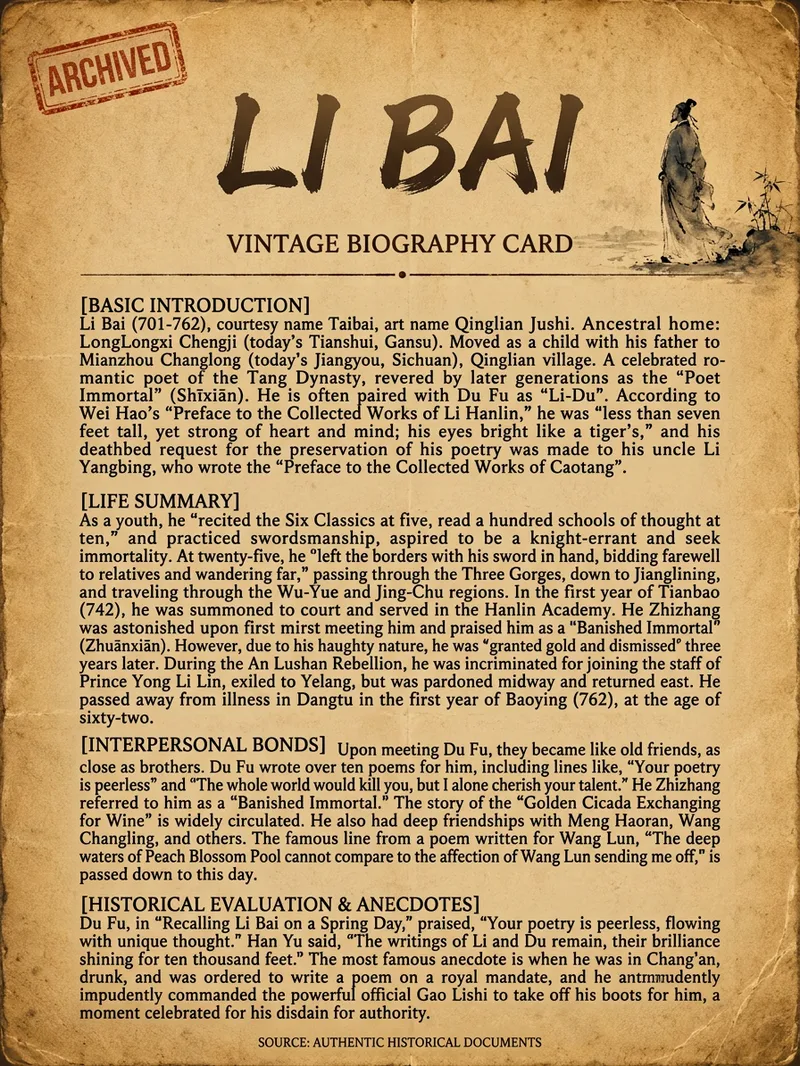 Image
Create Vintage Biography Cards
Enter the name of any historical figure or celebrity, and xiaoxiaodong will research reliable historical sources online to create a finished 3:4 portrait biography card with an aged kraft-paper texture. The body uses a coherent, flowing paragraph layout (large name heading → basic introduction → brief life story → personal connections → historical assessment and anecdotes), like an inner page from an old book, ready to save and share. It firmly avoids line charts, progress bars, pie charts, radar charts, and all other charts; when historical sources are unavailable, it truthfully notes “Not recorded in historical sources” and never fabricates years or evaluations.

On This Day
📅 Every day is a fold in history. Enter a date and instantly travel through time—from ancient to modern, East to West. 6–10 world-changing events unfold along a golden timeline. 🔍 Core Features: - Searches real historical events online, covering politics, technology, culture, military, exploration, and more. - Vertical timeline long-image with alternating event cards in an elegant, classic design. - Each event includes year, title, brief description, and domain tag for easy scanning. - Entrance animation brings the sense of unrolling a scroll. 🎯 Use Cases: - Daily morning curiosity: 'What happened in history today?' - Birthday/anniversary special: 'What was the world like on the day I was born?' - History class material, social media post inspiration, WeChat moments sharing. - Pure curiosity satisfaction—history is closer than you think. Enter a date and start your time travel. ⏳
 Image
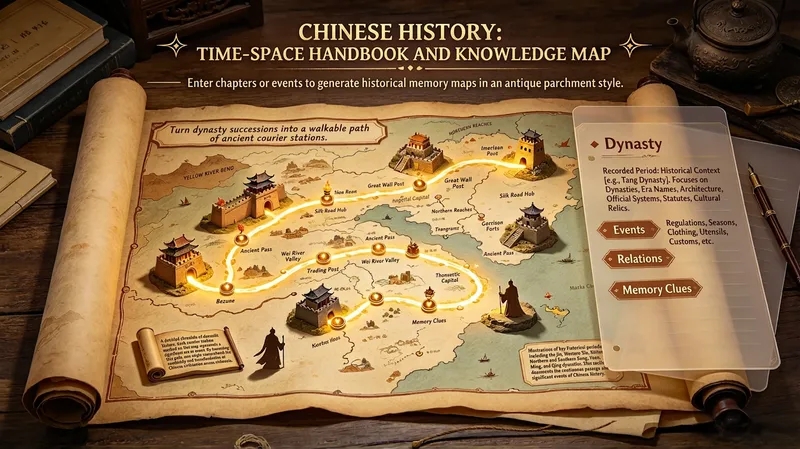
China History · Time & Map
Post-road format: Turn the timeline into a route of “post road—stations—passes,” with each dynasty as a city and each major transformation as a pass. Ancient and modern place names: Automatically label historical and present-day names (such as Chang'an → Xi'an, Lin'an → Hangzhou, and Jianye → Nanjing), showing both names on the map. Automatic fact-checking: Detect reign-title errors, mixed imperial temple and posthumous titles, reversed dynastic order, and misidentified figures. Correct errors before drawing the map. Longitudinal threads for institutional change: Trace systems such as civil service selection, taxation, and central government offices as standalone lines for cross-dynasty comparison without mixing their contexts. Character relationship map: Turn key figures into “travel companions,” with their factions, positions, and rivalries, helping solve the problem of forgetting names. Layered exam-point output: Separate recall-level content (dates, people, and places) from comprehension-level content (causes, effects, and comparisons), with mnemonics or comparison tables. Image-text cross-checking: The image handles routes and landmarks, while the text handles dates and conclusions. Neither repeats nor depends on the other. Multiple versions: Choose among three information-density levels: middle school general history, high school curriculum outline, or advanced preparation for graduate entrance and civil service exams. Recommended prompts Draw “the establishment and consolidation of unified Qin and Han rule” as a parchment map in an itinerary-on-the-post-road style. Turn “the evolution of ancient Chinese civil service selection systems” into a longitudinal institutional-change chart with a comparison table. Draw an ink-wash handscroll of “the Silk Road and Tang foreign relations,” with ancient and modern place names. Help me organize “the strengthening of autocratic monarchy in the Ming and Qing dynasties” at the high school curriculum-outline level, with a mnemonic.
Information
- Version
- v2
- Last updated
- Runtime credits
- Usage-based
- Models
- Auto
