
Sprout Signal Translator
Trace signals to the real economic winners.
Sprout Signal Translator
Trace signals to the real economic winners.
Showcase
Description
In a major industry news story, the company mentioned in the news is often not the one most worth researching. A surge in NVIDIA demand could reshape the server, power, and cooling industries; rapid growth at a private AI company could actually generate revenue for cloud providers, chip designers, and networking suppliers; and a highly publicized CEO speech may not have changed any economic facts. Sprout Signal Translator first verifies the event, then traces the value chain: What happened → What assumption changed → Where is the money flowing → What is the next bottleneck → Who already has the capability to solve it → Has the market already been revalued. It looks for both direct beneficiaries and potential losers, Picks & Shovels, and Emerging Sprout Candidates whose “mature core business provides a safety net while a new industry provides growth options.” When it cannot find a reliable economic transmission path, it allows the output NONE. It does not provide BUY / SELL recommendations, price targets, or return promises. Its goal is not to predict the next skyrocketing stock, but to translate industry changes into research leads worth validating further.
Recommended by
Dancang
Why we love this skill
It turns industry news into a verifiable value chain, separating facts, inferences, and narratives while using an evidence threshold to identify real economic beneficiaries—not investment hype.
Related Skills
View all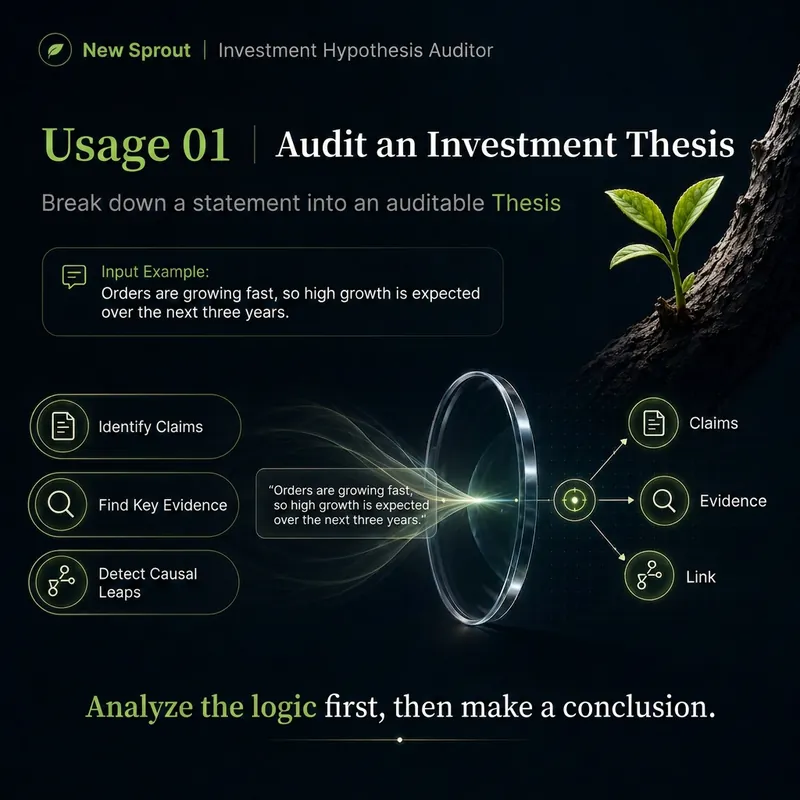 Research
Sprout | Thesis Auditor
Don't help prove my thesis. Help audit it. Many investment judgments fail not because the data is entirely wrong, but because accurate data supports an overextended conclusion. For example: “AI orders are abundant, so profits will definitely grow rapidly over the next three years.” “The company's business is strong, so the stock is cheap right now.” “Customers keep increasing, so the company has already achieved network effects.” “Management says the technology is leading, and it is stated in the financial report, so the moat has been proven.” 「Sprout | Thesis Auditor」does not help you find more reasons to prove yourself right. It breaks your investment thesis into an auditable Critical Path and checks each layer: Facts → Evidence → Causal Relationships → Hidden Assumptions → Commercialization → Economic Outcomes → Valuation By prioritizing primary sources, it answers the questions that truly matter: Which parts have already been supported by evidence? Which are merely reasonable inferences? Which necessary link is most fragile? Is there counterevidence that genuinely attacks the Thesis? What evidence is most likely to change the conclusion? It ultimately assigns one of five ratings: SUPPORTED / PARTIALLY SUPPORTED / FRAGILE / BROKEN / INSUFFICIENT DATA The conclusion must be traceable to specific Necessary Claims and evidence, rather than a vague “on balance” assessment.
High-Growth Stock Hunter
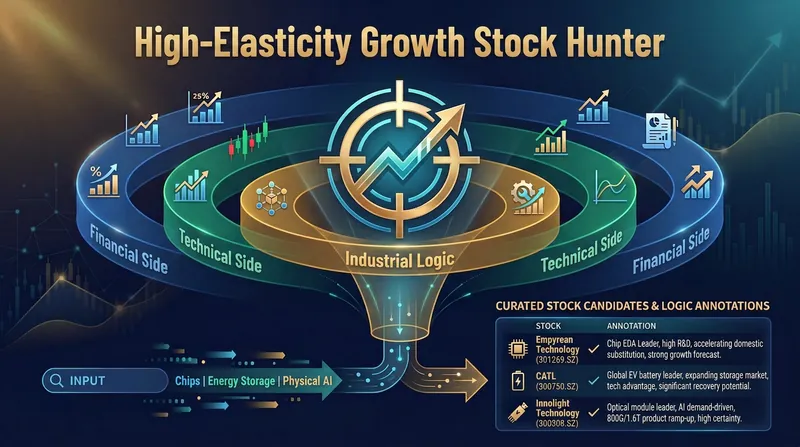
In a bull market, the most expensive thing isn't stocks—it's not knowing what to buy. This isn't fearmongering. It's the lesson the A-share market taught every retail investor in the first half of 2026. Chips are up 50% while you're holding cash. Energy storage has rallied three times while you're still flipping through Xueqiu posts. Stocks in the CXMT supply chain have already doubled, and you can't even name the upstream material companies. It's not that you lack courage—you lack a framework. Buy on tips, sell on feelings, pick stocks based on 'I heard XX is doing well.' That strategy might work in a range-bound market, but in a structural bull market, you're watching others feast while you can't even get a sip of soup. What is the High-Growth Stock Hunter? It's a stock-picking Skill that takes a sector keyword and automatically screens for high-growth A-share candidates. The core is a three-layer filter: Layer 1: Financials Eliminates pure hype. Only stocks that pass hard metrics—revenue growth rate, gross margin, R&D investment—move to the next round. No pump-and-dump stocks, no junk stocks, no pie-in-the-sky stories. Layer 2: Technicals Looks only at price-volume structure. Keep stocks that break out on volume from the bottom, discard those with high-volume bearish candles. Don't be the sucker buying at the top. Layer 3: Industry Logic This is the toughest layer. Candidates must be at key nodes in the supply chain—either upstream selling shovels or midstream bottlenecks. No downstream assemblers, no pure distributors, no story-driven turnarounds. After all three layers, what comes out isn't 'stock recommendations'—it's a candidate pool with selection logic. For every selected stock, you can see: why it's here, the logic behind it, and where the risks lie. Who needs this? If you fit any of the following: * You know a sector is about to take off but don't know which stocks to pick * You read three research reports and ended up more confused because each one recommends different stocks * You've bought chips, new energy, and innovative drugs—but bought each wave at the peak * Your portfolio is full of 'friend's tips' and 'influencer picks,' none of which you selected yourself * You believe there are still opportunities in A-shares, but you need a logic you can understand and reuse, not the next code someone feeds you Then this Skill is for you. Why the price tag? 1,999 credits—not cheap. But do the math: one impulsive chase-the-top trade will cost you more than that. Missing one high-conviction opportunity will lose you more than that. Spending three hours reading all the reports will cost you more than that in time. This Skill doesn't give you a single stock—it gives you a reusable hunting framework. Use it once and you're breakeven. Use it ten times and you start to build judgment. One final truth: The bull market won't wait for you. But it doesn't reward impulsiveness either. It rewards those who pick the right direction, the right stocks, and the right timing. The High-Growth Stock Hunter doesn't guarantee you win every time—nothing can. But it guarantees that next time you make a move, you'll have a map in hand, logic in your eyes, and calm in your heart. Ready to enter the game? Let the hunter take you into the woods.
Deep Stock Research Engine
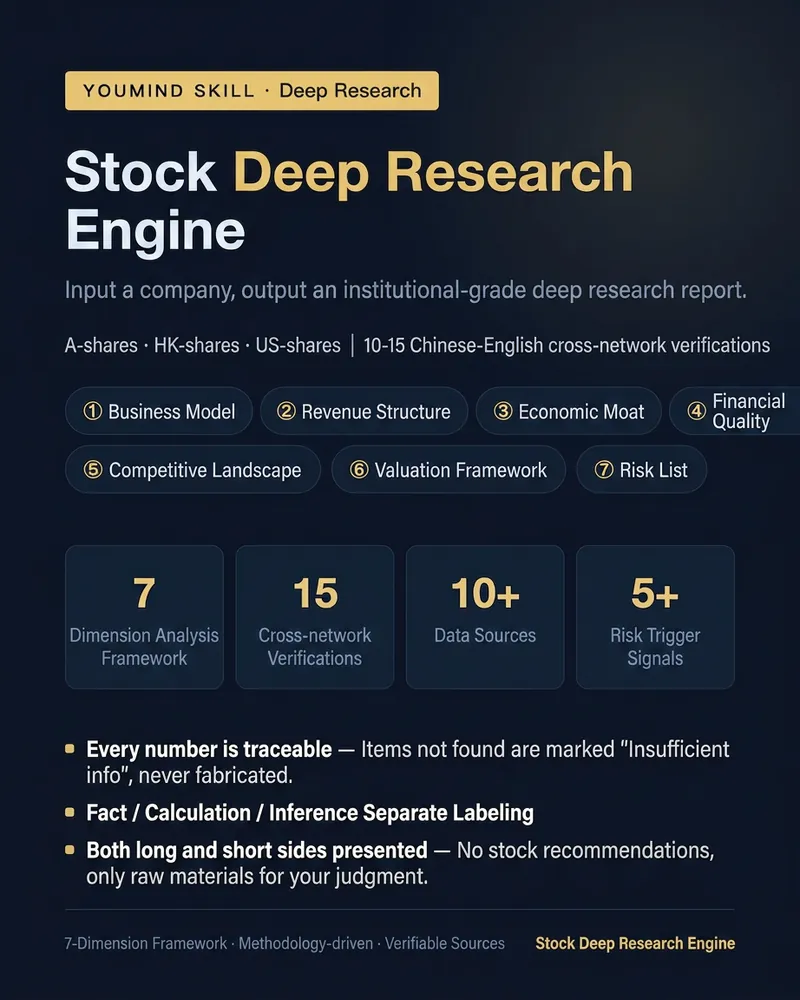
Not a news summary, but an individual stock research report with a methodological framework. Enter a company (A-share/H-share/US stock name or code), and it will perform 10-15 bilingual web searches to produce a report based on a seven-dimension framework: ① Business Model – where money comes from and goes, with a "translated into plain language" version ② Revenue Structure – breakdown by business, growth engines and drags ③ Moat – mandatory answer on widening or narrowing, using market share, gross margin, and pricing power ④ Financial Quality – cash flow vs profit alignment, changes in receivables, inventory, and goodwill ⑤ Competitive Landscape – competitor comparison table and concentration direction ⑥ Valuation Framework – only data and calculation framework, no judgment of over/undervaluation ⑦ Risk List – sorted by impact, each with verifiable trigger signals Each report includes: a one-page bull/bear summary (with substantial evidence on both sides), a next-quarter tracking list, and data sources for each point. Three iron rules: · Each key number is traceable to official filings or authoritative media; if not found, labeled 'insufficient information', never fabricated · Facts, calculations, and inferences are labeled separately · No stock price predictions, no target prices, no buy/sell advice – even for 'should I buy', only bull/bear evidence is given Supports three perspectives: Understand the Business (default), Financial Checkup, and Company Comparison. Suitable for investment researchers, financial content creators, and serious investors who want to systematically understand a company.
Information
- Version
- v16
- Last updated
- Runtime credits
- Usage-based
- Models
- Auto
