
Offer Toolkit
One-stop AI job search: from JD to offer
Offer Toolkit
One-stop AI job search: from JD to offer
Showcase
Description
A job search system backed by 10 years of experience at a major Silicon Valley company, packaging genuine hiring insights and job search methodologies into AI. Offer Toolkit | AI Job Search Assistant From "discovering your dream job" to "landing the offer," it breaks down the entire job search process into three smart modules: ① JD Decoder Deeply analyze the job description and generate a personalized Offer Strategy Report: - Whether it's worth applying - Role fit assessment - Core strengths and skill gaps - Interview focus and high-probability question predictions ② Resume Builder Transform your experience from a "job description" into a compelling impact story that recruiters recognize: - Automatically structure your personal experience - Optimize project descriptions and quantify achievements - Generate ATS-friendly, high-quality resumes - Supports 11+ print-ready professional templates ③ Behavioral Story Library Mine your real experiences to build reusable interview story assets: - Extract key projects and growth experiences - Automatically convert to STAR Framework - Build a personal Behavioral Interview Story Bank - Efficiently handle "Tell me about a time..." questions Whether you're debating "should I apply for this job," want to "optimize your resume," need to "analyze a JD," or are preparing for your next behavioral interview, Offer Toolkit will automatically identify your needs and route you to the most suitable AI module. Keywords: Job Search, Offer, Career, Job Hunt, JD, Job Description, Resume, CV, Behavioral Interview, STAR, Tell me about a time, Interview Preparation ------------------------------------- job-description-skill: Paste a JD and your resume, and you'll get an HTML report telling you: whether you should apply for this job, how well you match, what gaps exist, what the interview will likely ask, whether the salary is reasonable, and what to do in the next 6 weeks. resume-skill: Helps you polish your existing resume, import from LinkedIn, or write one from scratch through conversation. Provides 11 print-ready templates (Classic-ATS, Ledger, Tech Compact, Modern Sidebar, Pillar, Elegant Serif, Atelier, Timeline, Swiss, Executive, Color-block). Each time, it provides two files: one directly printable as PDF, and one you can edit by clicking words in the browser. bq-skill: It doesn't give you ready-made answers; instead, it helps you dig out things you've actually done and organize them into a reusable story library. It will ask about your experiences step by step, help you clarify your thinking using STAR/CAR, and tag them with labels like "decision-making" and "overcoming adversity." It saves one copy in Chinese and one in English, so you can use the same story for different behavioral questions next time. It can also look at a JD and predict 20 questions the company might ask, helping you prepare one by one. Three shared rules: 1. No fabrication. All experiences, responsibilities, and numbers come from what the user has actually said. It can help rephrase weak expressions, but it will never invent companies, positions, achievements, or quantified numbers. Numbers must be verified with the user. 2. Ask only one question at a time. Digging stories, building resumes, and preparing BQs are conversations, not questionnaires. 3. Structure first, then output. First convert to a standard data model, confirm it's correct, then render HTML or generate answers.
Recommended by
nene@YouMind
Why we love this skill
This tool integrates ten years of Silicon Valley job search methodology. Through three modules—JD decoding, resume reconstruction, and STAR story library—it achieves a full-process intelligent upgrade from job analysis to interview preparation.
Related Skills
View all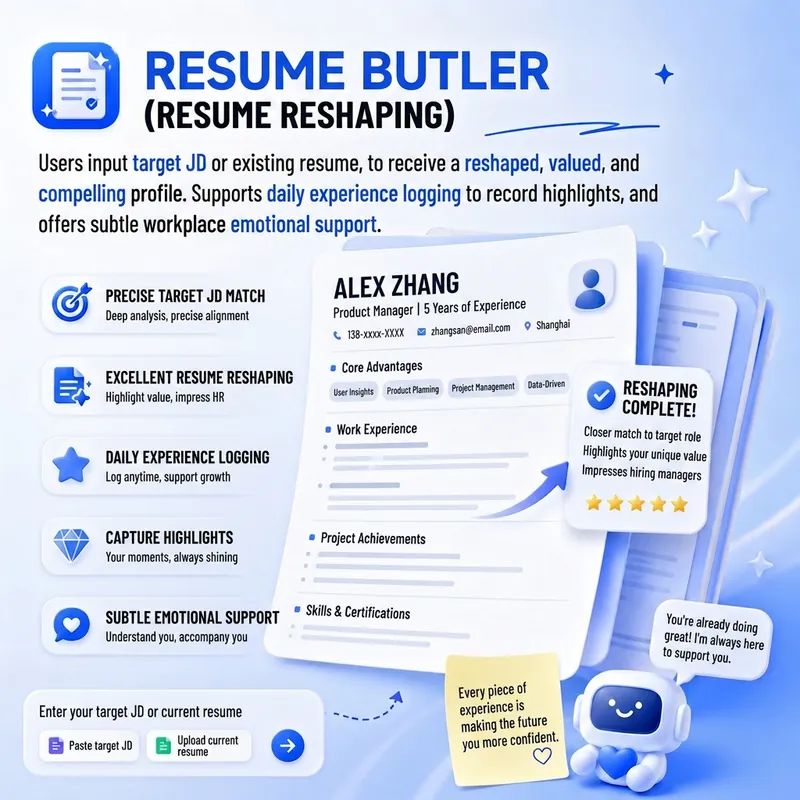
Resume Coach
Turn your resume from a list of experiences into a clear value proposition that helps recruiters understand why you’re worth hiring. Resume Coach supports resume diagnosis and rewriting, job description (JD) breakdowns, experience organization, and content streamlining for job searches including campus recruiting, experienced hires, career changes, and returning to the workforce after entrepreneurship. You can upload an existing resume or start with a work or project experience. From the perspective of recruiters and hiring managers, it helps you identify your core strengths and turn vague statements like “was responsible for,” “participated in,” and “was very busy” into specific actions, real results, and skills relevant to your target role. It can also work with a JD to help you decide which experiences to highlight and which points need to be expressed differently. When professional terms or job information are involved, it verifies them against reliable sources to avoid making things up. During the process, it moves forward on one question at a time, lets you temporarily skip uncertain information, and keeps items to be completed later. This helps you build your resume gradually through low-pressure conversation. Whether you’re creating your first resume, tailoring one for a specific role, or condensing an existing version, it can continuously maintain your career information and resume versions. Contact information is not requested proactively; remember to add it yourself before submitting your final resume. Keep growing throughout your career!

One-Click Hiring to Onboarding
Provides HR professionals with end-to-end recruiting automation, from job requirement assessment to hiring decisions, completing a professional recruitment process in 7 steps. Designed around the six core HR modules, it complies with the Labor Contract Law and the Employment Promotion Law. Core capabilities: job requirement assessment, smart JD generation, batch resume screening, interview question bank generation, background check guidance, hiring decision support, and recruitment review. Ideal for corporate HR, recruiting managers, headhunters, and startup founders. Trigger phrases: I want to hire / help me write a JD / screen resumes / interview question bank / background check / hiring decision / recruitment review
AI Prompt Architect MAX
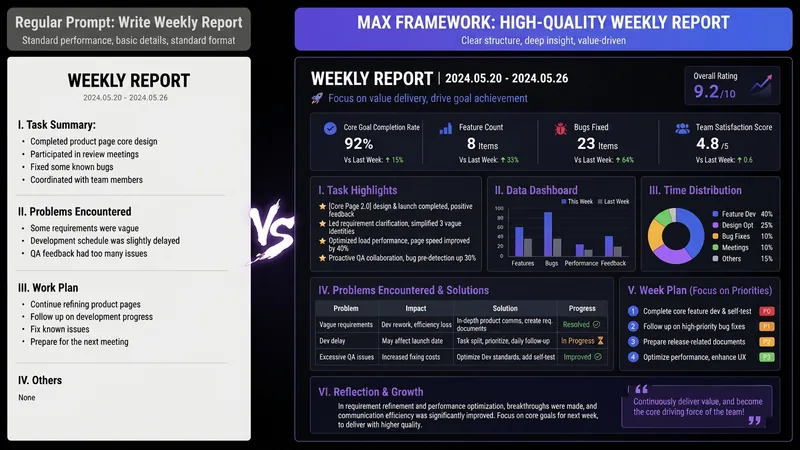
Have you ever had moments like these— You ask AI to write a weekly report, and it gives you a childish play-by-play; you ask it to revise a résumé, and it serves up “teamwork, diligence, and a strong sense of responsibility”; you ask it to analyze data, and it starts with, “As an AI, I’m happy to help you…” It’s not that AI is incapable—the problem is that your instructions are too amateurish. There are already plenty of Prompt templates teaching you how to write Prompts. But even after using them, you still can’t write your own—because what you’re missing isn’t a template. It’s the ability to compile requirements. This SKILL is my Prompt compiler: a condensed version of the Prompt architecture methodology I use every day as an AI OPC—someone working on the front lines of AI implementation—to write Prompts for teams. You explain what you need in plain language, and it gives you a top-tier architecture. Input: “Help me write a monthly report” Output: a complete eight-module Prompt architecture—role, task, audience, process, constraints, format, self-check, and examples, all locked in. Copy and paste it into ChatGPT / Claude / DeepSeek / Kimi, and the first output will be ready to use. Even better, it will tell you: ✓ Which model is best for this Prompt ✓ Which variables you can change directly next time (learn once, reuse repeatedly) ✓ Which one missing piece of information could take the output to the next level How is it different from an ordinary Prompt template SKILL? Other SKILLs give you a fish—one finished Prompt. This SKILL gives you a compiler—the ability to compile any requirement into a Prompt. Install it once, and every AI use case you have will improve—writing, reporting, analysis, translation, customer service, content creation, and more. Who should install it: People who use AI every day but are never satisfied with the output People who want to learn Prompt engineering without spending thousands on a course Team leaders who want to standardize AI use but don’t know where to start Content creators, researchers, students, job seekers, and side-hustle builders How well you use AI doesn’t depend on which model you choose. It depends on whether you can compile your requirements. Install it today, and the quality of your conversations with AI will take a dramatic leap forward.
Information
- Version
- v5
- Last updated
- Runtime credits
- Usage-based
- Models
- Auto