
Journal Needs & Topic Planning
Distill journal needs into publishable topics
Journal Needs & Topic Planning
Distill journal needs into publishable topics
Showcase
Description
Enter the target journal, source material (such as CNKI bibliographic records or several full-text articles), and your research area. The Skill first builds a journal needs profile using the “three-step demand distillation method” (explicit material → deeper identification → needs profile), then works backward from “potential–form–terms” and the “five-step topic selection method” to develop candidate topics and match them to the journal’s “four-step framework.” It ultimately develops a submission-ready plan including a proposed title, abstract, keywords, Chinese Library Classification number, document code, JEL classification, section-by-section outline, and source-material checklist. After the analysis, it separately produces three independent documents: Comprehensive Journal Analysis, Column Analysis, and Topic Analysis. Two modes are supported: 1) Journal analysis only (build the profile without presupposing research content); 2) Targeted topic development (the full workflow). User constraints are supported, such as using only public data, excluding certain angles, or working without internal materials. The Skill pauses for confirmation at each step and maintains a progress ledger to support resuming across sessions.
Related Skills
View all
Quantitative Topic Selection
Turn a vague research interest into a testable, feasible quantitative paper topic tailored to your target journal. Whether you plan to submit to a CSSCI or SSCI journal, or are comparing cross-sectional and longitudinal research, this Skill helps clarify your research direction, population, and scope while building a clear variable framework around independent, dependent, mediating, and moderating variables. As your topic takes shape, you can develop research questions, a theoretical framework, formal research hypotheses, measurement instruments, sampling and data collection plans, and statistical analysis approaches aligned with your hypotheses. If you already have a policy project or research keywords, you can use them to identify directions with academic publication potential. If you have not yet settled on a specific angle, you can generate and compare multiple candidate topics. The final output focuses on topic feasibility and publication potential: whether the data can be obtained, whether the variables can be operationalized, whether the theory, hypotheses, and methods form a coherent chain, whether the target journal is a good fit, and where the topic can occupy a distinct niche relative to existing research. You will receive a complete topic finalization plan covering the research direction, variable relationships, theoretical hypotheses, cross-sectional or longitudinal design, data and analysis plan, risk considerations, and feasibility recommendations—ready to share with your advisor or use as the basis for a literature review.

Target Journal DNA Deep Dive
This skill aims to provide scholars, researchers, and authors seeking precise submissions with a systematic and actionable method for journal analysis. By deeply encoding and analyzing published papers from the target journal, it helps users uncover the journal's true needs, preferences, and potential pitfalls. Users will learn to deconstruct the journal's review logic from multiple dimensions including its macro niche, paper structure, textual style, and even hidden editorial psychology. This involves identifying the journal's preferences in topic lifecycle, acceptance of different research question types, theoretical approach, as well as tolerance for author background and research risk. Ultimately, users can master a reusable journal demand function to support future submission strategies. By encoding and statistically analyzing at least 50 target journal papers one by one, this skill will guide users to produce a detailed journal DNA coding table, a comprehensive profile report of no less than 1,500 words, and three topic proposals with potential to fill gaps. These proposals will clearly indicate the journal's gap points, feasibility analysis, risk control measures, and emphasize their irreplaceability, thereby significantly improving submission acceptance rates.
 Write
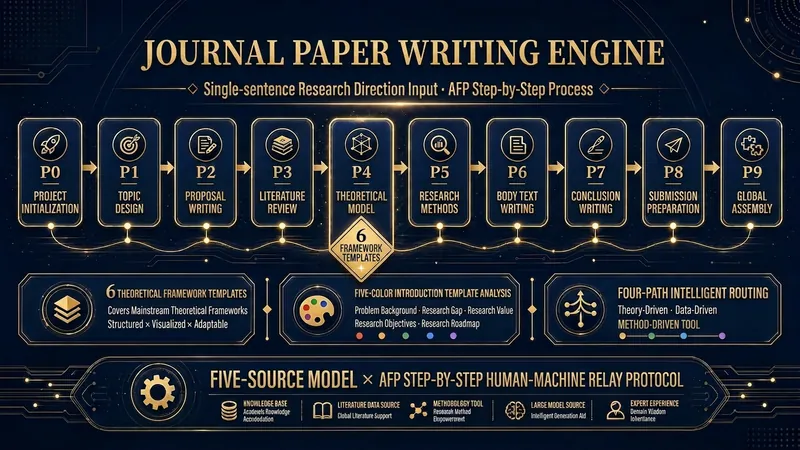
Journal Paper Writing Engine
Input your research direction in one sentence, and the AFP step-by-step engine guides you through the entire process. P1 Topic Design — Davis Interesting Theory + Problematization’s Five-Level Topic Selection Method, extracting real problems from phenomena. P2 Introduction Writing — Five-Color Template Analysis Method, breaking down top journal model papers section by section: emotional appeal → knowledge gap → literature positioning → research space → value declaration, with embedded full deconstruction prompts. P3 Literature Review — Structured organization, distinguishing research threads and dialogue objects. P4 Theoretical Framework — Six theory integration templates embedded throughout (complementary, contrast, bridging, hierarchical, evolutionary, general), each containing six paragraphs: introduction → justification → sorting → premise → analysis → conclusion; plus a five-level deep-drill sentence skeleton for single-theory depth. P5 Research Methods — Automatically adapts strategies based on four paths: empirical quantitative, qualitative, speculative, and mixed. P6 Body Writing — 9-3-1 pyramid structure. P7 Conclusion Writing — Three-level conclusion processing (findings → dialogue → extension). P8 Submission Preparation — Eight methods to reduce AI detection rate. P9 Global Assembly — Compiles independent documents from each stage into a complete draft, supports cross-chapter bidirectional backfill, and allows interruption and iterative backtracking at any time. 🎯 Suitable for: Graduate students (master's and PhD) and early-career researchers aiming to submit to Chinese C-journals, core journals, or SSCI, especially those stuck on theoretical framework and introduction writing. ⚙️ Underlying Architecture: Five-Source Model × AFP Step-by-Step Human-Machine Relay Protocol, with heartbeat signals, mandatory stop points, and dual-core auditing.
Information
- Version
- v11
- Last updated
- Runtime credits
- Usage-based
- Models
- Auto
