
Journal Paper Demand Analyst
Journal demand analysis for high-hit topics.
Journal Paper Demand Analyst
Journal demand analysis for high-hit topics.
Showcase
Description
Based on a supply-demand analysis framework, this tool deeply analyzes the actual needs of academic journals to help researchers precisely identify high-match research topics. By examining the titles, abstracts, and keywords of recent publications in a journal, it systematically identifies topic preferences, methodological tendencies, research object characteristics, innovation types, and underlying strategic needs. It then provides concrete, actionable topic recommendations and submission strategies to significantly boost paper acceptance rates.
Why we love this skill
This skill takes a unique approach, deeply analyzing journal needs from the perspective of supply and demand relationships. Driven by quantitative data, it provides researchers with high-hit-rate topic and submission strategies, making it a unique advantage on the academic path.
Related Skills
View all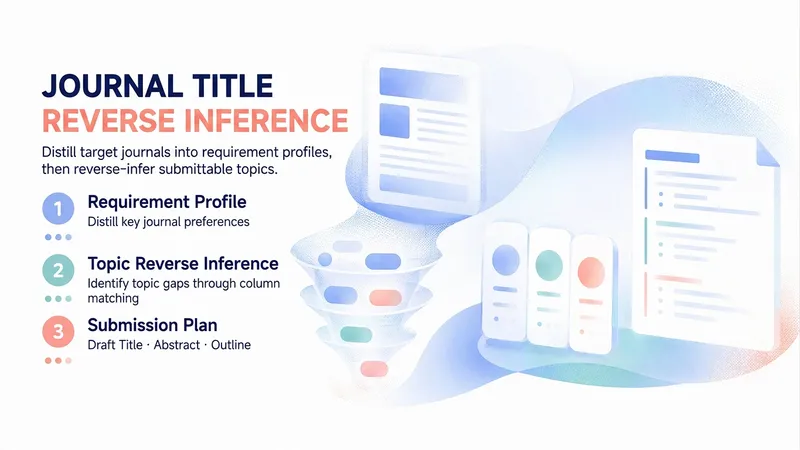
Journal Needs & Topic Planning
Enter the target journal, source material (such as CNKI bibliographic records or several full-text articles), and your research area. The Skill first builds a journal needs profile using the “three-step demand distillation method” (explicit material → deeper identification → needs profile), then works backward from “potential–form–terms” and the “five-step topic selection method” to develop candidate topics and match them to the journal’s “four-step framework.” It ultimately develops a submission-ready plan including a proposed title, abstract, keywords, Chinese Library Classification number, document code, JEL classification, section-by-section outline, and source-material checklist. After the analysis, it separately produces three independent documents: Comprehensive Journal Analysis, Column Analysis, and Topic Analysis. Two modes are supported: 1) Journal analysis only (build the profile without presupposing research content); 2) Targeted topic development (the full workflow). User constraints are supported, such as using only public data, excluding certain angles, or working without internal materials. The Skill pauses for confirmation at each step and maintains a progress ledger to support resuming across sessions.

Target Journal DNA Deep Dive
This skill aims to provide scholars, researchers, and authors seeking precise submissions with a systematic and actionable method for journal analysis. By deeply encoding and analyzing published papers from the target journal, it helps users uncover the journal's true needs, preferences, and potential pitfalls. Users will learn to deconstruct the journal's review logic from multiple dimensions including its macro niche, paper structure, textual style, and even hidden editorial psychology. This involves identifying the journal's preferences in topic lifecycle, acceptance of different research question types, theoretical approach, as well as tolerance for author background and research risk. Ultimately, users can master a reusable journal demand function to support future submission strategies. By encoding and statistically analyzing at least 50 target journal papers one by one, this skill will guide users to produce a detailed journal DNA coding table, a comprehensive profile report of no less than 1,500 words, and three topic proposals with potential to fill gaps. These proposals will clearly indicate the journal's gap points, feasibility analysis, risk control measures, and emphasize their irreplaceability, thereby significantly improving submission acceptance rates.

Journal Fit Advisor
Rejected? It's not necessarily bad writing—it's not writing like this journal. 「Journal Fit Advisor」doesn't boast about the journal's ranking. It does one thing: break down real samples from your target journal, show you exactly what it prefers, and help you revise your paper paragraph by paragraph to fit better. 🎯 How it helps Submit a target journal → Extracts real preferences across six dimensions: topic, structure, theory, methodology, language, argumentation → Diagnoses where your paper falls short → Provides actionable rewrites (2-3 versions each for title, abstract, introduction, conclusion). ✨ Why trust it • Each preference is labeled with evidence level: official statement (A), sample inference (B), cautious guess (C). If it's a guess, it says so. • Cross-checked for uniqueness: every feature asks 'Do other similar journals do this too?' Only retains true differentiators. • No fabrication: no fake impact factors, no fake acceptance rates, no promises of acceptance. Lowers confidence if material is insufficient. • Plus a 'Journal Style Prompt Card' – copy and paste into any LLM to instantly write in that journal's style. 💬 How to use it ·“Analyze the topics and writing style of Journal XX over the last three years” ·“I want to submit to Journal XX – run a submission fit diagnosis for me” ·“Rewrite my abstract to sound more like Journal XX” ·“How long are titles in Journal XX typically?” (quick answer for short questions) 👥 Who it's for: graduate students, early-career researchers, authors wanting to self-check before submission. ⚠️ Boundaries: It provides observable style analysis, not the editor's true thoughts, nor a guarantee of acceptance. Cross-journal topic selection, pure title polishing, and chapter ghostwriting will be redirected to more appropriate tools.
Information
- Version
- v3
- Last updated
- Runtime credits
- Usage-based
- Models
- Auto
