Peer Review Response & Revision
Streamlined academic revision letters and tracking
Peer Review Response & Revision
Streamlined academic revision letters and tracking
Showcase
Description
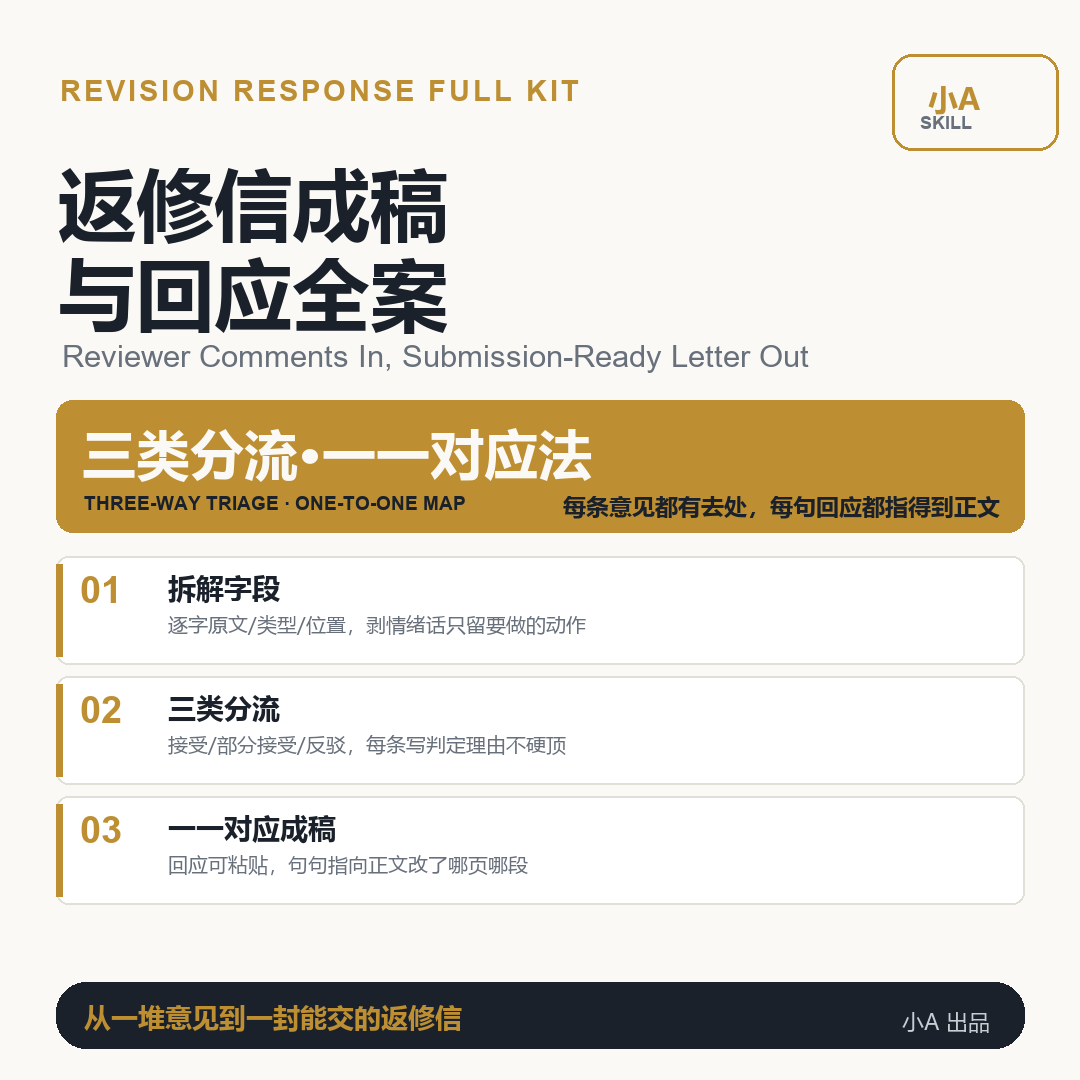
Struggling to organize dozens of reviewer comments into a cohesive response letter? The three-way triage and one-to-one matching method helps you break down, categorize, draft, and align every comment. With authorization, it generates ready-to-use response letters, item-by-item comparison tables, and revision checklists based strictly on your actual changes without fabricating data or reviewers. Key selling point: Goes beyond templates by delivering complete response letters, comparison tables, and checklists directly to you, backed by verifiable public guidelines and zero fabricated data. Best for: Graduate students and early-career researchers receiving major or minor revisions, resubmissions after rejection, or delayed responses; anyone struggling to organize multiple comments or respond without causing friction. Input: Original reviewer comments word for word, your planned changes (accept/partial/rebuttal), actual modification locations, and target journal requirements. Deliverables: 8 content items (comment breakdown, three-way triage, line-by-line responses, response-to-text comparison, revision checklist, response letter, follow-up letter plus log, compliance check) and 5 final items (authorization record, response letter file, response comparison table, revision checklist plus follow-up, sign-off sheet). When tools are unavailable, a ready-to-paste content package is provided instead. Methodology: Three-Way Triage & One-to-One Matching 1. Breakdown fields - Number each comment, keep verbatim text, type, location, and feasibility before writing. Isolate emotional remarks and focus solely on required actions. 2. Three-way triage - Accept, partially accept, or rebut, with clear justification for each. Rebuttals follow a framework of acknowledging valid points, presenting evidence, and explaining retention. 3. One-to-one matching - Generate paste-ready responses and create a comparison table with three valid status values, ensuring all promised changes appear in the text. Grounded in public guidelines: Based on journal author guidelines, COPE, ICMJE, APA 7, GB/T 7714-2015, and PRISMA 2020 where applicable. Every boundary is clearly marked, and authoritative sources are never fabricated.
Recommended by
Dancang
Why we love this skill
This Skill turns revision from scattered explanations into verifiable deliverables: triaging by acceptance level, mapping responses to text edits, and assembling the final letter and checklist reliably.
Best for
Graduate students and early-career researchers handling major revisions, minor revisions, or resubmissions.
How to use this Skill
Provide your input
Provide the original peer review comments, planned handling methods, actual modification locations, and target journal requirements.
Run the Skill
After submitting the materials, the tool organizes comments item by item, generates responses, and checks their alignment with text edits.
Review your result
Receive ready-to-paste response letters, item-by-item response and revision comparison tables, change checklists, and follow-up letters.
Related Skills
View all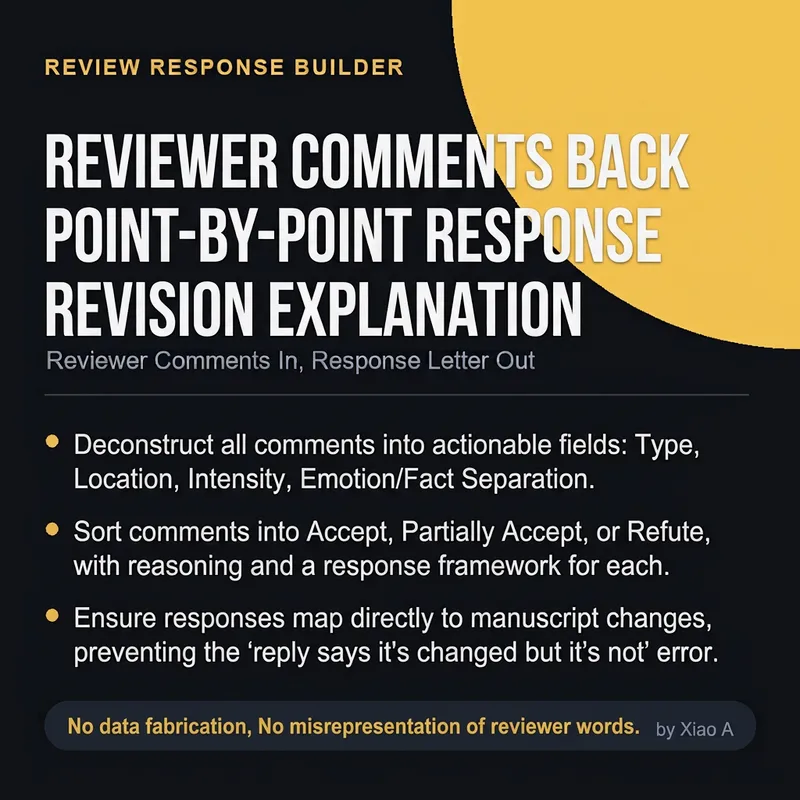 Write
Peer Review Response Generator
Struggling to respond to a mountain of peer review comments? This Skill parses feedback into actionable items, sorts them by acceptance status, provides structured response templates, creates a mapping table between replies and manuscript edits, and assembles a professional response letter and revision checklist. After receiving dozens of comments, the hardest part is categorizing them, prioritizing edits, and respectfully rebutting points without provoking reviewers. This workflow breaks down reviews into structured fields: type, location, demand strength, and feasibility. It separates reviewer tone from actual requested actions. Incoming comments are triaged into three categories: accept, partially accept, or rebut, with clear determination criteria and proven response frameworks. Rebuttals follow strict red lines to remain professional and evidence-based. The critical step is the revision mapping table, which ensures every promised change matches actual manuscript edits, preventing discrepancies. Finally, it formats a numbered response letter and a revision checklist for your supervisor. **Note**: This is a guidance-only Skill. It delivers worksheets, response frameworks, and checklists. It does not write manuscript text, fabricate experimental data or literature, or guarantee acceptance.
 Write
Literature Review Builder
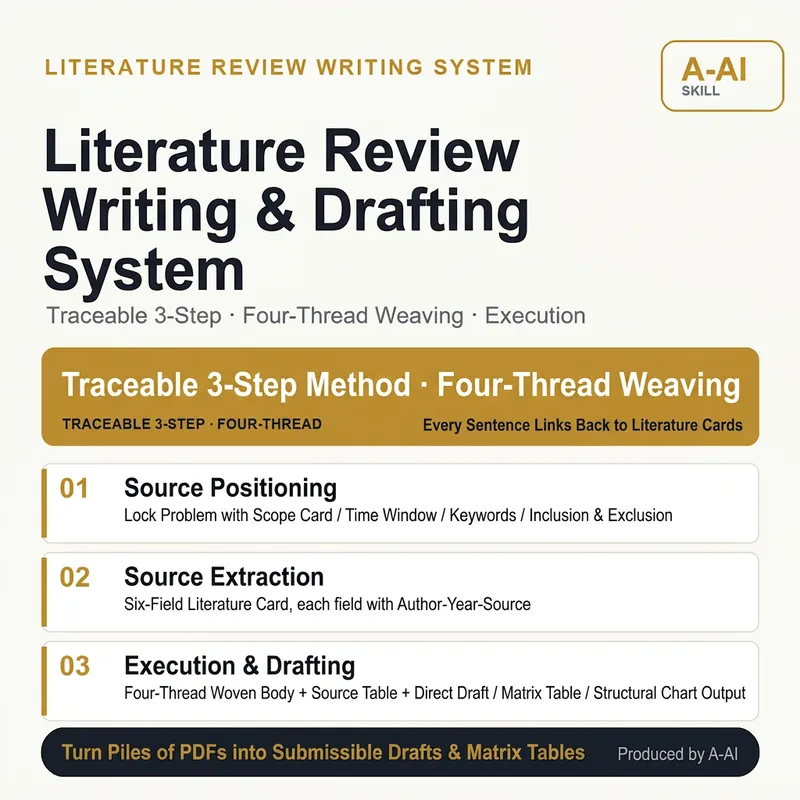
Struggling with a monotonous literature review or missing citations? The three-step provenance method and four-line weaving help you locate, extract, and weave content so every sentence links back to a literature card. Execution upgrade: upon authorization, directly receive a review draft, literature matrix table, and four-line structure diagram, organizing only what you have read without inventing citations. **Core Value**: Beyond templates—after authorization, receive the review draft, literature matrix table, and four-line weaving diagram directly; every step anchors to verifiable public standards without making up a single citation. **Best For**: Graduate students and early-career researchers writing research proposals, thesis chapters, or grant foundations; anyone with piles of unorganized literature, monotonous reviews, or unreferenced claims. **What to Input**: Service goal + concise research question + read literature list (PDF, notes, or citations) + discipline + target format. **What You Get**: 8 content items (verification card, scope card, 6-field card library, citation authenticity check, four-line outline, body draft, traceback table + gap, self-check + authoritative anchor check) + 5 finished items (authorization record, review draft, literature matrix table, four-line structure diagram, acceptance table). Replaced with a ready-to-paste content package when tools are unavailable. ## Exclusive Methodology: Three-Step Provenance & Four-Line Weaving Reviews read like laundry lists because claims lack sources and literature is not broken down. This method addresses precisely that: 1. **Provenance Location**: Scope cards lock in your research question, time window, keywords, database, and inclusions/exclusions to set boundaries. 2. **Provenance Extraction**: Create 6-field cards for each source—claim, method, finding, limitation, key quote, association—with (author, year, source). Never write about what you haven't read or invent page numbers. 3. **Provenance Weaving**: Weave timeline, theme, method, and debate into the body, linking each paragraph to card numbers for balanced critique. Output a citation traceback table and 3 gaps. Remember: Every claim links back to a literature card. ## Evidence-Based Public Standards Anchored in public standards rather than guesswork: GB/T 7714-2015, APA 7, COPE, PRISMA 2020 (applicable only to systematic or scoping reviews). Clear boundaries are marked, deferring to target school or journal requirements. ## Version 1 Update: From Templates to Finished Files This version turns content into usable files. It detects tool capabilities, informs you of generation plans, and proceeds upon confirmation: - **Review Draft**: Four-line format with provenance and references, ready for Word; - **Literature Matrix Table**: Row-by-row 6-field cards ready for Excel; - **Four-Line Structure Diagram**: Maps your cards and relationships. **No generation tools?** Receive a ready-to-paste content package with full text, Markdown matrix, and prompts. ## Details ### Why Reviews Become Laundry Lists It happens when you write without breaking down cards. The three-step method breaks down sources first, then weaves them logically. ### Three Steps 1. **Location**: Scope card + inclusion/exclusion. 2. **Extraction**: 6-field cards with source info and citation checks. 3. **Weaving**: Four-line body text + critique + traceback table + 3 gaps. + **Authoritative Anchoring**: Verifiable public standards. + **Execution Delivery**: Tool detection → authorization → output → acceptance. ### What It Does Not Do - **Only processes read content**: No invented citations, authors, years, sources, page numbers, or data. - **No fake generation**: Clearly marks missing tools and provides paste-ready packages. - **No publication guarantees**: Focuses on clarity and rigor. - **No forced authority**: Applies standards only when appropriate. - **Honest resource usage**.
 Write
NSSF Proposal Review & Audit
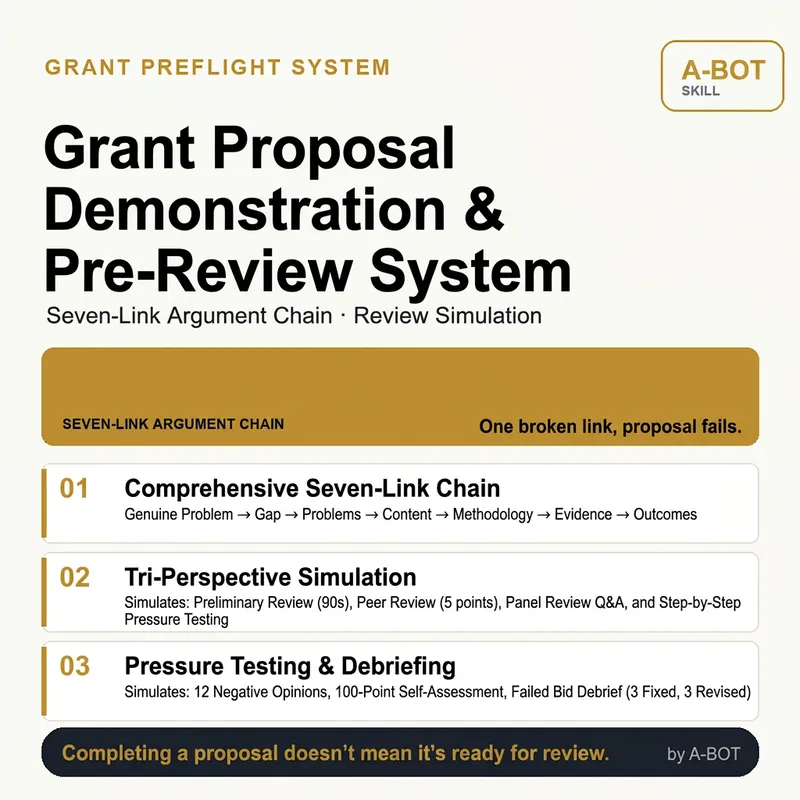
Does your proposal hold up under scrutiny? This skill compresses your National Social Science Fund or Ministry of Education humanities proposal into a one-page 7-ring logic chain, previews it from three review perspectives, and stress-tests it against 12 negative review opinions. With execution upgrades, it organizes your materials into a 7-ring argument table, a negative opinion comparison table, and a self-assessment form after authorization. It never ghostwrites text, fabricates facts, or guarantees approval. Key selling point: It doesn't just point out flaws—after authorization, it directly generates the 7-ring argument table, negative opinion comparison table, dual-track framework, and self-assessment form for you. Announcements for the current year apply; no preliminary results are fabricated. Best for: Applicants for National Social Science Fund or Ministry of Education humanities projects, early-career researchers looking to review rejected submissions, or anyone whose content resembles a textbook table of contents, whose innovations sound like slogans, whose main thread is broken, or who worries about identity disclosure in blind reviews. What to input: Discipline + category + batch (subject to the current year's announcement) + research direction + your actual completed work + draft (optional). What is delivered: 8 content items (identity card / rejection review / restriction checklist / three-perspective card / 7-ring one-pager / dual-track framework / 12 negative opinions / 100-point self-assessment / authoritative anchor check) + 5 finished items (authorization record / 7-ring argument table / negative opinion comparison + dual-track framework / self-assessment form / rejection review & acceptance sheet). If tools are unavailable, a copy-pasteable finished content package is provided with notes. ## Exclusive Methodology: The 7-Ring Logic Chain Most rejections aren't due to formatting, but fragile arguments. Before writing a single word of text, this method compresses your logic onto a single page: 1. 7-ring thread: True problem → literature gap → research question → content → methods → evidence → outcomes. Any broken ring is highlighted in red with a fix, and rings 3→4→5→7 must connect. 2. Three-perspective preview: 90-second initial review, five-item desk review, and panel review skepticism—each step highlights "who is being defended against," helping you understand why the check matters. 3. Stress testing and review: Check off 12 negative opinions one by one, take a 100-point self-assessment (submissions under 70 points are not recommended), and conduct a rejection review for secondary submissions adhering to "three unchanged, three must-change" principles to block skin-deep rejections. Remember this: Break one ring, and the proposal fails. ## Evidence-Based: Parameter Rules Follow Current Announcements Anchored strictly to authentic public guidelines: current year's NSSF application announcement / Ministry of Education humanities notification / institutional research office template (highest priority), historical approval libraries, and CNKI/Wanfang novelty checks (self-checked), plus standard publishing ethics (background only). Age limits, word counts, restrictions, columns, and deadlines that cannot be confirmed are marked as "pending verification"; numbers are never filled in from memory. Unrelated guidelines (PRISMA, ICMJE, etc.) are explicitly marked as not applicable. ## v1 Update: From Tables to Finished Files Older versions provided modifiable intermediates, but this version turns content into usable files: it first tests your current session's tool capabilities, tells you what will be generated and resource consumption, and only proceeds upon your confirmation. - One-page 7-ring argument table: 7 rows of arguments with broken rings highlighted in red and connectivity conclusions, ready for Excel. - Negative opinion preview comparison table: 12 rows checked one by one, hit location + one-sentence fix. - Dual-track framework + self-assessment form + rejection review table: Frameworks based on Type A blind review 8 sections / Type B form 5 columns, complete with self-assessment scores and secondary submission revision lists. No generation tool in the session? Delivered as a "ready-to-paste finished content package"—all five tables written in Markdown, ready to copy into Word or Excel. Never pretends to generate or fabricates file paths. ## Detail Page Text ### Proposal AIGC is a hard red line. How does this skill safeguard it? Its scope is narrow: it only organizes the authentic materials you provide into tables and frameworks. If you lack data, interviews, samples, preliminary results, literature, or approved entries, they remain "pending supplement / pending verification." The skill will not fabricate them just to make a table look good; the 7,000-word text is written by you. ### Five Steps 1. Identity card + rejection review (secondary submissions prioritize three unchanged, three must-change rules); 2. Track gate + restrictions + three perspectives (mutually exclusive blocking, age verification, current year parameters); 3. 7-ring one-pager (broken rings highlighted in red, connectivity must pass); 4. Dual-track framework (no ghostwriting of text); 5. Negative opinions + removing AI tone + formal review + 100-point self-assessment. + Authoritative anchoring layer + execution delivery layer (detect → authorize → generate finished file → accept/downgrade).
Information
- Version
- v3
- Last updated
- Runtime credits
- Usage-based
- Models
- Auto
- Use cases
- Writing & contentResearch & analysis
- What you get
- DocumentData
