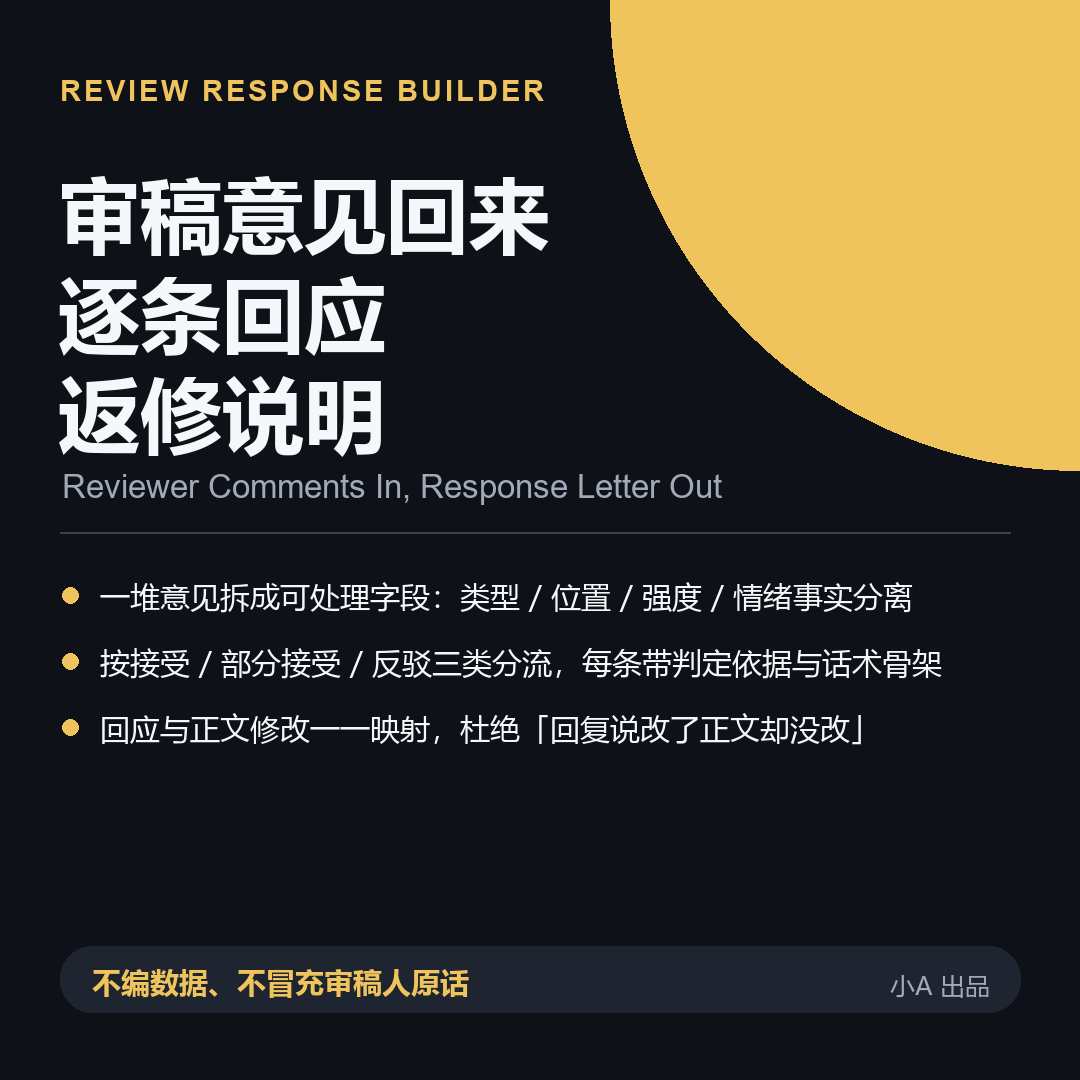
Peer Review Response Generator
Break down reviewer comments and generate response letters
Peer Review Response Generator
Break down reviewer comments and generate response letters
Showcase
Description
Struggling to respond to a mountain of peer review comments? This Skill parses feedback into actionable items, sorts them by acceptance status, provides structured response templates, creates a mapping table between replies and manuscript edits, and assembles a professional response letter and revision checklist. After receiving dozens of comments, the hardest part is categorizing them, prioritizing edits, and respectfully rebutting points without provoking reviewers. This workflow breaks down reviews into structured fields: type, location, demand strength, and feasibility. It separates reviewer tone from actual requested actions. Incoming comments are triaged into three categories: accept, partially accept, or rebut, with clear determination criteria and proven response frameworks. Rebuttals follow strict red lines to remain professional and evidence-based. The critical step is the revision mapping table, which ensures every promised change matches actual manuscript edits, preventing discrepancies. Finally, it formats a numbered response letter and a revision checklist for your supervisor. **Note**: This is a guidance-only Skill. It delivers worksheets, response frameworks, and checklists. It does not write manuscript text, fabricate experimental data or literature, or guarantee acceptance.
Recommended by
Dancang
Why we love this skill
Transforms complex revisions into an actionable, point-by-point workflow. It categorizes feedback, generates responses, and maps text changes, making it ideal for handling additional experiments, challenging questions, misinterpretations, and conflicting feedback while strictly avoiding fabricated data.
Related Skills
View all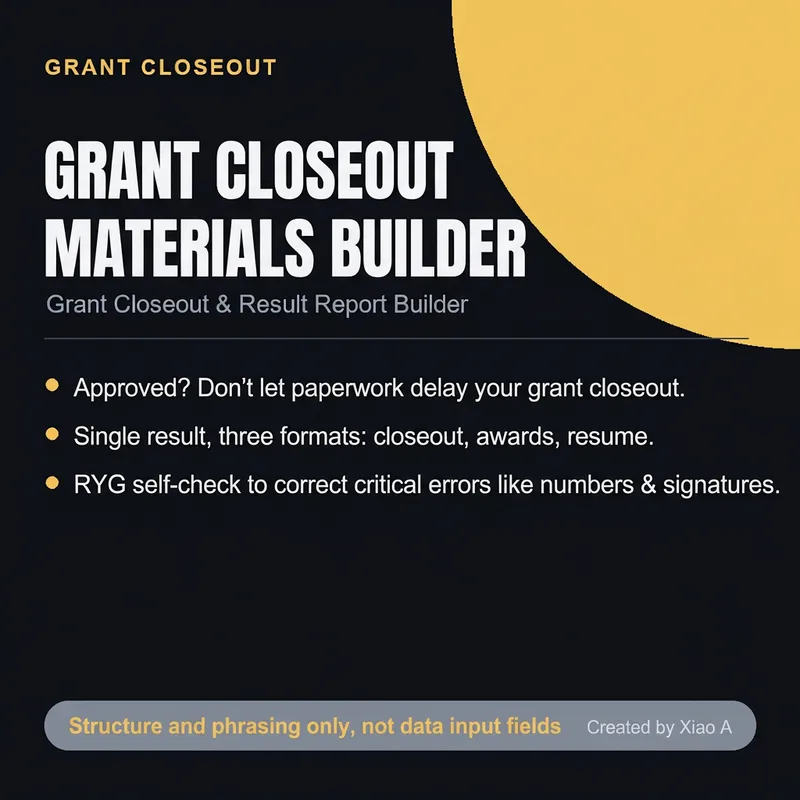 Write
Project Completion Generator
While the Social Science Fund Dual-Track Application Argumentation Generator handles applications, this skill handles completion. For university faculty, early-career researchers, and graduate students who have secured project approval, the most time-consuming part is often not the research itself, but the administrative paperwork: completion reports, achievement submissions, award materials, promotion forms, and CV entries. They have rigid formats, strict phrasing conventions, require the same achievement to be rewritten in three different ways, and are easily rejected over minor details like serial numbers, dates, or authorship. ## Quick Overview **Application approved? Don't let the paperwork block completion.** Turn your project approval info and achievement list into a completion report skeleton, three-angle achievement descriptions, scenario-based submission checklists, and a red-yellow-green self-check table. It provides structure and phrasing only, does not invent table fields or achievements, and does not guarantee review approval. ## What You Get 1. **Completion ID card and achievement inventory**: Align serial numbers, dates, members, and achievement counts at once, marking missing items as needs verification. 2. **One achievement, three angles**: Academic completion angle, award contribution angle, and CV/promotion entry angle, with traceable facts, phrasing, and evidence for each column. 3. **Six-section completion report skeleton**: Objective review, execution process, main conclusions, achievements and impact, funding and progress, and challenges and next steps, complete with writing points, customizable starting sentences, and common reasons for rejection. 4. **Scenario-based material checklist**: Common items for project completion, awards, promotions, CVs, and annual reviews, plus common format issues. 5. **Red-yellow-green self-check table**: Catch hard errors like inconsistent serial numbers, dates, or authorship first, with a printable version. 6. **Exaggerated phrasing replacement table**: Replace phrases like filling a gap or remarkable results with verifiable, review-friendly wording. ## Who It Is For - University faculty, early-career researchers, and project leaders: When projects are due for completion and you are worried about mismatched serial numbers, authorship, or achievements. - Graduate students and research assistants: Helping advisors organize achievement submissions, award applications, and annual review materials. - Previous users of the Social Science Fund Dual-Track Application Argumentation Generator: Moving naturally from application to completion.
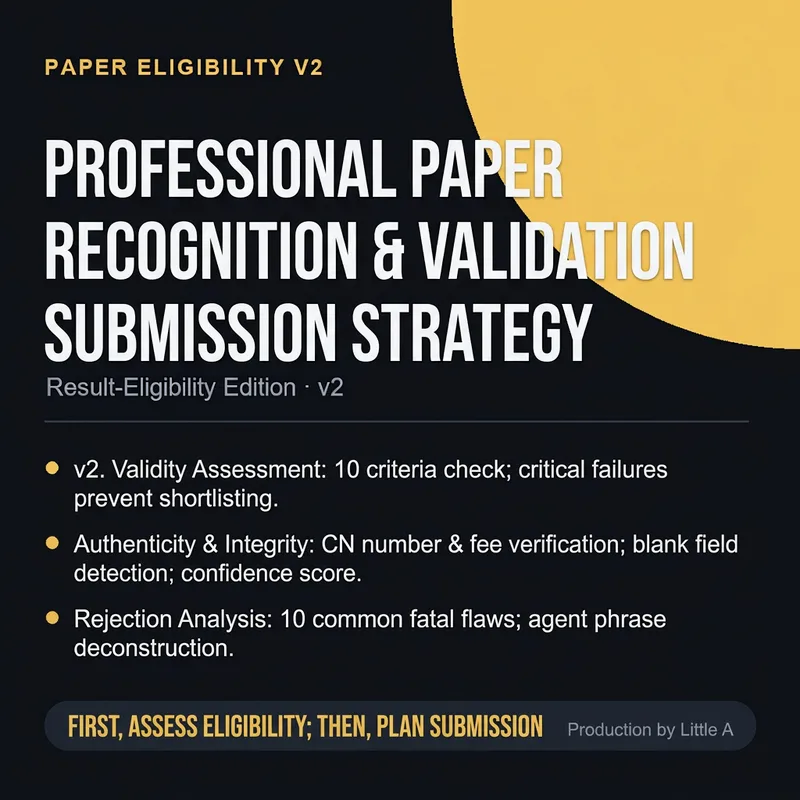
Professional Title Paper Evaluation and Submission Planner
v1 solved where to submit, common pitfalls, and scheduling. Real pain points usually surface beforehand: people spend thousands and wait months only to have materials rejected because the paper isn't recognized—wrong author order, mismatched affiliations, missing database indexing, supplements, duplicate submissions, or high AIGC/plagiarism scores. ## Quick Summary **Verify whether the paper qualifies before choosing a journal.** Many people waste a year not from picking the wrong journal, but due to author rank, affiliation mismatch, unindexed issues, supplements, duplicate use, etc. v2 prioritizes 10 validity checks and eliminates AI-generated journal numbers and fees. ## What Changed from v1 to v2 | Dimension | v1.0.0 | v2.0.0 | | --- | --- | --- | | Priority | Journal Selection: Red/Yellow/Green lists | **10 Validity Checks**: Red flags stop journal selection | | Journal Data | Recommended 5-10 journals with CN/fees/cycles | **Never generated**: Verification portals + blank fields + confidence ratings | | Insufficient Time | Margin warning only | 4 alternative path decision trees | | After Rejection | None | 10 hard-hit rejection reviews + agency phrasing breakdown | Retained: Institutional requirements, red/yellow/green ratings, comparison tables, countdown schedules, 4-step verification, audit trails, and agency red lines. ## What You Will Get 1. **10 Validity Check Items**: Author rank, affiliation, relevance, time window, indexing, regular issues, plagiarism/AIGC, reuse, word count, negative list. 2. **Rank Check Items**: What intermediate, associate, and senior titles need to confirm with their institution. 3. **Hard Criteria Checklist**: Translates institutional terms into 6 actionable constraints. 4. **Candidate Journal Verification Sheet**: Official verification portals with blank fields to prevent fabrication. 5. **Decision & Countdown Tables**: Reverse-calculates deadlines, separating publication and indexing. 6. **Rejection Review & Agency Phrasing**: Evaluates claims like fast indexing or guaranteed approval with ready-to-use replies. 7. **4-Step Verification & Audit Trail**: Official filing, directory checks, issue comparison, and report packaging. ## Who This Is For - Teachers in primary/secondary schools or universities, and engineering, healthcare, agricultural, or research professionals. - **Those with a paper who are unsure if it qualifies.** - Anyone confused by agency recommendations or timeframes. - **Those whose materials were rejected last year.** - Previous v1 users: updated via this skill, replacing outdated journal lists. ## Why No Recommended Journal List Journal data constantly changes, and AI-generated numbers and fees are risky. v2 provides verification portals and rules so you can check official sites and editor offices—taking 5 minutes to prevent rejection. > Pure guidance format · No ghostwriting · Output editable intermediate assets.
 Write
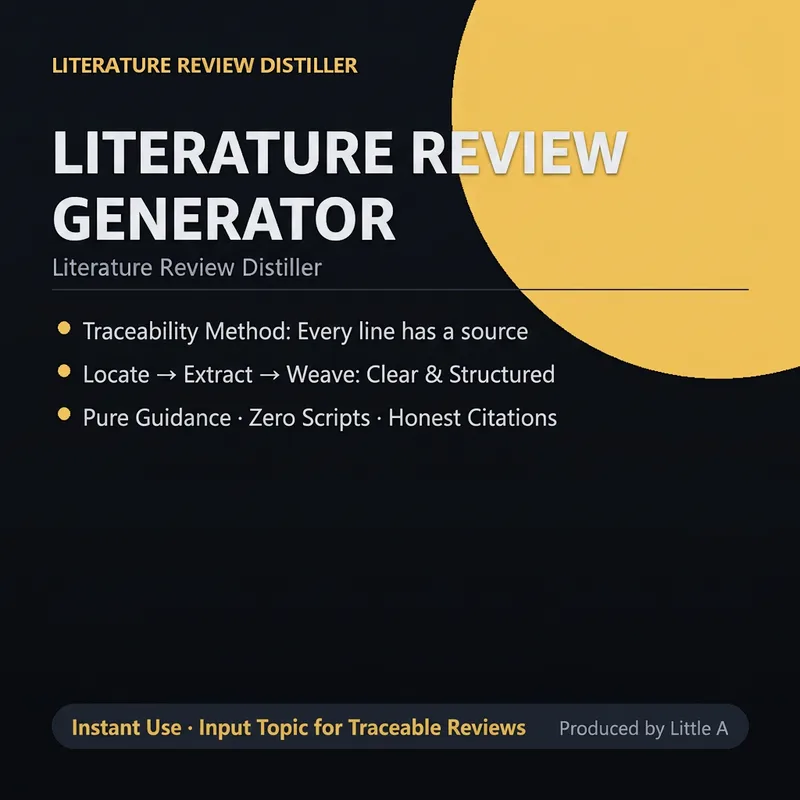
Literature Review Builder
Help graduate students, early-career faculty, and researchers turn a pile of scattered literature (PDFs, notes, keywords) into a logically clear literature review where every claim can be traced and used directly in a paper. The three-step source-tracing method guides you through scope definition, individual paper extraction, and four-line weaving, providing templates and editable intermediate outputs throughout without fabricating citations. Ideal for research proposals, thesis background chapters, and grant applications when you are stuck organizing too many papers or finding research gaps.
Information
- Version
- v3
- Last updated
- Runtime credits
- Usage-based
- Models
- Auto
