
Evidence-Based Tool Finder
Describe the task, then test and compare
Evidence-Based Tool Finder
Describe the task, then test and compare
Showcase
Description
Which open-source tool can actually handle the task at hand? Tell me the task, operating system, budget, and input samples. I’ll check official sources, licenses, and dependencies, set acceptance criteria, then compare the tools’ actual results, costs, and failure points. Suitable for creators, indie developers, and small teams. By default, I focus on one task and a small number of candidates, prioritizing tools you already have. I record hands-on results only when a tool can run; otherwise, I provide documentation for verification and a reproducible plan for future testing. Web access, command execution, and file handling depend on the host’s existing capabilities. Automatic installation and hands-on testing for every tool are not guaranteed, and star counts are not used as a substitute for quality. Product design and workflow: leowang.
Related Skills
View all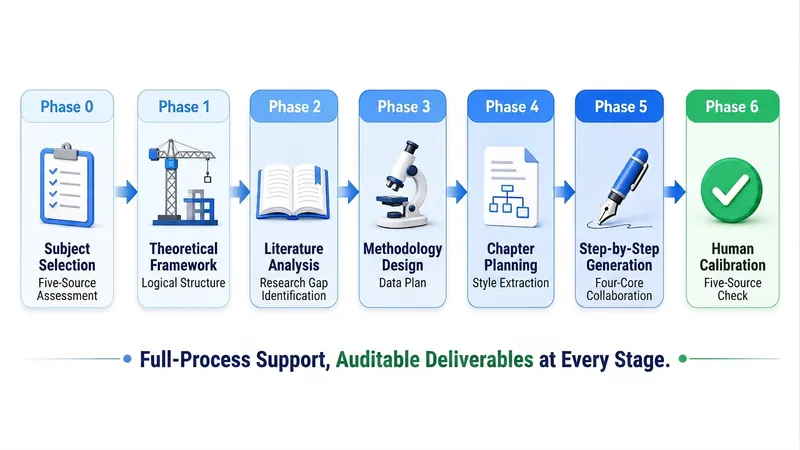
Proposal Readiness Checker
Before you spend dozens of hours writing your thesis, take ten minutes to run a structured checkup. This skill does only one thing: It diagnoses, not writes. It tells you whether your topic can hold up, whether your materials are sufficient, what's missing, where to fill the gaps, and in what order. Then it gives you an actionable missing-material checklist and search queries. It will not write your introduction, literature review, methods, or discussion. Four steps: 1. Discipline diagnosis: Classify your work into 1A Humanities/Arts, 1B Social Sciences, 2A Science/Engineering, or 2B Agriculture/Medicine/Life Sciences, and load the corresponding regulatory red lines; 2B triggers a mandatory ethics review block. 2. Topic checkup: Examine the topic from three dimensions—momentum, shape, and wording—to judge whether the research unit can be operationalized, whether the research question can be answered, and whether the topic has been done to death. 3. Material checkup: Register your existing literature into an M1/M2… material library, verify each entry against the four elements (author/year/title/verifiable locator), and compute the true coverage rate. 4. Gap list and search queries: Specify how many papers of what type are missing and which piece of evidence is lacking, and provide search queries ready to paste into databases (including Boolean keyword combinations, time ranges, and screening criteria). When to use it (trigger phrases): "Help me check my proposal" "Can this topic work?" "Do I have enough literature?" "My proposal was sent back" "I want to confirm before starting to write" — for graduate students who have just set a direction but haven't started writing; for those whose proposal was rejected but don't know why; for those with a pile of literature but unsure if it's enough to begin; for those wanting to confirm whether the topic is worth the investment before committing fully. Deliverables: A Proposal Checkup Report document + a Five-Source Readiness Scorecard (each level has behavioral criteria, not vague scoring) + a prioritized list of missing materials + search queries + an archive code. The archive code is compatible with the Academic Paper Full-Process Writing System v4.0; after the checkup, paste it there to continue writing without re-stating your discipline, topic, or journal. What this skill explicitly does not do: It does not write the main text, generate reference lists, or fabricate authors, years, volumes, issues, pages, or DOIs. Any literature found via online search is flagged with ⚠️ "needs verification" and must be verified by you before use. This skill does not promise any acceptance or passing outcome.
Overseas Tool Demand Analysis
Are you looking for low-competition, high-potential overseas tool website startup opportunities? This skill is designed for independent developers, SEO webmasters, and AI tool entrepreneurs, helping you accurately identify truly valuable directions from vast market information. It deeply analyzes your market ideas, keywords, or competitors, revealing target user pain points, use cases, and potential business value. Through detailed search intent analysis, this skill expands tool-type keywords such as 'generator,' 'converter,' 'checker,' etc., and evaluates whether there are clear user needs, community complaints, and monetization potential. It helps you distinguish which are suitable as SEO traffic entry points, which can effectively acquire potential customers, and which have the potential to develop into sustainable paid products or SaaS, avoiding blind investment. Notably, this skill pays special attention to the reuse potential of tools and prioritizes opportunities suitable for small teams, simple implementation, and not relying on complex operations. Ultimately, you will receive a clearly ranked list of candidate directions, including detailed user personas, pain points, keyword strategies, competitive analysis, monetization signals, and minimum viable product (MVP) recommendations, helping you reduce decision risk and increase startup success rates.

Startup Opportunity Radar
Turn “I think this could make money” into “What evidence is worth testing?” Discover and screen early-stage business opportunities suited to solo businesses, micro-SaaS, AI tools, digital products, data products, physical goods based on supply chains, and transaction services. It starts with real user friction, substitute behaviors, payment actions, and industry changes, helping you avoid mistaking popular trends, search volume, or scattered complaints for genuine demand. You can ask it to scan for new startup directions, or submit a product idea, market, link, screenshot, plan, sales feedback, or historical opportunity list for an individual health check, validation design, or periodic review. The analysis distinguishes facts, inferences, assumptions, and opposing evidence. It examines buyers, use cases, competitive gaps, data and supply chain legality, customer acquisition channels, standardization potential, maintenance costs, and related liability risks. When evidence is insufficient, it states that clearly instead of inventing market size or purchase intent. You will receive a clear opportunity assessment, an evaluation of opportunity quality and user adoption readiness, and a minimum validation plan focused on the riskiest assumptions. This includes validation actions, a stage budget, the maximum acceptable loss, and criteria for proceeding or stopping. It helps you decide which opportunities are worth investigating further while allowing conclusions such as “monitor,” “gather more evidence,” or “do not pursue this cycle,” making startup investment more manageable and gradually building repeatably sellable products and long-term assets.
Information
- Version
- v2
- Last updated
- Runtime credits
- Usage-based
- Models
- Auto
