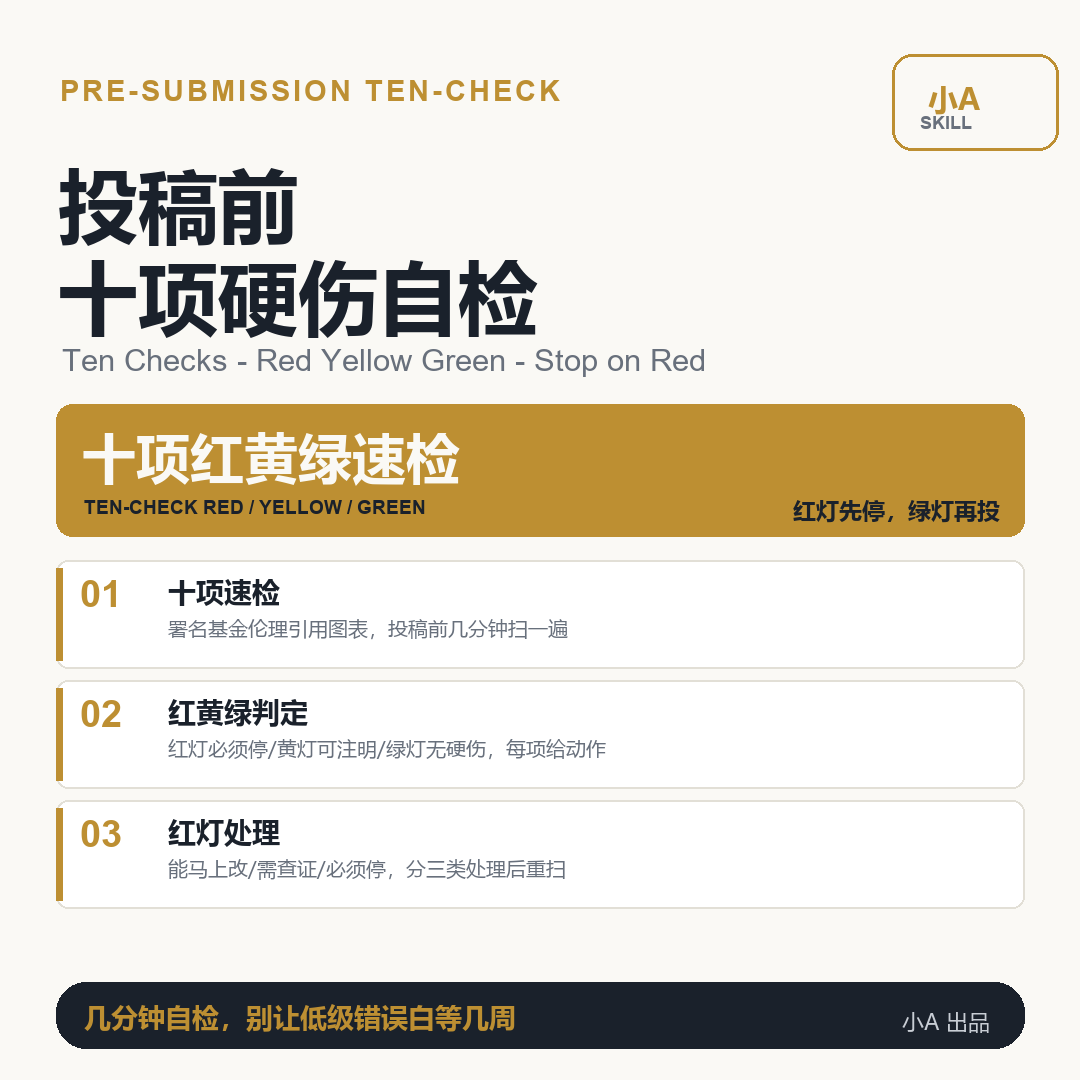
Pre-Submission Flaw Check
Quickly check academic papers for fatal flaws before submission
Pre-Submission Flaw Check
Quickly check academic papers for fatal flaws before submission
Showcase
Description
A few minutes before clicking submit, run this ten-point red-yellow-green checklist to scan for fatal rejection-level flaws: authorship, funding, duplicate submission, ethics, data, citations, figures, and length. Stop on a red light, proceed on a green light. Pure guidance only—no ghostwriting, no fabrication, and no acceptance guarantees. **One-Line Selling Point**: A quick pre-submission checklist to run through in minutes: stop on red, proceed on green, and catch amateur mistakes before wasting weeks waiting for a rejection. **Who It Is For**: Graduate students, early-career faculty, and researchers who have finished a draft and worry about missing authors, incorrect grant numbers, omitted ethics statements, or duplicate submissions. **What to Input**: The manuscript to submit + target journal author guidelines + author list + funding or ethics credentials (mark missing items as pending, do not fabricate). **What You Get**: A ten-point self-check list (red/yellow/green criteria + red-light actions) + deep authorship and ethics check + deep citation and data check + formatting and figure checklist + red-light handling quick reference + next-step guidance + 2 sample files. ## [Detail Page Content] ### Great Paper, Why Was It Desk-Rejected? Often it is not the research itself, but amateur pre-submission flaws: missing authors, wrong grant numbers, duplicate submissions, omitted ethics statements, unnumbered figures, or forgetting to remove author names from an anonymous draft. Editors spot these errors instantly, wasting weeks of your time and hurting your credibility. **This tool does only one thing: scans for fatal flaws a few minutes before submission.** ### How the Ten Points Are Checked Ordered from most to least severe: ① Author names and affiliations ② Funding acknowledgments ③ Duplicate submission and redundant publication ④ Ethics review and informed consent ⑤ Traceable data ⑥ Consistency between data and conclusions ⑦ Citation authenticity ⑧ Citation format and numbering ⑨ Figure and table standards ⑩ Length and submission format. Each point provides red (must stop) / yellow (known risk) / green (no fatal flaws) criteria and "what to do on a red light." ### Three Paired Deep Checks - **Authorship and Ethics**: Most severe consequences—missing an author is a retraction-level incident, and missing ethics leads to instant desk rejection. - **Citations and Data**: Most prone to stumbling—AI-generated fake references, mismatched data, and conclusions extending beyond the data. - **Red-Light Handling**: Divided into three categories: fix immediately / needs investigation / must stop. Re-scan after addressing. ### After Flaws Are Detected The checklist tells you what kind of advanced processing tool to use next (revisions, review rewriting, credential recognition, etc.), but **does not process it for you or promise results**. ### What It Does Not Do (Red Lines) - **No Ghostwriting**: Does not write body text, polish, or judge research value. - **No Fabrication**: Grant numbers, ethics approval letters, data, and citations—mark missing items as "pending verification." - **No Guarantees**: Does not guarantee acceptance, publication, or passing review. - **Official Guidelines Prevail**: Target journal and institutional requirements at the time of submission take precedence.
Recommended by
Dancang
Why we love this skill
Compresses ten categories of desk-rejection risks into a fast red-yellow-green checklist covering authorship, ethics, data, citations, and format.
Best for
Graduate students, early-career faculty, and researchers preparing to submit manuscripts who want to check for common rejection-level flaws.
How to use this Skill
Provide your input
Provide the manuscript, target journal author guidelines, author list, and funding or ethics credentials. Mark missing materials as pending.
Run the Skill
Checks authorship, funding, duplicate submission, ethics, data, citations, figures, and formatting against a 10-point list using red, yellow, and green flags.
Review your result
Receive a pre-submission self-check checklist with risk flags, red-light action steps, and items that need to be supplemented or verified further.
Related Skills
View all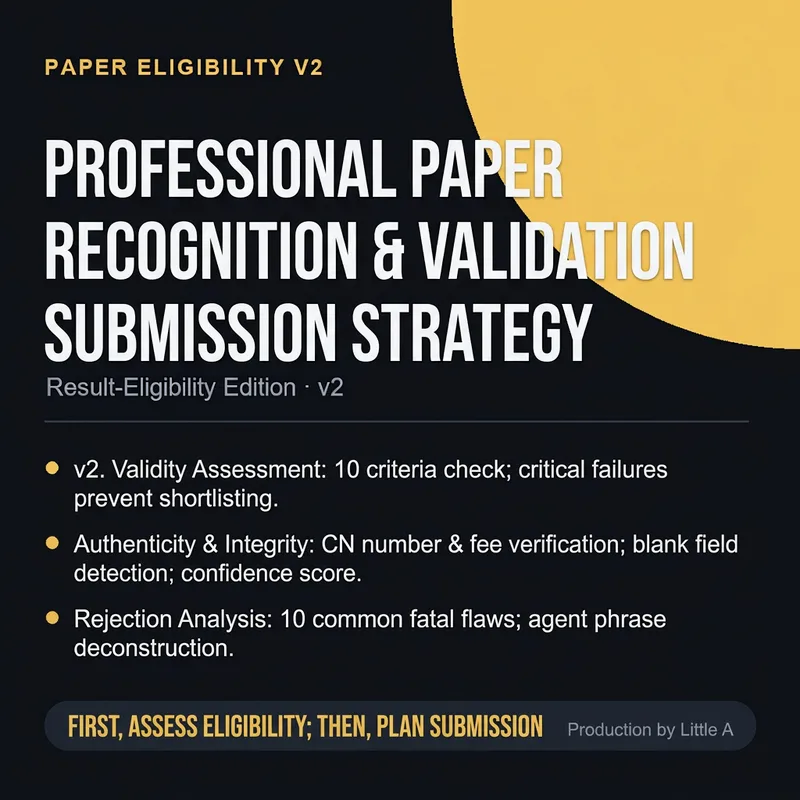
Professional Title Paper Evaluation and Submission Planner
v1 solved where to submit, common pitfalls, and scheduling. Real pain points usually surface beforehand: people spend thousands and wait months only to have materials rejected because the paper isn't recognized—wrong author order, mismatched affiliations, missing database indexing, supplements, duplicate submissions, or high AIGC/plagiarism scores. ## Quick Summary **Verify whether the paper qualifies before choosing a journal.** Many people waste a year not from picking the wrong journal, but due to author rank, affiliation mismatch, unindexed issues, supplements, duplicate use, etc. v2 prioritizes 10 validity checks and eliminates AI-generated journal numbers and fees. ## What Changed from v1 to v2 | Dimension | v1.0.0 | v2.0.0 | | --- | --- | --- | | Priority | Journal Selection: Red/Yellow/Green lists | **10 Validity Checks**: Red flags stop journal selection | | Journal Data | Recommended 5-10 journals with CN/fees/cycles | **Never generated**: Verification portals + blank fields + confidence ratings | | Insufficient Time | Margin warning only | 4 alternative path decision trees | | After Rejection | None | 10 hard-hit rejection reviews + agency phrasing breakdown | Retained: Institutional requirements, red/yellow/green ratings, comparison tables, countdown schedules, 4-step verification, audit trails, and agency red lines. ## What You Will Get 1. **10 Validity Check Items**: Author rank, affiliation, relevance, time window, indexing, regular issues, plagiarism/AIGC, reuse, word count, negative list. 2. **Rank Check Items**: What intermediate, associate, and senior titles need to confirm with their institution. 3. **Hard Criteria Checklist**: Translates institutional terms into 6 actionable constraints. 4. **Candidate Journal Verification Sheet**: Official verification portals with blank fields to prevent fabrication. 5. **Decision & Countdown Tables**: Reverse-calculates deadlines, separating publication and indexing. 6. **Rejection Review & Agency Phrasing**: Evaluates claims like fast indexing or guaranteed approval with ready-to-use replies. 7. **4-Step Verification & Audit Trail**: Official filing, directory checks, issue comparison, and report packaging. ## Who This Is For - Teachers in primary/secondary schools or universities, and engineering, healthcare, agricultural, or research professionals. - **Those with a paper who are unsure if it qualifies.** - Anyone confused by agency recommendations or timeframes. - **Those whose materials were rejected last year.** - Previous v1 users: updated via this skill, replacing outdated journal lists. ## Why No Recommended Journal List Journal data constantly changes, and AI-generated numbers and fees are risky. v2 provides verification portals and rules so you can check official sites and editor offices—taking 5 minutes to prevent rejection. > Pure guidance format · No ghostwriting · Output editable intermediate assets.
SCI Desk Reject Pre-check
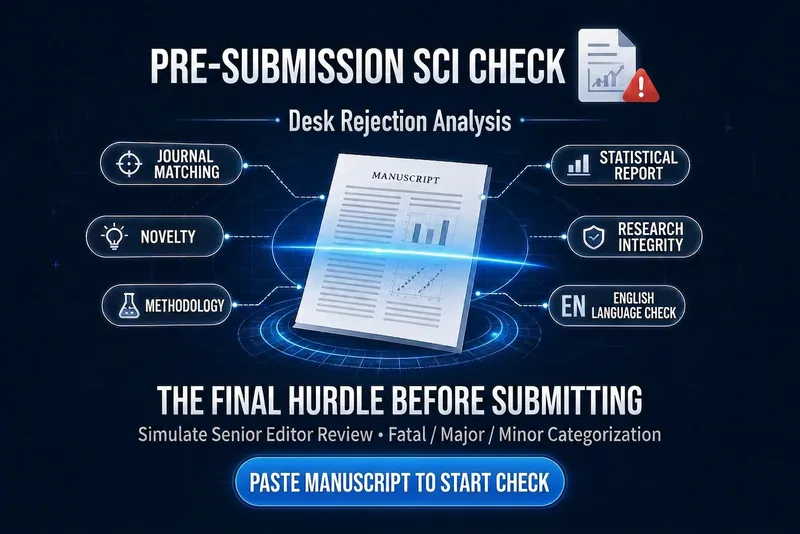
You spend months writing a manuscript, submit it—and three days later receive a rejection letter with no review comments. The editor-in-chief didn't even send it out for peer review; it was a desk rejection. 「SCI Desk Reject Pre-check」offers the initial screening perspective of a seasoned handling editor, helping you ensure quality before submission. What does it check? 📌 Journal Fit — Whether the topic aligns with the target journal's scope 🔍 Novelty and Contribution — Can the editor-in-chief identify your core contribution in 30 seconds? ⚗️ Methodology and Reproducibility — Design flaws and description gaps that trigger red flags 📊 Statistics and Quantitative Reporting — Issues in data presentation, significance, sample size, etc. 🛡️ Research Integrity and Ethics — Ethics approval, conflicts of interest, plagiarism check, AI disclosure, data availability 📝 Structure and Readability — Broken logic chains, weak abstracts, buried key information 🌐 English Language Risk — Whether language quality might trigger a language-based desk rejection All issues are categorized as 'Fatal / Major / Minor', each with actionable revision suggestions. Suitable for any SCI discipline: physics, chemistry, materials, engineering, life sciences, computer science, environment, geosciences, and more. Send your manuscript (or abstract + methods section) and start the check.
Proposal Readiness Checker
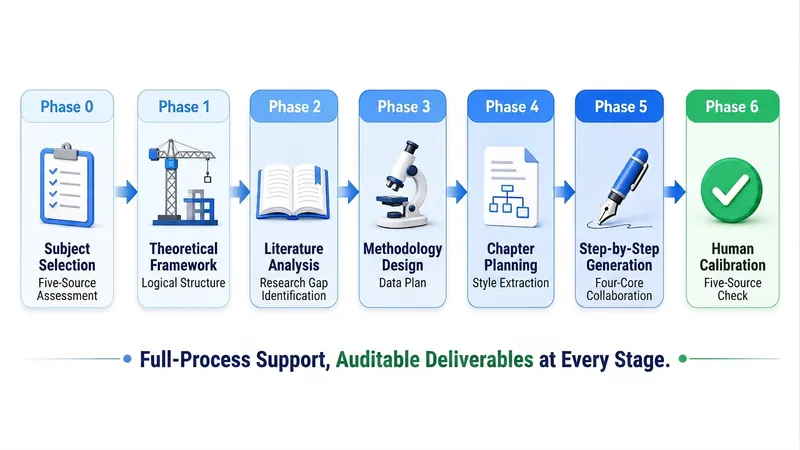
Before you spend dozens of hours writing your thesis, take ten minutes to run a structured checkup. This skill does only one thing: It diagnoses, not writes. It tells you whether your topic can hold up, whether your materials are sufficient, what's missing, where to fill the gaps, and in what order. Then it gives you an actionable missing-material checklist and search queries. It will not write your introduction, literature review, methods, or discussion. Four steps: 1. Discipline diagnosis: Classify your work into 1A Humanities/Arts, 1B Social Sciences, 2A Science/Engineering, or 2B Agriculture/Medicine/Life Sciences, and load the corresponding regulatory red lines; 2B triggers a mandatory ethics review block. 2. Topic checkup: Examine the topic from three dimensions—momentum, shape, and wording—to judge whether the research unit can be operationalized, whether the research question can be answered, and whether the topic has been done to death. 3. Material checkup: Register your existing literature into an M1/M2… material library, verify each entry against the four elements (author/year/title/verifiable locator), and compute the true coverage rate. 4. Gap list and search queries: Specify how many papers of what type are missing and which piece of evidence is lacking, and provide search queries ready to paste into databases (including Boolean keyword combinations, time ranges, and screening criteria). When to use it (trigger phrases): "Help me check my proposal" "Can this topic work?" "Do I have enough literature?" "My proposal was sent back" "I want to confirm before starting to write" — for graduate students who have just set a direction but haven't started writing; for those whose proposal was rejected but don't know why; for those with a pile of literature but unsure if it's enough to begin; for those wanting to confirm whether the topic is worth the investment before committing fully. Deliverables: A Proposal Checkup Report document + a Five-Source Readiness Scorecard (each level has behavioral criteria, not vague scoring) + a prioritized list of missing materials + search queries + an archive code. The archive code is compatible with the Academic Paper Full-Process Writing System v4.0; after the checkup, paste it there to continue writing without re-stating your discipline, topic, or journal. What this skill explicitly does not do: It does not write the main text, generate reference lists, or fabricate authors, years, volumes, issues, pages, or DOIs. Any literature found via online search is flagged with ⚠️ "needs verification" and must be verified by you before use. This skill does not promise any acceptance or passing outcome.
Information
- Version
- v3
- Last updated
- Runtime credits
- Usage-based
- Models
- Auto
- Use cases
- Research & analysis
- What you get
- Document
