
BookLens Insights & Healing
Understand yourself deeper through classic books
BookLens Insights & Healing
Understand yourself deeper through classic books
Showcase
Description
After you share your experiences, confusion, or problems, the AI asks clarifying questions before searching and verifying across 30 bilingual classic books, papers, articles, and theories. It uncovers deep-seated causes and provides actionable, testable healing and action suggestions.
Recommended by
Dancang
Why we love this skill
Integrates classic books, psychology, and social perspectives into rigorous problem exploration: starts with safety screening and clarification, verifies sources, analyzes deep causes, and provides phased action plans with clear criteria. Balances empathy and evidence without diagnosing or sugarcoating.
Best for
Ideal for anyone who wants to use classic books and research to better understand personal dilemmas and build a testable action plan.
How to use this Skill
Provide your input
Enter the dilemma, relationship issue, emotional state, or behavior you want to change, noting its duration, impact, and desired outcome.
Run the Skill
The AI performs a safety check and asks clarifying questions. Once you confirm the focus, it cross-references classic books, papers, and theories for a multi-perspective analysis.
Review your result
Receive an analysis report with problem insights, evidence, multiple perspectives, phased action steps, and professional support tips.
Related Skills
View all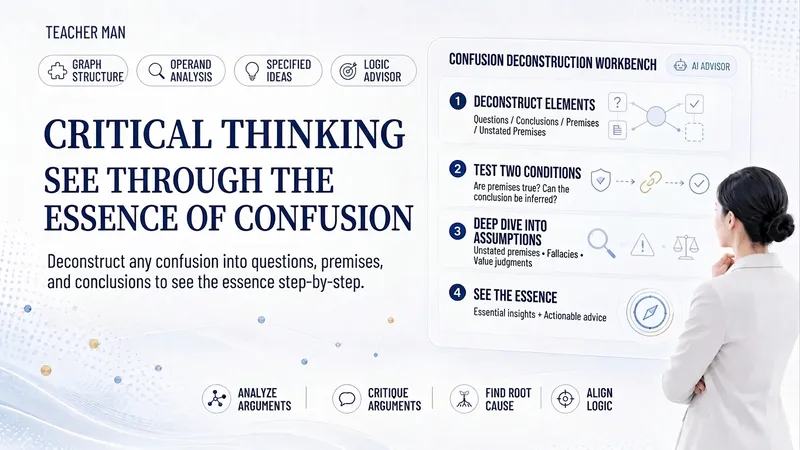
Slow Teacher · Think Clearly
Share any confusion—about work, study, life, relationships, emotions, decisions, or anything else. Using the framework from Tian Hongyun's “General Course in Critical Thinking: Methods for Thinking Correctly,” the Skill breaks it down into “question—premise—conclusion—unstated premise,” then tests it with two questions: “Is the premise true?” and “Can the premise support the conclusion?” It identifies unstated premises and common fallacies, distinguishes factual judgments from value judgments, and ultimately helps you see the essence of the situation and define a practical next step. The tone is equal, gentle, and conversational, with hand-drawn marker-style illustrations added automatically for key steps.
AI Problem Decomposer
# AI Problem Decomposer **One complex question, one clear analysis diagram.** Why is store traffic unchanged while profits keep falling? Why did video views suddenly drop? Why are projects always delayed? Enter the question you want to understand, and AI will break down possible causes, map out cause-and-effect relationships, determine what to investigate first, and generate a clear, easy-to-understand Chinese-language analysis diagram. It does more than tell you **what the possible causes might be**. More importantly, it tells you: **why they might be happening and what to check next.** ## What you'll get **① Intelligent problem breakdown** Identify the key parts of a problem. For situations that can be analyzed with formulas, the tool prioritizes establishing metric relationships to help identify what needs to be investigated. **② 4–6 possible causes** Each cause includes: - Possible symptoms - The cause-and-effect mechanism behind the outcome - A practical way to verify it Unverified speculation is not presented as fact. **③ Intelligent investigation order** Based on impact, verification difficulty, and the information available, the tool recommends what to check first and what to check later, helping you avoid investigating blindly. **④ One professional Chinese-language analysis diagram** The tool automatically selects a suitable structure based on the question, such as a radial map, causal chain, fishbone diagram, or timeline. Different colors distinguish information types, and specific action prompts are placed next to causes, such as: - Check: impression click-through rate - Check: product gross margin - Review: customer comments and feedback **⑤ Image text check** After generation, the tool checks the Chinese text, number of causes, and consistency between the diagram and its content. If obvious text errors are found, it attempts one automatic correction based on the run settings; additional generation may use more credits. ## What kinds of questions is it suited for? **Business operations** - Why are profits falling even though store traffic is unchanged? - Why are returning customers decreasing despite good reviews? **Content creation** - Why did YouTube views suddenly drop? - Why are impressions high but click-through rates low? **Work and learning** - Why are projects always delayed? - Why hasn't performance improved significantly despite investing more time in learning? ## How to use it 1. Enter a specific question you want to analyze. 2. Include any data, screenshots, or reference materials you have. 3. AI breaks down the causes, analyzes the mechanisms, and provides verification methods. 4. Generate a Chinese-language multifactor analysis diagram to help you investigate each item step by step. ## Usage tips - The more specific the question and the more complete the data, the more targeted the analysis will be. - Do not fabricate statistics, survey results, or external sources. - The causes shown in the diagram are analytical hypotheses and do not mean the actual causes have been confirmed. - Generated images may contain layout or text errors. - A single test run uses approximately 100–200 credits. Actual credit usage depends on the model, task complexity, and whether additional generation is needed. **Make complex questions easier to understand, investigate, and act on.**
Power of True Stories
Find verifiable real experiences from historical and modern books, respond to confusion with warm storytelling, and extract practical action steps.
Information
- Version
- v6
- Last updated
- Runtime credits
- Usage-based
- Models
- Auto
- Use cases
- Research & analysisPersonal growth
- What you get
- ReportDocument
